What Is Multimodal AI? How Does It Affect SEO and Digital Marketing?
Search is no longer limited to typing a few words into a search box. People can now upload an image, take a photograph, circle something on their screen, speak a question, combine text with an image, and expect an AI system to understand what they mean. This is where multimodal AI becomes important. Multimodal AI refers to artificial intelligence systems that can understand and work with multiple types of information, or modalities, such as text, images, video, audio and sometimes other forms of data. Instead of treating each format separately, these systems can connect information across different inputs to understand a more complete context.
For SEO and digital marketing, that changes an important assumption. The question is no longer simply whether your website can be found when someone searches for a keyword. It is whether your brand, products and content can be understood and surfaced when someone searches using different forms of information. For ecommerce businesses in particular, this makes visual content, product information, structured data, page experience and commercial context increasingly connected.
Google has also made this shift more measurable. In September 2026, Google introduced multimodal Search performance reporting in Search Console, giving site owners a dedicated way to understand how their content is surfaced through multimodal searches. The new reporting covers experiences including Google Lens, Circle to Search on Android, image uploads to Google Search and Chrome’s “Search this image” feature.
That does not mean SEO has been replaced. It means the search environment is becoming broader, and the way businesses think about visibility needs to broaden with it.
Key takeaways
- Multimodal AI expands how people search. Search behaviour can now combine text, images, voice and other inputs. A user does not always need to know the exact words for what they are looking for.
- Visual assets are becoming part of search visibility. For ecommerce brands, product photography, supporting images, videos, image context and product information can all contribute to how a business is understood across search experiences.
- Traditional SEO fundamentals still matter. Google’s current guidance makes clear that foundational SEO remains relevant for AI search. Crawlability, useful content, internal linking, structured data, page experience and accurate information still matter.
- Search Console gives businesses a clearer way to measure multimodal visibility. The new multimodal search filter provides additional performance data, helping businesses understand whether users are discovering their content through visual and multimodal search journeys.
What is multimodal AI?
Multimodal AI is AI that can process and understand more than one type of input. Traditional search has largely been built around text. A user enters a phrase, a search engine interprets the words, retrieves relevant information and presents results. Multimodal AI allows the interaction to become more natural. Someone could photograph a pair of shoes and ask which style would work best for a particular occasion. Someone could upload a picture of a piece of furniture and ask where they can buy something similar. A shopper could take a photograph of a product and ask for its specifications, alternatives or compatibility.
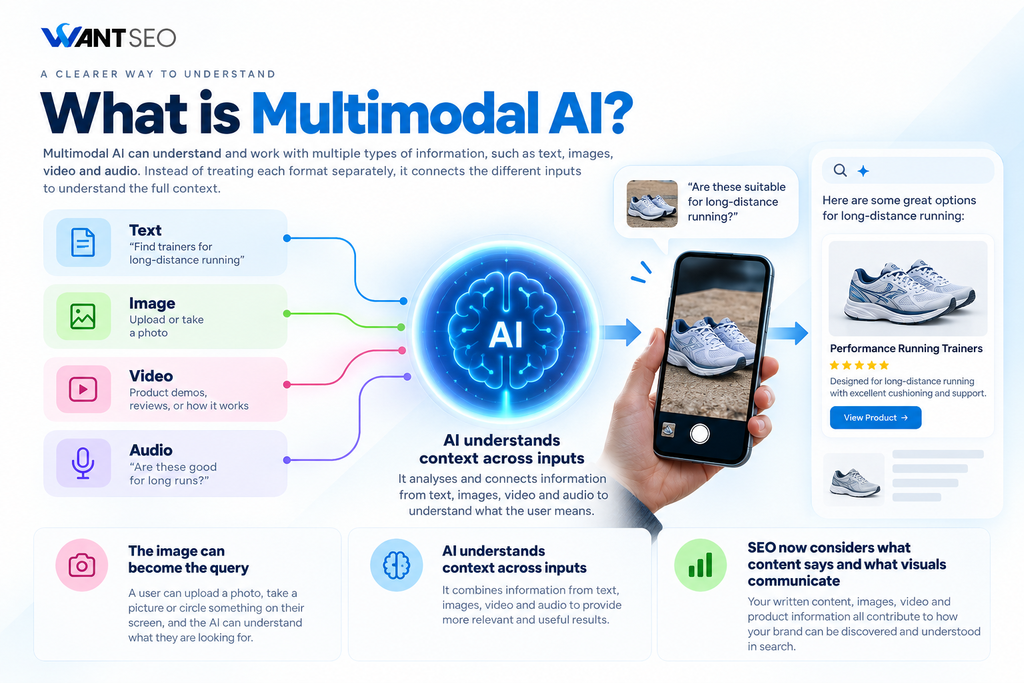
The image is no longer simply an illustration of the query. It can become part of the query itself. This distinction matters for digital marketing because brands need to consider not only what their pages say, but also what their visual and multimedia content communicates.
How does multimodal AI work?
At a high level, multimodal AI brings different types of information into the same understanding process. A system might analyse:
- Text
- Images
- Video
- Audio
- Product information
- Context from the user’s question
- Information retrieved from the web
The AI then attempts to understand the relationship between these inputs.
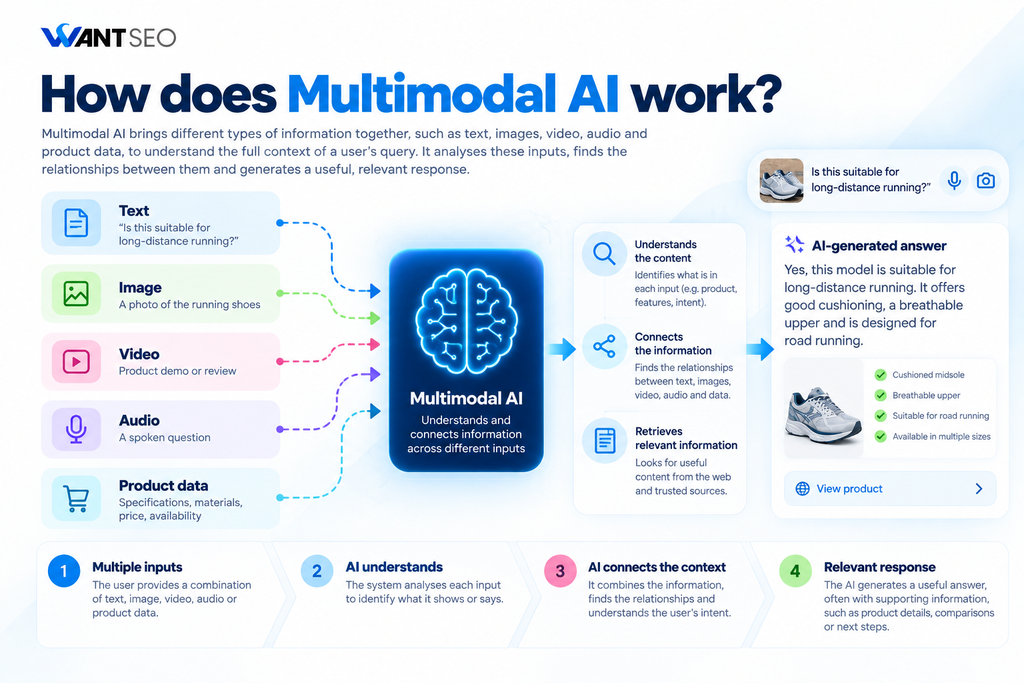
For example, imagine someone uploads a photograph of a particular type of running shoe and asks:
“Is this suitable for long-distance road running?”
The system needs to identify what is shown in the image, understand the question, connect the product with relevant information and provide an answer. For a retailer, this creates a broader visibility question.
Is the product information on the website clear enough to support that journey? Are the images high quality and relevant? Are product specifications consistent? Can search engines access the important information? Does the visible content agree with the structured data? Does the website provide enough context for the product to be understood?
These are SEO questions, but they are also wider digital experience questions.
Why does multimodal AI matter for SEO?
Multimodal AI matters because search engines are increasingly capable of understanding information beyond traditional text queries. Google’s own guidance for AI search recommends supporting textual content with high-quality images and videos where appropriate. It also recommends maintaining clear technical structures, useful content and accurate structured data.
This is important because there is a tendency to treat every development in AI search as a reason to create a completely new SEO strategy. That is usually the wrong starting point. The fundamentals still matter. The difference is that those fundamentals now need to work across more ways of discovering and understanding information. SEO therefore becomes less about optimising one page for one keyword and more about making the information architecture of a business clear.
Multimodal AI and visual search
Visual search is one of the clearest examples of multimodal AI changing the search experience. Instead of describing an object using words, a user can provide an image. This can be particularly relevant to ecommerce. Consider a customer who sees a particular style of jacket, lamp, sofa or pair of trainers. They may not know the product name or the terminology used by the retailer. An image can remove that barrier. For brands, this means visual assets need to be treated as useful search assets rather than decoration.
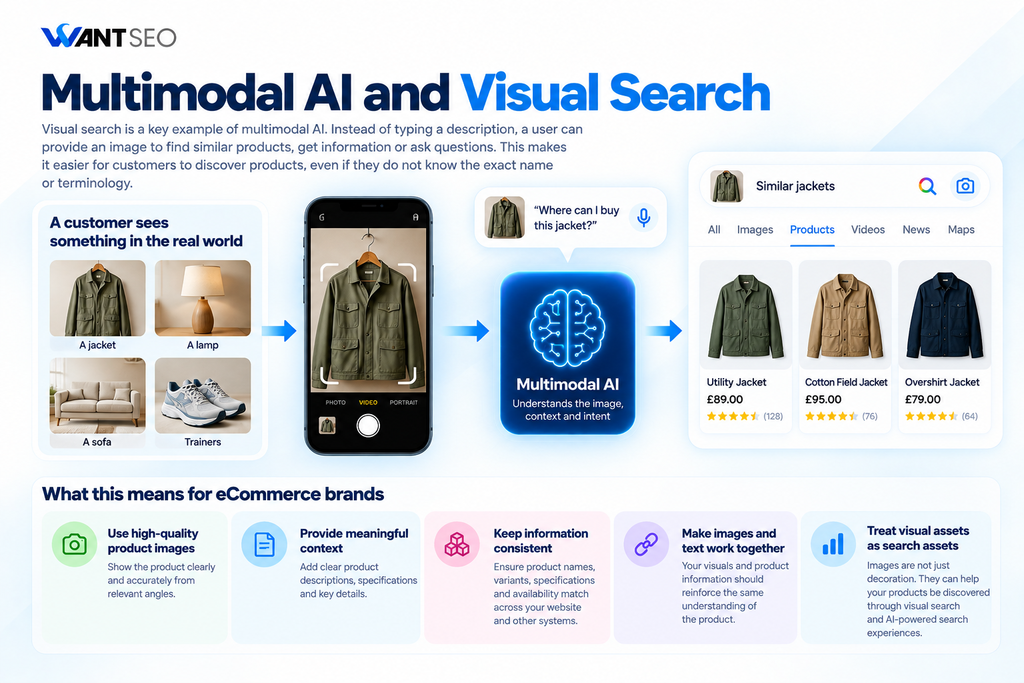
Product images should accurately represent what is being sold. Supporting text should provide meaningful context. Product names, specifications, variants and availability should be consistent across the website and other relevant systems. This is especially important where the image and text need to reinforce the same understanding of a product.
A beautiful image with weak product information is not a complete search asset. Likewise, a highly detailed product page with poor or irrelevant imagery misses part of the opportunity.
What does multimodal AI mean for ecommerce SEO?
For ecommerce businesses, the implications are particularly practical. A product can be discovered through a traditional keyword search, an image search, a visual search experience, a product result, a recommendation or an AI-generated response. The customer may enter the journey at a completely different point from the one your SEO strategy originally anticipated. This means ecommerce SEO should increasingly consider the consistency of product information across the entire customer journey.
For example, a product page may contain:
- Product title
- Product description
- Specifications
- Dimensions
- Materials
- Product imagery
- Video
- Reviews
- Variants
- Availability
- Price
- Structured data
The objective is not to add every possible element simply because AI exists. The objective is to identify which information helps a customer understand and evaluate the product. That distinction matters.
How multimodal AI affects product pages
Product pages need to communicate information clearly to both people and search systems. This does not mean writing descriptions for machines. It means removing ambiguity. A product description should make it clear what the product is, who it is for, what it does and what differentiates it. Images should reinforce that information rather than contradict it.
If there are multiple variants, the differences should be obvious. If dimensions matter, they should be stated clearly. If compatibility matters, it should be explained. If a product is available in different materials or sizes, those relationships should be understandable. This is good e-commerce UX regardless of AI. Multimodal search simply increases the importance of getting that information right.
Does multimodal AI replace traditional SEO?
No. Multimodal AI does not make traditional SEO irrelevant.
Google states that its generative AI search experiences are built on its existing Search systems and that foundational SEO practices continue to apply. These include making content accessible, ensuring pages can be crawled and indexed, creating useful content, using internal links appropriately, providing a good page experience and supporting textual information with relevant images and video.
This is an important distinction. Businesses do not need to abandon SEO and replace it with something called “multimodal SEO”. They need to understand how existing SEO principles operate within a search environment that increasingly accepts and interprets different types of inputs. The underlying goal remains the same:
Make useful information accessible, understandable and relevant to the people looking for it.
How does multimodal AI affect content marketing?
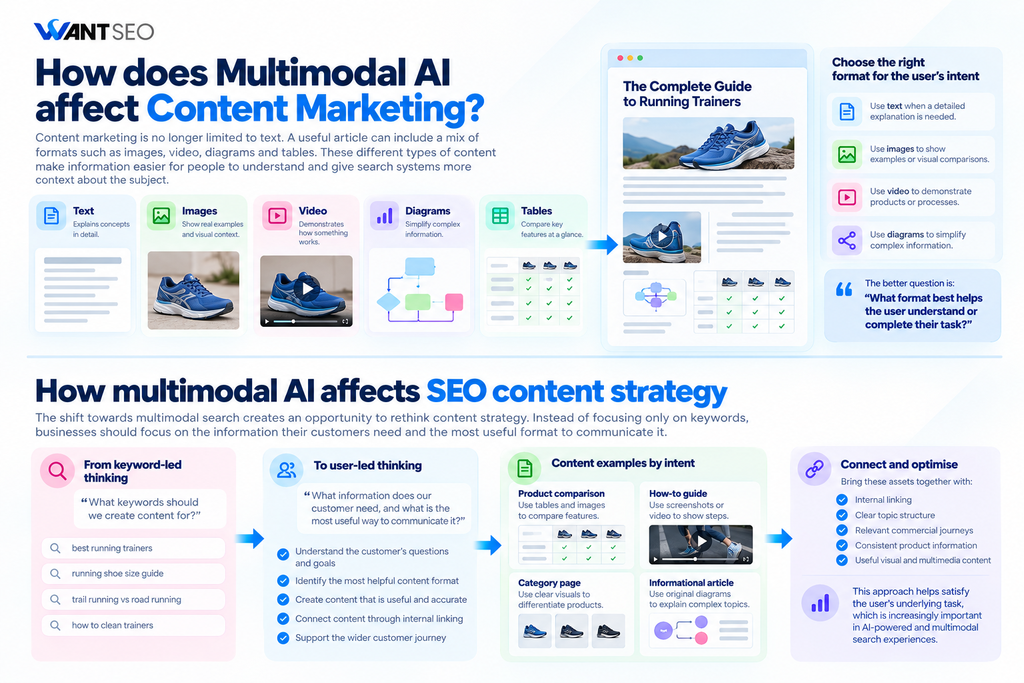
Content marketing also becomes less dependent on text alone. A useful article may contain explanatory diagrams, original photography, product demonstrations, videos, comparison tables or other supporting media. These elements can make the content easier for people to understand. They can also give search systems more information about the subject. However, this does not mean every article needs a video, infographic and gallery simply to appear more comprehensive. That would create activity without necessarily creating value. The better question is:
What format best helps the user understand or complete their task?
For some topics, that will be text. For others, an image may communicate the information more effectively. For products, video may demonstrate something that a paragraph cannot. For complex processes, a diagram may remove ambiguity. Multimodal content should therefore be driven by user intent rather than by a checklist.
How multimodal AI affects SEO content strategy
The shift towards multimodal search creates an opportunity to rethink content strategy. Instead of asking: “What keywords should we create content for?”
Businesses can ask: “What information does our customer need, and what is the most useful way to communicate it?”
That produces a more useful content model. A product comparison might benefit from a table and supporting images. A how-to guide might benefit from screenshots or video. A product category page might benefit from clearer visual differentiation between products. An informational article might benefit from original diagrams.
The SEO strategy then connects these assets through internal linking, topic structure and relevant commercial journeys. This fits a broader shift in search towards satisfying the user’s underlying task rather than matching an exact phrase.
Multimodal AI and AI search visibility
Multimodal AI is also relevant to AI search visibility. Modern AI search experiences can retrieve information from websites and use it to construct responses to user questions. Google’s current guidance emphasises valuable, original content, clear technical structure, relevant images and videos, and information that can be reliably understood by its systems. That means brands should think about the information ecosystem around a page.
A page that clearly explains a product, provides accurate supporting imagery, uses appropriate structured data and links to relevant information gives search systems more context to work with. Again, this is not a guarantee of visibility. It is about reducing ambiguity and making useful information easier to discover and understand.
Google Search Console now includes multimodal search reporting
One of the most practical developments for SEO teams is Google’s introduction of multimodal Search performance reporting in Search Console. Google announced the update on 24 September 2026, introducing a new multimodal search type filter in Search Console’s Performance reports. The reporting covers searches involving experiences such as:
- Google Lens
- Circle to Search on Android
- Image uploads to Google Search
- Chrome’s “Search this image” functionality
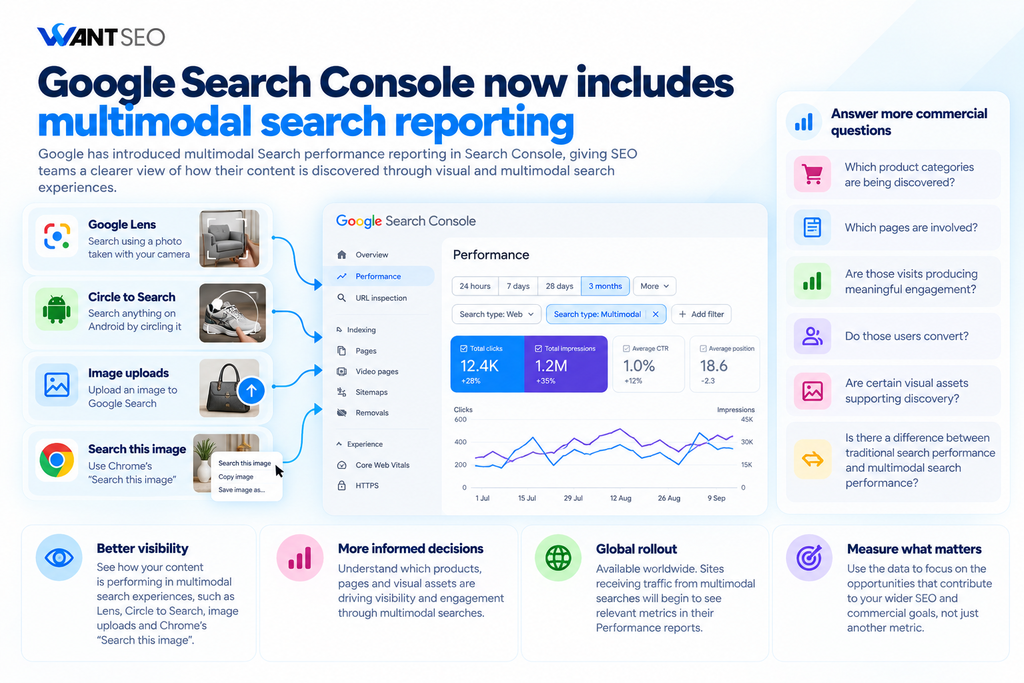
Google says the rollout is global and that sites receiving traffic from these queries will begin seeing relevant metrics in their Performance reports. This gives SEO teams better visibility into a type of search behaviour that was previously harder to isolate. That matters because measurement influences prioritisation. If a retailer can see that its products or content are receiving visibility through multimodal searches, it can begin asking more useful commercial questions.
- Which product categories are being discovered?
- Which pages are involved?
- Are those visits producing meaningful engagement?
- Do those users convert?
- Are certain visual assets supporting discovery?
- Is there a difference between traditional search performance and multimodal search performance?
The value is not simply having another metric. The value is being able to understand more of the customer discovery journey.
What should businesses track?
The answer should depend on the business model. For ecommerce brands, sales and commercial engagement are likely to matter more than simply counting additional multimodal impressions. Useful areas to investigate can include:
- Multimodal search visibility: Are pages appearing for image-led or other multimodal searches?
- Engagement: What happens after someone reaches the website?
- Product interaction: Are users exploring products, variants or related categories?
- Conversion: Do multimodal visitors contribute to purchases or other meaningful actions?
- Content performance: Which types of visual and supporting content appear to be associated with useful visits?
The important point is to avoid treating multimodal search as another vanity metric. More visibility is not automatically more commercial value. The purpose of measurement should be to improve decisions about where effort is worthwhile.
How should you optimise a website for multimodal AI?
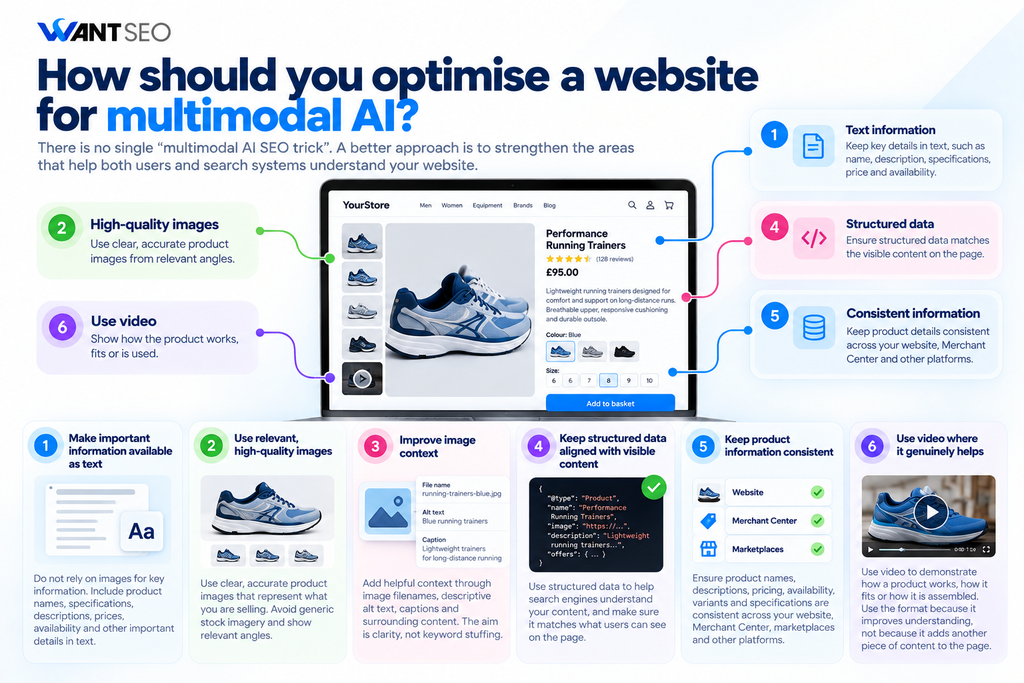
There is no single “multimodal AI SEO trick”. A better approach is to strengthen the areas that help both users and search systems understand your website.
1. Make important information available as text
Images can communicate a great deal, but important product and business information should not exist only inside images. Product names, specifications, descriptions, prices, availability and other commercially important information should be clearly represented on the page where relevant. Google’s guidance continues to emphasise the importance of important content being available in textual form.
2. Use relevant, high-quality images
Images should represent what the page is actually about. For ecommerce, this means accurate product photography rather than generic stock imagery wherever possible. The image should help the customer understand the product. It should not simply exist because an SEO checklist says the page needs an image.
3. Improve image context
An image does not exist in isolation. The surrounding page content, image filename, alt text where appropriate, captions and other contextual information can help communicate what an image represents. The objective is clarity rather than keyword stuffing.
4. Keep structured data aligned with visible content
Structured data can help search engines understand page information, but it needs to accurately reflect the visible content. Google specifically recommends ensuring structured data matches the content users can see on the page. For ecommerce, this is particularly relevant to product information. If the page says one thing while structured data communicates something else, you have introduced unnecessary ambiguity.
5. Keep product information consistent
Product information may exist across the website, Merchant Center, marketplaces and other platforms. Consistency becomes increasingly important as search systems combine information from different sources. Review important attributes such as product names, descriptions, pricing, availability, variants and specifications.
6. Use video where it genuinely helps
Video can demonstrate information that is difficult to communicate through text or still images. For example, a retailer could use video to demonstrate how a product works, how it fits or how it is assembled. The same principle applies here:
Use the format because it improves understanding, not because it adds another piece of content to the page.
What should ecommerce brands prioritise?
Most businesses do not need to rebuild their entire SEO strategy around multimodal AI. Start with the pages that matter commercially. Review your highest-value products and categories first. Look at whether the product information is complete, consistent and easy to understand. Review the quality and usefulness of the imagery. Check whether structured data reflects the visible page. Look at internal linking and whether supporting content helps customers make decisions. Then look at Search Console data, including the new multimodal reporting where available.
The aim is to identify where the opportunity actually exists. A business selling visually distinctive products may have a very different multimodal search opportunity from a B2B software company. That is why copying a generic “AI SEO checklist” is rarely the right approach. The strategy should follow the customer, the product and the commercial opportunity.
Common mistakes with multimodal AI SEO
One common mistake is assuming that more images automatically mean better visibility. However, they do not. Another is creating large amounts of AI-generated visual content without a clear purpose. More assets do not necessarily make a website more useful. A third mistake is treating image optimisation as an isolated technical exercise. Images need to work with the page they sit on.
There is also a temptation to create separate pages for every possible visual query. That can quickly become a content volume exercise rather than a useful information strategy. Google’s guidance continues to emphasise helpful, people-first content and warns against creating large amounts of content primarily to manipulate search visibility. The better approach is to improve the information that already has commercial importance.
Multimodal AI is changing the customer journey, not just search
The biggest change may not be technical at all. Multimodal AI makes it easier for people to start a search without knowing exactly what to type. That reduces the importance of perfect vocabulary at the beginning of the journey. A customer can show the system what they mean.
This creates an important opportunity for brands. Your customer does not need to know your product terminology if the search experience can understand the object, image or context they provide. But once the customer reaches your website, the same principle applies in reverse. Your website needs to make the product and its value clear. That is where SEO, CRO and content strategy start to overlap.
How multimodal AI connects SEO and CRO
SEO traditionally focuses on helping people discover a website. CRO focuses on what happens after they arrive. Multimodal search makes the boundary between the two increasingly interesting. A customer might discover a product through an image, arrive on a product page and immediately need information about sizing, compatibility, materials or use. If that information is difficult to find, the discovery opportunity may not translate into commercial value. This is why multimodal optimisation should not be treated purely as an SEO project. The better question is:
Can the entire journey move from discovery to understanding to action without unnecessary friction?
That is a much more commercially useful question than simply asking whether a page can appear for an image search.
How Want SEO approaches multimodal AI and SEO
At Want SEO, we do not treat every change in search as a reason to create another list of tactics. The starting point is the business problem. We look at how customers discover the brand, where search contributes to that journey and which parts of the website have the greatest commercial importance.
From there, we prioritise the areas where effort is most likely to compound. This could include:
- Improving product information before investing in creating more content.
- Fixing inconsistencies between structured data and the information users can see on the page.
- Improving category architecture so products and content are easier to understand and navigate.
- Strengthening internal linking to create clearer relationships between relevant pages.
- Making visual assets more useful, particularly where images or video help customers understand products.
- Using multimodal search data to identify whether there is a meaningful commercial opportunity.
- Choosing not to act immediately when multimodal search does not represent a significant opportunity for the business.
That last point is important. Strategic SEO is not about optimising everything simply because it is possible. It is about understanding where effort is justified and where it is better spent elsewhere. Multimodal AI is another development within a wider search ecosystem. It should therefore be considered alongside technical SEO, content, CRO, ecommerce architecture and AI search visibility rather than treated as a separate activity.
Our approach is built around clarity over activity. We start with intent, consider the trade-offs and prioritise what matters rather than trying to optimise everything at once. That reflects Want SEO’s wider approach to SEO, CRO and growth strategy. The underlying question is simple:
What decision will this work help the business make better?
If multimodal search data shows a meaningful opportunity, it can inform where to invest next. If it does not, there may be more valuable work elsewhere. That is the difference between responding to every change in search and making a considered SEO decision.
Conclusion
Multimodal AI is changing how people interact with search. Instead of relying entirely on typed keywords, users can combine images, text, voice and other forms of information to describe what they want. For SEO, the implication is not that everything needs to change. The fundamentals still matter. Useful content, clear information architecture, crawlability, internal linking, structured data, strong page experience and relevant visual content remain important. Google explicitly continues to position these foundations as relevant to its AI search experiences.
What is changing is the range of ways people can discover information. Google’s new multimodal reporting in Search Console is particularly useful because it gives businesses a clearer view of this behaviour. The new reporting can help SEO teams understand where multimodal discovery is happening and, more importantly, whether it creates meaningful value.
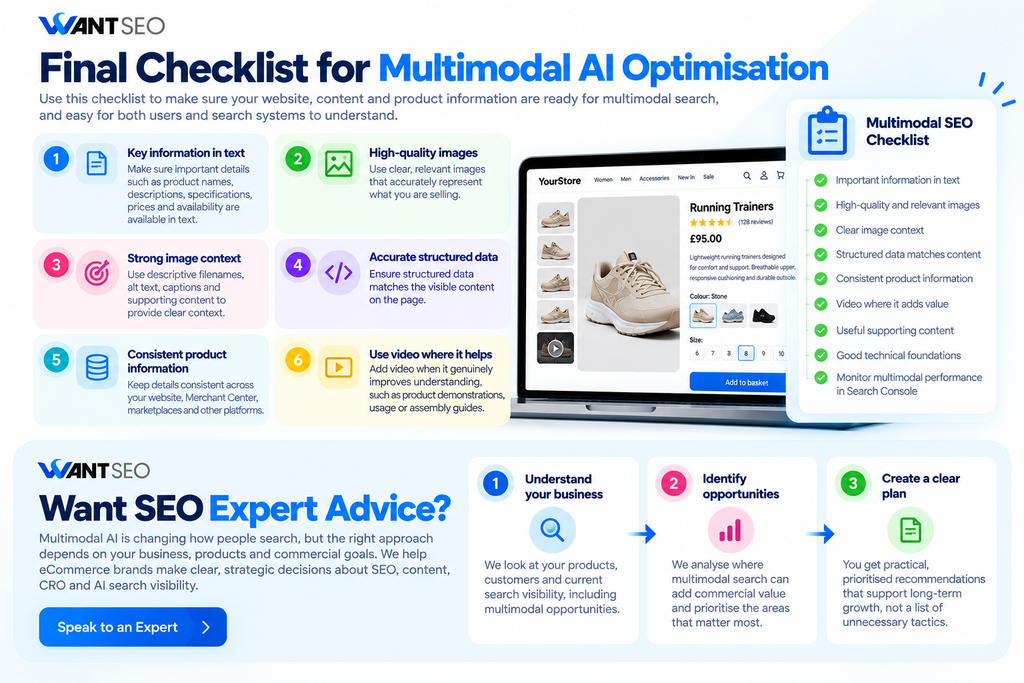
For ecommerce brands, the practical response is straightforward: make important information clear, make visual assets useful, keep product data consistent and prioritise the parts of the customer journey that matter commercially. You do not need to optimise for every new AI feature. You need to understand where your customers are going, what information they need and where your effort is most likely to make a difference. That is a better way to approach multimodal AI, SEO and digital marketing.
FAQs
What is multimodal AI in simple terms?
Multimodal AI is artificial intelligence that can understand and work with different types of information, such as text, images, video and audio. It allows people to interact with AI using more than just written prompts.
How does multimodal AI affect SEO?
Multimodal AI expands the ways people can discover websites and products. SEO therefore needs to consider not only written content but also useful images, video, product information, structured data, technical accessibility and the wider context surrounding a page.
Does multimodal AI replace traditional SEO?
No. Traditional SEO fundamentals remain important. Google continues to recommend practices such as creating useful content, maintaining crawlable and indexable websites, using internal links, providing a good page experience and supporting text with relevant images and video.
Can Google Search Console track multimodal searches?
Yes. Google introduced multimodal Search performance reporting in September 2026, including a new multimodal search type filter. The reporting covers experiences including Google Lens, Circle to Search, image uploads to Google Search and Chrome’s “Search this image” functionality.
What should ecommerce businesses do about multimodal AI?
Start with commercially important pages and products. Check that product information is clear and consistent, imagery is useful and accurate, structured data matches visible content, and important information is accessible as text. Then use Search Console data to understand whether multimodal search is creating meaningful visibility and engagement before deciding where further investment is justified.