Want SEO
What Are the Top 3 Most Used AI Tools?
Artificial intelligence (AI) has become part of how people search for information, write content, conduct research and complete everyday tasks. From answering questions to analysing data, AI tools are changing how individuals and businesses approach their work. But with so many AI tools available, which ones are the most widely utilised, and which ones are the top 3 most used AI tools?
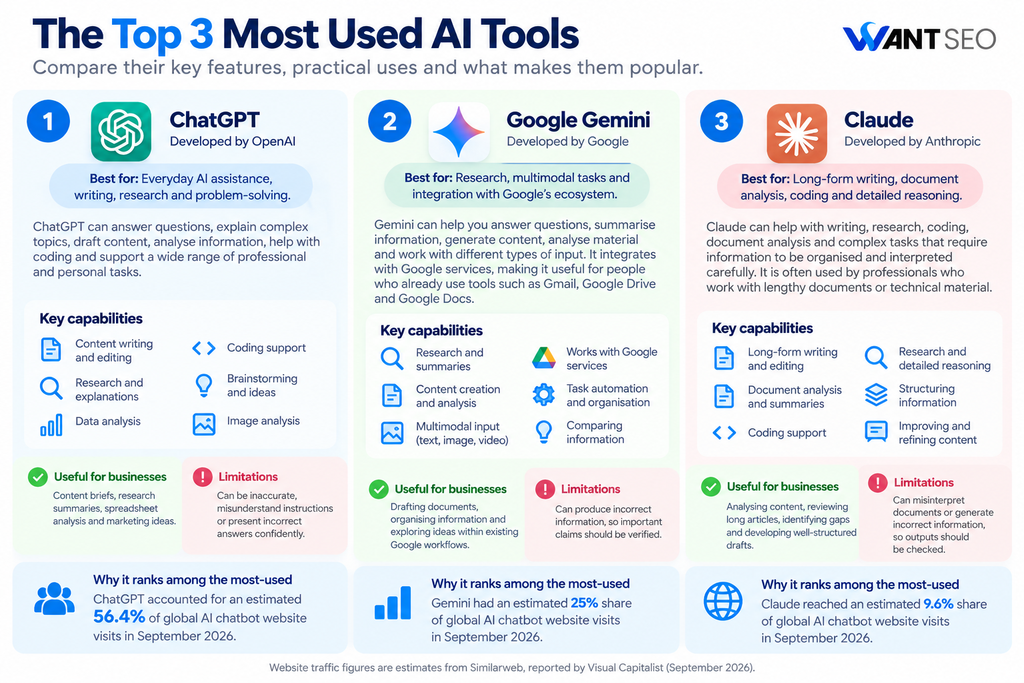
The three leading general-purpose AI assistants by global website traffic in September 2026 were ChatGPT, Google Gemini and Claude, according to data from Similarweb reported by Visual Capitalist. ChatGPT accounted for 56.4% of global AI chatbot website visits, followed by Gemini at 25% and Claude at 9.6%. These figures measure website visits rather than total users across apps and other integrations.
In this guide, we explore these three popular AI tools, what they do best and how to decide which one suits your needs. We also look at how AI adoption differs across the UK, USA and global markets.
Key Takeaways
- ChatGPT, Google Gemini and Claude lead AI adoption: Each offers different capabilities for writing, research, problem-solving and everyday tasks.
- Choose AI tools based on your needs: ChatGPT offers broad functionality, Gemini integrates with Google’s ecosystem, and Claude supports detailed writing and document analysis.
- AI adoption varies by market: Usage patterns differ across the UK, USA and globally, depending on whether you measure website traffic, app usage or reported adoption.
- AI is changing SEO and online discovery: Businesses should prioritise useful content, accurate information and accessible websites to support visibility across traditional search engines and AI-powered platforms.
What Are the Top 3 Most Used AI Tools?
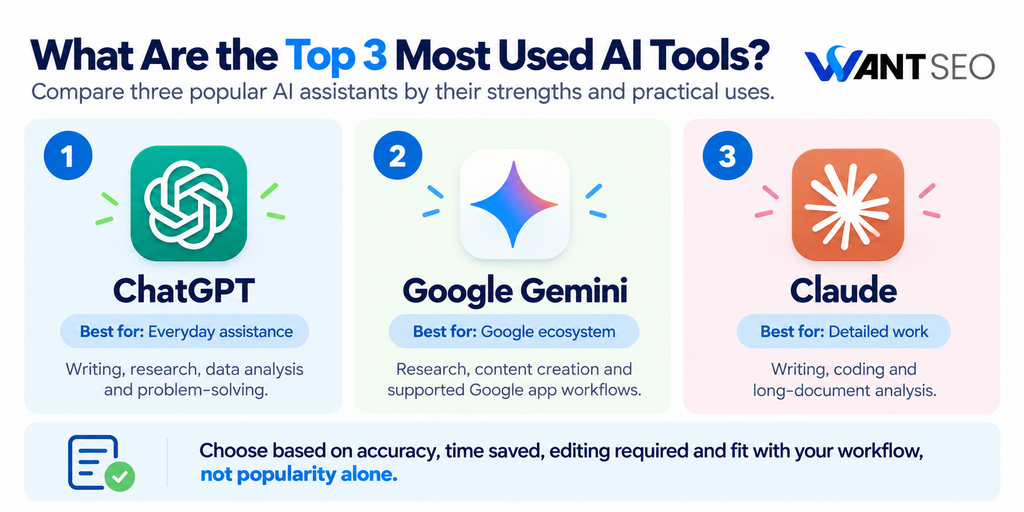
Three of the most widely used AI assistants are ChatGPT, Google Gemini and Claude. Each offers a range of capabilities, from answering questions and generating content to analysing information and supporting complex tasks. Their popularity reflects the growing role of AI in everyday activities, professional workflows and business decision-making.
- ChatGPT: Developed by OpenAI, ChatGPT supports a broad range of tasks, including content writing, research, data analysis, brainstorming and problem-solving. Its versatility makes it useful for individuals and businesses looking for an AI assistant that can handle different types of work.
- Google Gemini: Google’s AI assistant helps users research topics, create content, analyse information and work with supported Google services. It can be particularly useful for people who already use Google’s ecosystem for communication, document creation and collaboration.
- Claude: Developed by Anthropic, Claude is designed to assist with writing, coding, research and detailed document analysis. It can be useful for professionals who need to organise complex information, review lengthy material or develop structured written content.
Although these tools share many capabilities, their strengths, integrations and available features differ. Some users may prioritise research and productivity, while others need support with writing, technical tasks or existing business workflows.
Rather than choosing an AI assistant based solely on popularity, consider how accurately it handles your tasks, how much editing its output requires and whether it fits your working process. These factors will help you identify which tool offers the most practical value for your needs.
1. ChatGPT
Best for: Everyday AI assistance, writing, research and problem-solving.
ChatGPT is an AI assistant developed by OpenAI. It can answer questions, explain complex topics, draft content, analyse information, help with coding and support a wide range of professional and personal tasks. One reason for its popularity is its versatility. Rather than needing a separate tool for every task, users can work through different problems in one conversation. Depending on the available features and plan, ChatGPT can also work with uploaded files, analyse data, interpret images and assist with research.
For businesses, ChatGPT can support tasks such as developing content briefs, summarising research, analysing spreadsheets and generating ideas for marketing campaigns. However, its output still requires human judgement, particularly when accuracy, brand positioning or commercial decisions are involved.
ChatGPT also has limitations. It can produce inaccurate information, misunderstand instructions or present an incorrect answer confidently. Important facts should therefore be checked against reliable sources.
Why it ranks among the most-used AI tools: ChatGPT combines a broad range of capabilities with a familiar conversational interface. In September 2026, it accounted for an estimated 56.4% of global AI chatbot website visits, according to Similarweb data reported by Visual Capitalist.
2. Google Gemini
Best for: Research, multimodal tasks and integration with Google’s ecosystem.
Google Gemini is Google’s AI assistant. It can help users answer questions, summarise information, generate content, analyse material and work with different types of input. One of Gemini’s main advantages is its connection with Google’s wider ecosystem. Depending on account settings, availability and the features being used, Gemini can work alongside supported Google services, making it useful for people who already rely on tools such as Gmail, Google Drive and Google Docs.
Gemini can also support research by helping users explore subjects, compare information and develop initial summaries. As with other AI assistants, users should verify important claims rather than assuming that every generated answer is correct.
For businesses, Gemini may be particularly useful when teams already use Google’s productivity tools. It can help with drafting documents, organising information and exploring ideas without requiring a completely separate workflow.
Why it ranks among the most-used AI tools: Gemini has grown into a major alternative to ChatGPT. Similarweb data reported in October 2026 placed it second globally by AI chatbot website traffic, with an estimated 25% share in September 2026.
3. Claude
Best for: Long-form writing, document analysis, coding and detailed reasoning.
Claude is an AI assistant developed by Anthropic. It can help with writing, research, coding, document analysis and complex tasks that require information to be organised and interpreted carefully. Claude is often considered by professionals who work with lengthy documents, technical material or detailed written content. It can help summarise reports, review code, structure arguments and turn rough notes into clearer documents.
For marketing and SEO teams, Claude can be useful for analysing content, reviewing the structure of long articles, identifying gaps in explanations and developing well-organised drafts. The quality of its output depends on the instructions, supporting information and review process provided by the user.
Claude can also make mistakes, including misinterpreting documents or generating incorrect technical information. Its responses should be checked before they are used in published content or important decisions.
Why it ranks among the most-used AI tools: Claude has experienced substantial growth in AI chatbot website traffic. According to Similarweb data reported by Visual Capitalist, its share reached 9.6% in September 2026, placing it third among the measured AI chatbot websites.
How Popular Are These AI Tools in the UK, USA and Globally?
The popularity of AI tools varies by country and by how usage is measured. Website traffic, app adoption, brand awareness and self-reported use are different metrics, so their rankings should not be treated as interchangeable.
Global AI usage
Globally, ChatGPT remains the leading AI chatbot by website traffic, with Gemini in second place and Claude in third in the September 2026 comparison. Together, these three platforms accounted for more than 90% of the measured website visits in that comparison. The figures exclude app usage and AI features integrated into other products.
AI usage in the USA
A June 2026 Pew Research Center survey of US adults found that 44% had used ChatGPT, compared with 24% for Gemini and 17% for Microsoft Copilot. Meta AI followed at 14%, while 8% reported using Grok and 6% Claude. This survey measures whether respondents had ever used each chatbot, rather than the number of visits to its website. It therefore provides a different view of adoption from global web traffic rankings.
AI usage in the UK
UK data also shows strong interest in ChatGPT and other AI assistants. The IAB UK’s summary of Ipsos iris audience measurement reported that ChatGPT reached 15.1 million monthly users in July 2025, while Microsoft Copilot reached 2.5 million. The measurement covered selected AI websites and apps, rather than every AI feature integrated into other services. The figures illustrate why it is important to consider the market and measurement period when comparing AI adoption. A platform can generate substantial global website traffic while another has a different position in a particular country’s app usage or brand preference data.
Which AI Tool Should You Use?
The right AI assistant depends on your needs, existing software and the type of work you want to complete.
| Your main requirement | AI tool to consider |
| General-purpose assistance and everyday tasks | ChatGPT |
| Working within Google’s ecosystem | Google Gemini |
| Long-form writing and document analysis | Claude |
| Exploring and comparing research | ChatGPT or Gemini |
| Coding and technical problem-solving | ChatGPT or Claude |
| Drafting and refining professional content | Any of the three, depending on the task |
These are practical starting points rather than definitive rankings of performance. All three tools can support multiple types of work, and their capabilities change as new features and models are introduced. For businesses, it is worth testing the tools against real tasks rather than choosing one solely because it is popular. Compare the accuracy of their outputs, the time required to review them, their integration with existing workflows and the cost of using them at your intended scale.
How Does AI Usage Affect SEO and Digital Marketing?
The growth of AI assistants is changing how people discover information, research products and evaluate businesses. Alongside traditional search engines, some users now turn to AI tools for explanations, comparisons and recommendations. For eCommerce businesses, this creates an additional consideration: how easily can your products, services and expertise be understood by both search engines and AI systems?
Start with the foundations. Make sure your website provides accurate product information, clear descriptions, accessible pages and useful content that answers genuine customer questions. Structured data, consistent business information and a logical internal linking structure can also help search systems interpret your website. However, no single technique guarantees that an AI assistant will mention or recommend your business. It is also important to distinguish between using AI to create content and making content useful to people. Publishing more AI-generated articles does not automatically improve visibility. Content should provide accurate information, demonstrate relevant expertise and help readers make better decisions.
At Want SEO, the focus is on understanding where visibility matters, what customers are looking for and which improvements are most likely to support commercial goals. AI search, traditional SEO and conversion rate optimisation should be considered as connected parts of a wider growth strategy, rather than isolated activities.
Conclusion
ChatGPT, Google Gemini and Claude are three of the most widely used general-purpose AI assistants, although their relative popularity depends on the market and the measurement method. ChatGPT offers broad capabilities for everyday tasks, Gemini provides useful integration with Google’s ecosystem, and Claude supports writing, coding and detailed document work.
There is no need to choose an AI tool simply because it leads a popularity ranking. Identify the tasks you want to improve, test the available options and assess the accuracy, usefulness and cost of their outputs. For businesses, the same principle applies to AI adoption. The goal is not to use more AI tools, but to make better decisions, improve workflows and create genuine value for customers.
FAQs
1. What are the top 3 most used AI tools?
By global AI chatbot website traffic in September 2026, the top three were ChatGPT, Google Gemini and Claude, according to Similarweb data reported by Visual Capitalist.
2. Which AI tool is the most popular worldwide?
ChatGPT led global AI chatbot website traffic in September 2026. However, rankings can differ when measured by app usage, survey responses or total monthly users.
3. Is ChatGPT better than Google Gemini?
Neither is universally better. ChatGPT offers broad general-purpose capabilities, while Gemini may be particularly useful for people working within Google’s ecosystem. The best choice depends on your requirements.
4. What is Claude AI used for?
Claude can assist with writing, document analysis, coding, research and complex tasks. It is useful for organising information and working with detailed material, but its outputs still require verification.
5. Are AI tools free to use?
ChatGPT, Gemini and Claude offer access options that may include free and paid plans. Available features, usage limits and subscription prices vary, so check each provider’s current offering.
6. How are AI tools changing SEO?
AI assistants are creating additional ways for people to discover information and compare products. Businesses should prioritise useful content, accurate information and accessible websites rather than relying on tactics that promise AI visibility.