Top 6 Ways to Prevent LLM Hallucinations & Protect Your Brand’s SEO
As AI-powered search becomes increasingly influential, businesses face a new challenge that traditional SEO never had to address: LLM hallucinations. Large Language Models (LLMs) such as ChatGPT, Gemini, Claude, Perplexity, and Microsoft’s Copilot are changing how people discover information, compare products, and make purchasing decisions. While these tools provide faster answers, they can also generate inaccurate, outdated, or completely fabricated information. For businesses, this presents a significant risk. An AI model that misrepresents your products, services, pricing, or expertise can damage trust, reduce conversions, and weaken your online authority. Learning how to prevent LLM hallucinations is no longer just an AI concern. It has become an essential part of modern SEO, Answer Engine Optimisation (AEO), and Generative Engine Optimisation (GEO).
At Want SEO, our experts have researched how AI search engines evaluate brands and content across multiple industries. This guide explains the six most effective ways to prevent AI misinformation while strengthening your visibility across both traditional search engines and AI-powered platforms.
Key Takeaways
- If you want to prevent LLM hallucinations, it starts with publishing accurate, authoritative, and well-structured content.
- SEO, AEO, GEO, semantic SEO, and structured data all contribute to reducing AI misinformation.
- Consistent brand signals across your website and the wider web improve AI confidence in your business.
- Businesses that optimise for AI search today will be better positioned as search continues evolving.
What Are LLM Hallucinations?
LLM hallucinations occur when an artificial intelligence model confidently generates information that is incorrect, misleading, or entirely fabricated. Unlike a traditional search engine, an LLM predicts the most likely response based on patterns learned during training rather than verifying every fact in real time. Examples include:
- Incorrect business information
- Fabricated product features
- Outdated pricing
- Misquoted statistics
- Wrong company history
- False citations
- Invented customer reviews
These mistakes may appear convincing to users, making them particularly dangerous for brands that rely on trust and authority.
The True Cost of AI Hallucinations on Your Organic Rankings
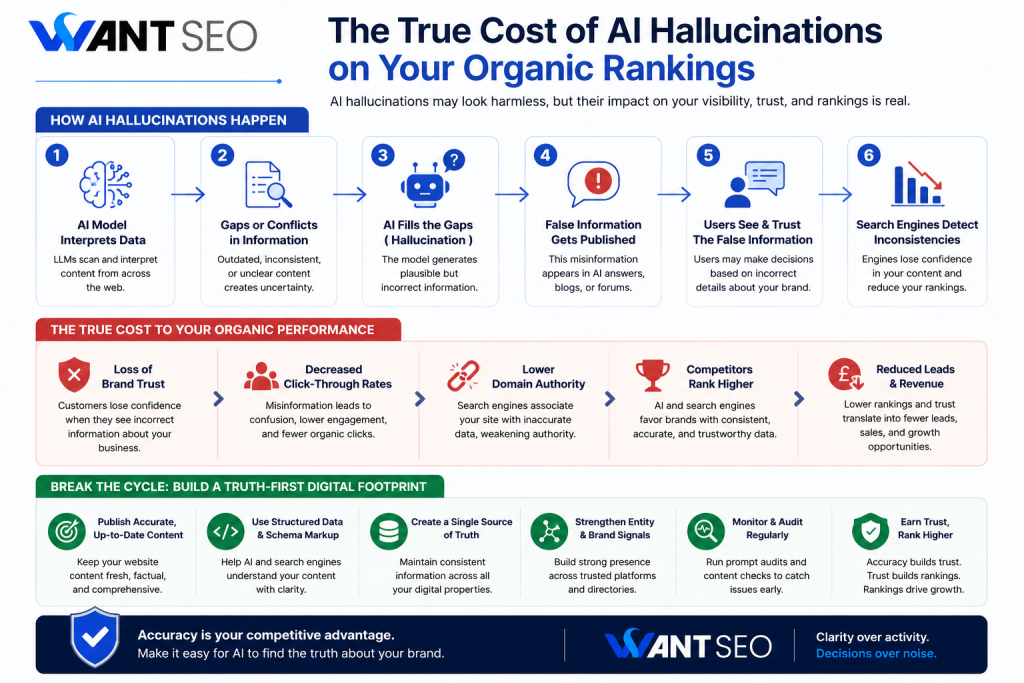
An LLM hallucination occurs when a model generates syntactically flawless text that is factually incorrect, highly inaccurate, or completely fabricated. In the context of digital marketing, this might look like an AI tool advising a customer that your service includes a feature you do not actually offer, or directing a searcher to a non-existent, broken URL.
When these hallucinations are published online or integrated into conversational search engines, they directly threaten your organic performance. If search engines crawl false claims and associate your brand with inaccurate data, your domain authority can drop.
Furthermore, search engines prioritise accuracy and trust; if an AI engine repeatedly provides conflicting information about your company, it will drop your rankings in favour of competitors with more consistent and clearly defined data. To stop this cycle, you must build a clean, structured digital footprint that makes it incredibly easy for LLMs to find the absolute truth.
Top 6 Ways to Prevent LLM Hallucinations
As AI search becomes a primary way people discover brands, preventing misinformation is no longer optional. The best way to prevent LLM hallucinations is to provide AI systems with accurate, structured, and consistent information that leaves little room for interpretation. The following six strategies help strengthen your visibility across traditional search engines while improving how AI models understand and represent your business.
1. Implement Robust Schema Markup and Structured Data
Structured data is one of the most effective ways to help search engines and Large Language Models interpret your website correctly. Instead of relying solely on page content, schema markup provides machine-readable information about your organisation, products, services, authors, reviews, and FAQs.
Using Schema.org markup such as Organization, LocalBusiness, Product, Article, Person, FAQ, and Breadcrumb creates clear signals that reduce ambiguity. This allows AI systems to identify factual information such as your business name, contact details, service areas, pricing, where applicable, and areas of expertise without making assumptions.
Although structured data cannot completely eliminate hallucinations, it significantly improves semantic understanding, making it easier for Google AI Overviews, ChatGPT, Gemini, Claude, and Perplexity to retrieve accurate information about your brand.
2. Create a Single Source of Truth for Your Brand
One of the most overlooked ways to prevent LLM hallucinations is ensuring there is only one authoritative version of your business information. Many companies unintentionally publish conflicting information across service pages, blogs, press releases, and third-party websites. When AI models encounter these inconsistencies, they may combine outdated and current information into inaccurate responses.
Create a dedicated brand authority page that clearly defines:
- Business name
- Company description
- Services
- Locations
- Leadership team
- Brand mission
- Awards and certifications
- Contact details
Supporting this information with an organisation schema and consistent internal linking helps establish a canonical source that AI systems can trust.
3. Remove Outdated Content and Eliminate Contradictions
AI models are only as reliable as the information they find. If your website contains outdated statistics, retired services, old pricing, or conflicting product information, there is a greater chance that AI will surface incorrect answers.
Regular content audits should become part of your SEO strategy. Review older pages to ensure that every important fact matches your latest information. Remove duplicate pages, update historical data, refresh case studies, and redirect obsolete URLs where appropriate.
Maintaining consistency across your website improves user trust while strengthening your SEO, Answer Engine Optimisation (AEO), and Generative Engine Optimisation (GEO) efforts. In turn, it will automatically help prevent LLM hallucination and protect your brand’s SEO.
4. Optimise Content for Retrieval-Augmented Generation (RAG)
Many modern AI search platforms no longer rely exclusively on their training data. Instead, they use Retrieval-Augmented Generation (RAG) to retrieve relevant information from trusted web pages before generating a response. To improve your chances of being selected, create content that is easy for AI to extract and understand.
This includes:
- Clear H2 and H3 headings
- Concise introductory summaries
- Question-and-answer sections
- Helpful comparison tables
- Logical page structure
- Accurate statistics with context
- Well-organised FAQs
Content that is easy to retrieve is also easier to cite, improving your visibility in AI-generated answers while helping you reduce the likelihood and prevent LLM hallucination for information.
5. Strengthen Your Brand Entity and Knowledge Graph Presence
Search engines and AI models increasingly understand businesses as entities rather than collections of keywords. They connect information from multiple trusted sources to build a knowledge graph that represents your brand.
To strengthen these entity signals, ensure your business information remains consistent across your website, Google Business Profile, LinkedIn, official social media accounts, business directories, industry publications, and other authoritative sources.
Where relevant, establish verified profiles on platforms such as Wikidata or recognised industry databases. Consistent entity information helps AI systems confidently identify your business, making it less likely that they will confuse your brand with competitors or generate inaccurate details.
Entity SEO has become an essential component of both traditional search optimisation and AI search visibility. This can let you easily prevent LLM hallucinations on your website.
6. Regularly Audit AI Platforms for Brand Accuracy
Even with strong SEO foundations, monitoring how AI platforms describe your business is essential. Search experiences evolve rapidly, and inaccuracies can appear as your website, products, or services change. Create a quarterly review process that tests your brand across leading AI platforms, including ChatGPT, Gemini, Claude, Perplexity, Microsoft Copilot, and Google AI Overviews.
Ask questions such as:
- What services does our company provide?
- Where are we located?
- Who are our competitors?
- What industries do we specialise in?
- Why would customers choose our business?
Record any inaccuracies, identify where conflicting information may exist online, and update your website, structured data, and authoritative content accordingly. Regular AI prompt audits provide valuable insight into how generative search engines understand your business today, allowing you to improve accuracy before misinformation affects potential customers. Audits and documentation can help you effortlessly prevent LLM hallucinations.
Why These Six Strategies Matter
Remember that if you want to prevent LLM hallucinations, it is not about trying to control AI. It is about reducing uncertainty. When your website provides accurate, comprehensive, and well-structured information supported by strong entity signals, structured data, and consistent brand messaging, AI systems have far less need to infer or invent details.
This approach not only helps prevent LLM hallucinations but also strengthens your performance across traditional SEO, AI search, Answer Engine Optimisation (AEO), Generative Engine Optimisation (GEO), semantic SEO, and future search technologies. Businesses that invest in these foundations today will be better positioned to earn trust, improve visibility, and remain discoverable as AI-powered search continues to evolve.
Comparing LLM Hallucination Impact Across Different Search Channels
Not all search platforms process information in the same way. Traditional search engines primarily index and rank web pages, while modern AI-powered search engines generate answers by combining information from multiple sources. As a result, the risk and impact of LLM hallucinations vary significantly across search channels.
Understanding these differences helps businesses prevent LLM hallucinations, strengthen brand authority, and optimise content for SEO, Answer Engine Optimisation (AEO), and Generative Engine Optimisation (GEO).
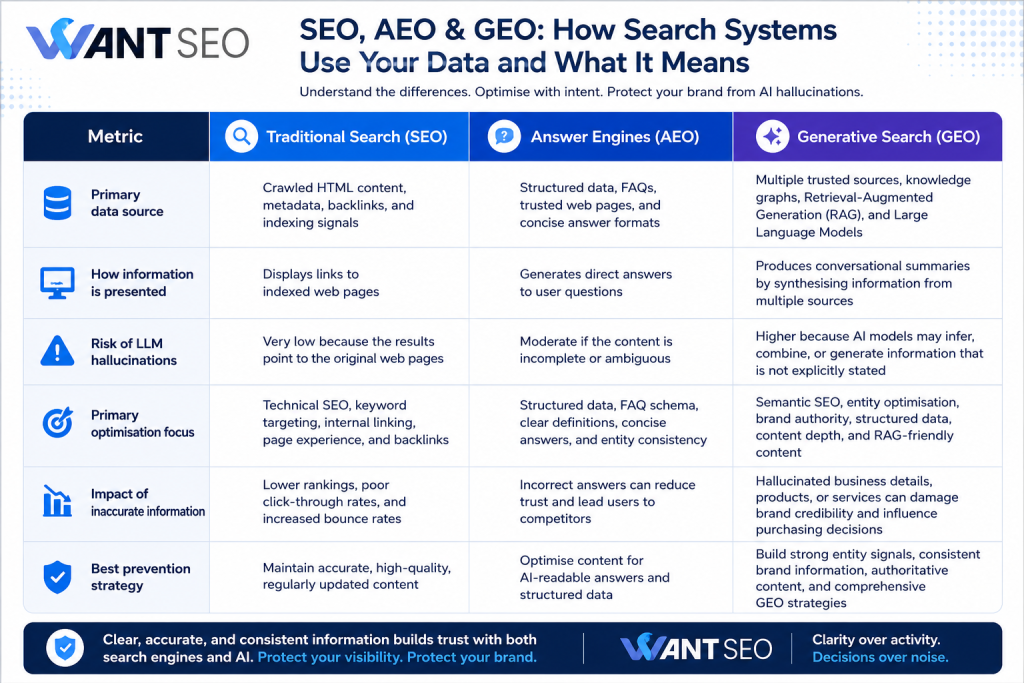
Key Insight: Traditional SEO helps search engines discover and rank your content, but AI-powered search requires an additional layer of optimisation. By combining SEO, AEO, and GEO with structured data, semantic SEO, and consistent brand entities, businesses can significantly prevent LLM hallucinations while improving their visibility across Google AI Overviews, ChatGPT, Gemini, Claude, Perplexity, and other AI-driven search experiences.
Common Mistakes That Increase AI Hallucinations
Many businesses unknowingly make AI confusion more likely. These include:
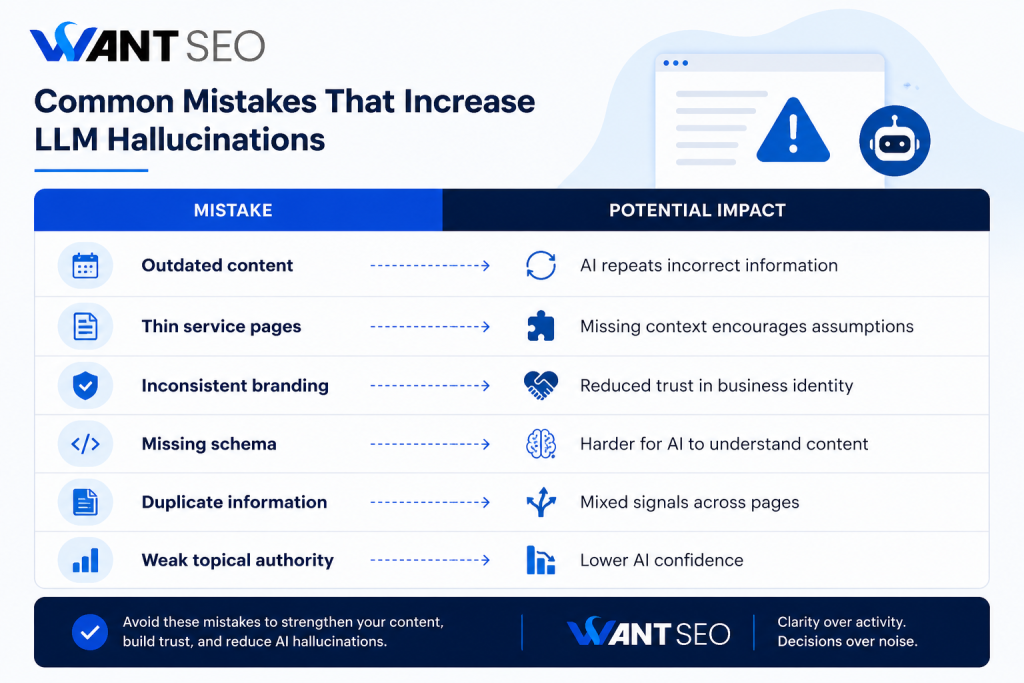
Avoiding these mistakes improves search performance, AI reliability and prevent LLM hallucinations.
How This Protects Your Brand
If you want to prevent LLM hallucinations, it is not simply about correcting AI mistakes. It is about giving AI systems enough trustworthy information that incorrect answers become less likely in the first place.
Businesses that invest in semantic SEO, structured data, entity optimisation, digital PR, and high-quality content create stronger knowledge signals. These signals improve visibility in Google Search, AI Overviews, ChatGPT, Gemini, Claude, Perplexity, and future AI-powered search experiences.
Rather than chasing rankings alone, organisations should focus on becoming the most authoritative source about their own expertise.
Protecting Your Digital Future in the AI Era
As the search landscape shifts from simple blue links to generative AI answers, protecting your online reputation requires a highly technical, forward-thinking approach. Leaving your brand’s narrative up to the interpretation of generative models is a massive risk to your hard-earned organic visibility. By implementing clean structured data, maintaining brand consistency, and actively monitoring how search systems perceive your business, you can keep your brand safe from the negative impacts of generative errors and prevent LLM hallucinations.
At Want SEO, we specialise in cutting-edge SEO strategies built for the age of artificial intelligence. Recognised as a top local SEO company and the best local SEO company in UK, our specialists understand how to configure your digital assets so they are easily read and accurately cited by modern engines. Whether you want to work with the best search engine optimisation expert to secure your local rankings, prevent LLM hallucinations or optimise your brand for global generative search, we can help.
Contact Want SEO today to audit your brand’s AI visibility and build a strong, future-proof search strategy.
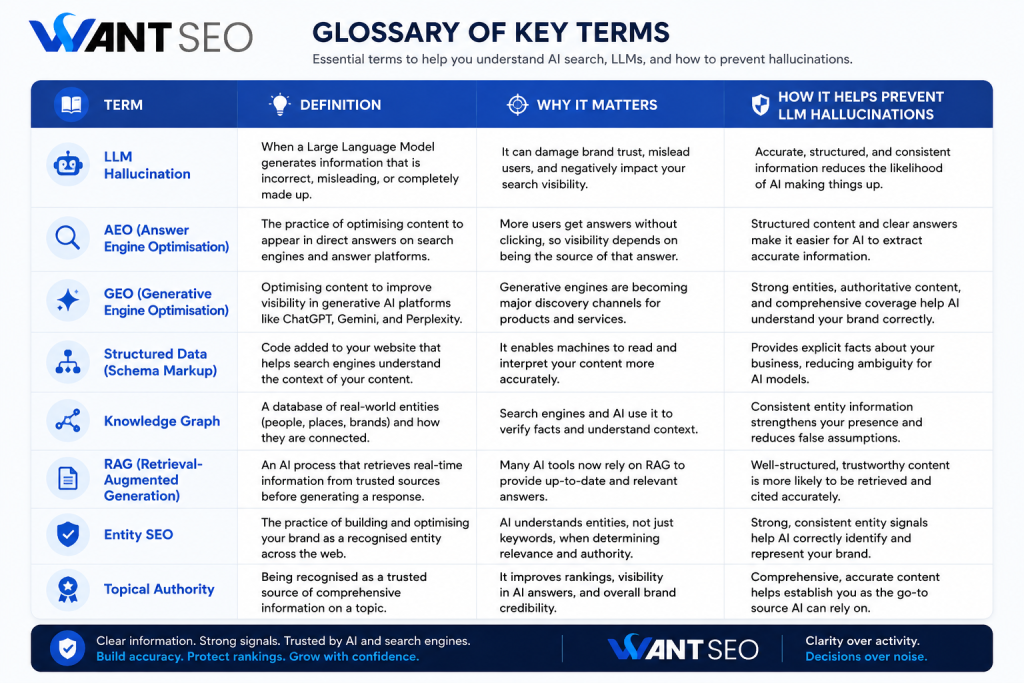
Glossary Table
FAQs
1. What are LLM hallucinations?
LLM hallucinations are AI-generated responses that contain inaccurate, fabricated, or misleading information despite appearing confident and believable.
2. Can SEO help prevent LLM hallucinations?
Yes. High-quality SEO improves content accuracy, authority, and consistency, making it easier for AI systems to generate reliable responses about your brand and prevent LLM hallucinations.
3. What is the difference between SEO, AEO and GEO?
SEO focuses on search engine rankings, AEO optimises content for direct answers, while GEO improves visibility within AI-powered generative search experiences.
4. Does structured data reduce AI nuances and prevent LLM hallucinations?
Structured data helps AI and search engines understand your content more accurately by providing explicit information about your business, products, and services. This strategy lets you greatly reduce AI nuances and prevent LLM hallucinations.
5. Why should businesses optimise for AI search?
AI assistants are increasingly influencing customer decisions. Optimising for AI search improves brand visibility, strengthens trust, helps businesses remain competitive as search behaviour evolves and prevent LLM hallucinations.