
How to Write Product Descriptions That Perplexity and Gemini Will Actually Cite
E-commerce websites and pages are no longer written solely for human shoppers; they must also communicate effectively with AI discovery engines. Platforms like Perplexity and Gemini scan pages, product descriptions, structured data, and customer reviews to synthesise direct answers for buyers asking:
- Which option best fits a specific use case, budget, or skill level?
- How do two competing models compare on technical specifications?
- Does an item offer the exact feature or compatibility required?
This shift redefines the purpose of modern product descriptions. Beyond persuasive marketing, your copy serves as an authoritative data source that must be easily parsed by both shoppers and machine algorithms. Rather than writing artificial, machine-focused text, the most effective approach combines natural, direct language with precise, verifiable product facts.
This guide explores how to optimise your content across traditional search, Answer Engine Optimisation (AEO), and Generative Engine Optimisation (GEO). By improving data clarity, structural hierarchy, and trust signals, you ensure your e-commerce catalogue becomes a reliable source that AI answer engines confidently reference and cite.
Key takeaways
- Write product descriptions around real buying questions, not just keywords.
- Make important product facts explicit, specific and easy for AI systems to interpret.
- Combine persuasive context with structured product data, schema and consistent information across the web.
- GEO and AEO work best when your product page is part of a wider ecosystem of reviews, editorial content, retailer information and brand authority.
What Does It Mean for an AI to Cite a Product Page?
When Perplexity cites a page, it is generally providing a source that supports information included in its answer. Perplexity describes its system as searching the web, gathering information and producing answers with citations that allow users to verify the original sources. For ecommerce brands, this creates an important distinction. A product can be:
- Mentioned by an AI system.
- Recommended as an option.
- Cited as a source of specific information.
These are not necessarily the same thing. For example, an AI system may recommend a product after considering several sources, but cite a retailer, review website or editorial publication rather than the brand’s own product page.
This is why the objective should not simply be, “How do I get my product page cited?”
A better question is: Does the product page contain the clearest and most useful source of information for the question a potential customer is asking? If the answer is yes, the page has a stronger chance of becoming useful to both traditional search engines and AI search systems.
Why Product Descriptions Matter More in AI Search
Traditional search generally helps a user discover pages. AI search increasingly helps a user make a decision. That difference is commercially important. A user who previously searched for “best waterproof hiking jacket” might now ask:
“What is the best waterproof hiking jacket for someone who hikes regularly in wet and windy UK conditions but does not want a heavy winter coat?”
This query contains more context, more constraints and more decision-making information. A product description that only says “Premium waterproof hiking jacket made from high-quality materials” does not provide enough useful information. A stronger description might explain:
“This lightweight waterproof hiking jacket is designed for regular hiking in wet and windy conditions. It is suitable for users who need protection from rain without the weight and insulation of a winter jacket. The jacket has a waterproof outer layer, adjustable cuffs and a breathable construction for active outdoor use.”
The second version is more useful because it connects product descriptions and attributes with a use case. That connection is important for AI search. An AI system needs to understand not only what the product is, but also where it fits within the decision a user is trying to make.
The Shift From Traditional SEO to GEO and AEO
Traditional search engine optimisation focused heavily on keyword placement, backlink volume, and meta tags designed to secure a spot on Google’s first page. While those core principles remain valuable, modern technologies demand a broader strategy. AI engines use Retrieval-Augmented Generation (RAG) to scan web pages, extract precise facts, and cite the most reliable sources in real time.
Generative Engine Optimisation (GEO) focuses on optimising content so that large language models can parse, evaluate, and output your brand as a recommended solution. Simultaneously, Answer Engine Optimisation (AEO) ensures that conversational engines find immediate, precise answers to direct user queries. When you refine your product descriptions with both frameworks in mind, you cater to the algorithms driving classic search engines and modern conversational AI.
The Difference Between Traditional SEO, AEO and GEO for Product Pages
Product page optimisation is increasingly becoming a combination of several disciplines.
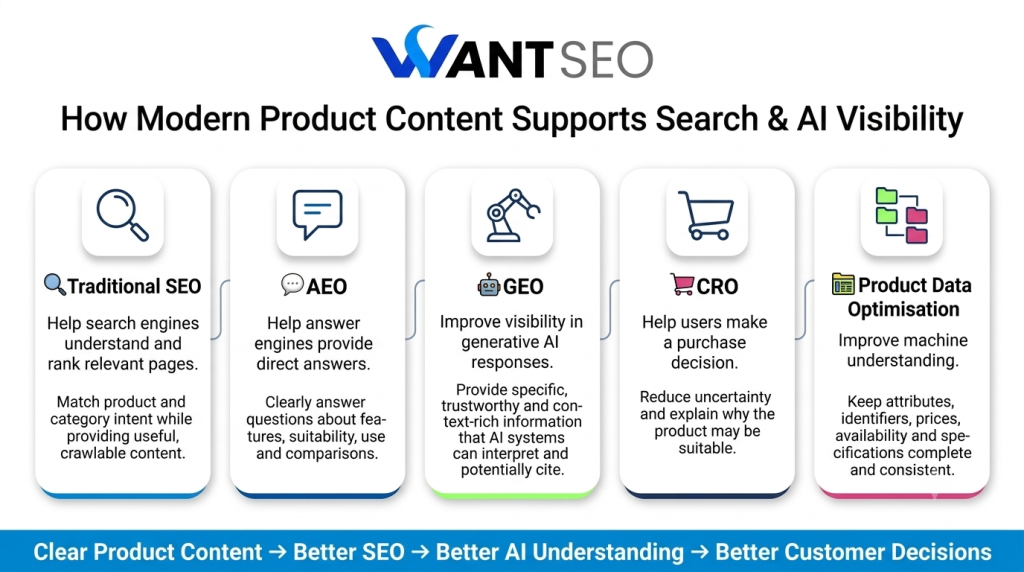
The important point is that these disciplines should not be treated as separate projects. A product description that is clear to a customer is often easier for a search engine and AI system to understand. A complete product data feed also helps shopping platforms and AI systems interpret the product more accurately. A strong product page, therefore, becomes part of a wider system rather than an isolated piece of copy.
1. Start With the Questions Customers Actually Ask
The first mistake many ecommerce brands make is starting with a keyword list. Keywords still matter, but product content should begin with the decision the customer is trying to make. Consider a product such as a standing desk. A traditional approach might focus on:
- standing desk
- adjustable standing desk
- electric standing desk
A more commercially useful approach asks:
- How tall is the desk?
- Is it suitable for someone over 6 feet tall?
- How much weight can it support?
- Is it stable at its highest setting?
- Is it suitable for working from home?
- How noisy is the motor?
- How quickly can it move between sitting and standing positions?
- Does it fit in a small home office?
- Is assembly difficult?
These questions provide much stronger inputs for product descriptions. The product page can then connect the product to the situations in which it is likely to be considered. This is particularly important for long-tail searches and conversational queries. AI systems are designed to interpret meaning and context. A product description that explains the relationship between a product feature and a real customer need gives an AI system more useful information to work with.
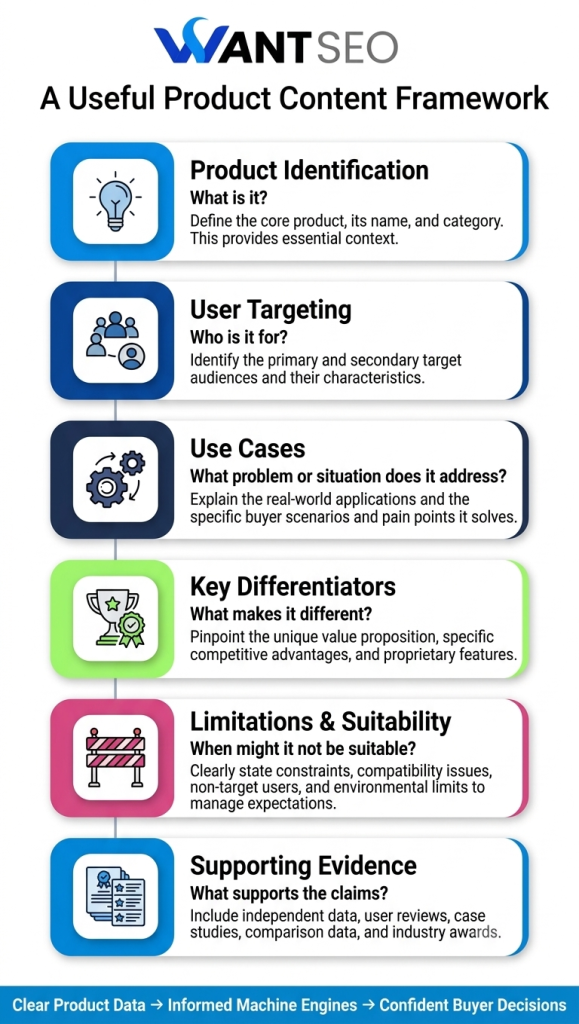
This structure creates better product descriptions because it moves beyond adjectives and focuses on decisions.
2. Make Product Facts Explicit
AI systems can interpret natural language, but they still need clear information. One of the most important principles for AI-friendly ecommerce content is to avoid making the reader infer important facts. For example, “Designed for everyday adventures” sounds appealing, but it is vague. A more useful version might be:
“The 20-litre backpack is designed for day trips, commuting and short hikes. It has a padded laptop compartment that fits laptops up to 15 inches and a water-resistant outer fabric for light rain.”
The second version contains information that can be interpreted more easily:
- product type
- capacity
- use cases
- laptop size
- material characteristic
- weather suitability
The key principle is simple: if an important product fact matters to the buying decision, state it directly. Do not assume that AI systems, search engines or customers will infer the answer from vague marketing language.
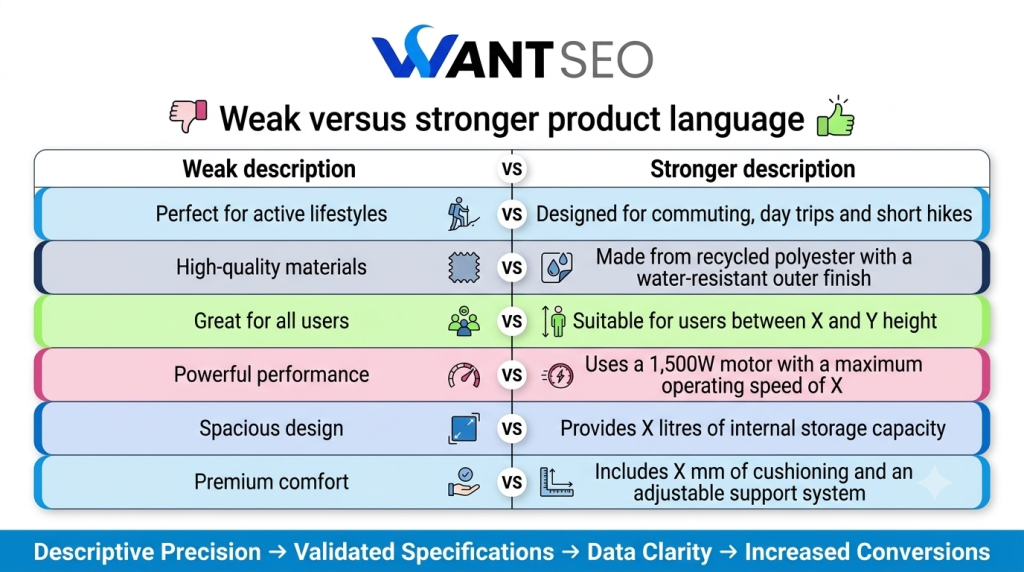
The stronger version is not necessarily more creative. It is more useful. That distinction matters.
3. Write Product Descriptions Around Product Attributes and Context
A product description should provide both what the product has and why that attribute matters. For example, “500ml stainless steel bottle” provides an attribute. A more useful version is:
“The 500ml stainless steel bottle is compact enough for commuting and everyday use while providing enough capacity for short trips, workouts and office use.”
The attribute is still present, but the context makes the information more useful. This is particularly important for ecommerce GEO because AI systems often need to match products to the specific constraints in a user’s question. A user may not ask “Which products have a 500ml capacity?”. They may ask, “What is a compact water bottle for commuting that I can carry in a small work bag?” The product page should make it possible to understand why the product might be relevant.
4. Use Specific Language Instead of Generic Marketing Claims
AI search does not need more generic ecommerce language. It needs better information. Words such as premium, innovative, high-quality, luxurious, advanced, revolutionary, perfect, and/or best-in-class may have a place in brand messaging, but they do not provide much useful product information on their own. The question is “What does this claim actually mean?” instead of “A premium travel bag for modern travellers.” Consider:
“This 40-litre travel bag is designed for short trips and weekend travel. It includes a separate shoe compartment, a padded laptop section for devices up to 16 inches and an airline-compatible carry-on format.”
This version gives the user and AI systems information they can use. The aim is not to remove persuasive language completely. It is to make persuasion more credible by connecting it to evidence.
5. Build a Clear Product Information Hierarchy
Many product pages contain all the required information, but the information is scattered. A user may need to navigate through product descriptions, technical specifications, image captions, tabs, accordions, FAQs, and downloadable PDFs to answer a simple question. This can create unnecessary friction. A better product information hierarchy usually presents the most important decision-making information early. A useful structure may include:
- Product summary: Explain what the product is and who it is for.
- Primary benefits: Explain the main reasons someone might consider it.
- Key specifications: Present measurable product facts.
- Use cases: Explain the situations where the product is suitable.
- Limitations and compatibility: Clarify where the product may not be suitable.
- FAQs: Answer common questions that may prevent a purchase. Reviews and supporting evidence. Provide customer experience and third-party validation.
The exact layout will vary by product category. The principle remains the same: important information should not be hidden behind unnecessary complexity. For AI search, this also creates a clearer information structure. For customers, it reduces the effort required to understand the product.
6. Use Declarative Sentences for Important Product Facts
One of the most useful approaches for Product Descriptions is to write key facts in direct sentences. For example, “The X backpack has a 25-litre capacity and is designed for daily commuting, short trips and light hiking.” This sentence contains product identity, capacity, and primary use cases.
Another example, “The X office chair supports users weighing up to X kg and includes adjustable lumbar support for users who spend extended periods working at a desk.” This connects product, specification, intended user, and use case.
The information is easy to understand without needing to combine several disconnected fragments. This is useful for humans and machine systems. A product page should not be written as if it were a database. However, important information should be stated with enough clarity that both a shopper and a machine can understand it without excessive interpretation.
7. Make Product Descriptions Complete, Not Merely Long
Longer is not automatically better. A 1,500-word product description can still be poor if it does not answer the questions that matter. A 200-word description can be highly useful if it clearly explains:
- what the product is
- who it is for
- what it does
- its important specifications
- how it is used
- what makes it different
- any relevant limitations
The right question is not “How many words should a product description have?” The better question is “What information does a customer need to make a confident decision?”
This is one of the areas where ecommerce SEO often becomes inefficient. Brands sometimes add more copy because they believe a longer page must be better for SEO. That can result in repetitive content that adds little value. Product Descriptions should be as detailed as the decision requires, not as long as possible.
8. Add FAQs Based on Real Product Uncertainty
FAQs can support both AEO and conversion because they address questions that may otherwise prevent a purchase. However, FAQs should not exist simply because every product page is expected to have them. The questions should reflect real uncertainty.
For example, a product page for a waterproof jacket might answer:
- Is the jacket suitable for heavy rain?
- Is it suitable for winter?
- Does it have taped seams?
- What temperatures is it designed for?
- How should it be washed?
- Does it fit true to size?
A product page for a laptop might answer:
- Is it suitable for gaming?
- How long does the battery last?
- Can the RAM be upgraded?
- Is it suitable for video editing?
- Does it support an external monitor?
These questions can also help identify gaps in the main description. If customers repeatedly ask a question, the answer may belong directly on the product page rather than only in an FAQ section.
9. Support Product Descriptions With Structured Data
Structured data helps search engines interpret the meaning of information on a page. For ecommerce product pages, relevant structured data may include information such as:
- product name
- brand
- description
- SKU
- GTIN
- image
- price
- currency
- availability
- reviews
- ratings
- variants
The important principle is consistency. If the visible page says one thing, the structured data says another, and the product feed contains a third version, the overall information ecosystem becomes less reliable. Product schema should support the page, not replace it. A product page should still contain clear, visible information that a customer can read. Structured data is best treated as a layer of machine-readable context that reinforces the visible content.
This is particularly important as ecommerce discovery becomes increasingly dependent on product data, feeds and AI systems that need to identify products and match them to user requirements. Current ecommerce guidance highlights the importance of complete product attributes, identifiers and structured data for AI shopping and product discovery.
10. Keep Product Information Consistent Across the Web
Your product page is only one source of information. AI systems may also encounter:
- retailer listings
- marketplaces
- review websites
- editorial publications
- social media
- forums
- comparison websites
- product feeds
- manufacturer pages
If your product has different specifications across these sources, the system has to determine which information is correct. This can create uncertainty. For example, your website says “1.2kg” and a retailer says “1.5kg” while the marketplace says “1.8kg” and a review says “approximately 1.3kg”. Here, the problem is not simply an SEO problem. It is a product information problem.
Consistent product information gives search engines and AI systems a clearer picture of the entity they are trying to understand. For larger ecommerce businesses, this is where product information management and feed governance can become important. The question becomes: Do we have one reliable source of truth for our product information? If not, improving the copy on one product page may not solve the wider problem.
11. Use Reviews as a Source of Real Product Language
Your customers often describe products in ways that your marketing team would not. They may explain:
- how they use the product
- what problem it solves
- what they like most
- what they expected
- who they think it is suitable for
- where it falls short
This makes reviews valuable for Product Descriptions. A product description written entirely by an internal team may describe the product using brand language. Customer reviews reveal the language of real use. This can help you identify recurring use cases, common questions, unexpected benefits, common objections, important limitations, and phrases customers use to describe the product.
The objective is not to copy reviews into the description. It is to use customer language to improve the accuracy and relevance of the product content. Reviews also provide external evidence that can support AI systems when evaluating products. Search Engine Land’s ecommerce AI guidance highlights the importance of product pages, reviews, retailer information and other external signals in the wider AI discovery ecosystem.
12. Do Not Treat AI Visibility as a Keyword Density Exercise
The keyword is important for any product or article. But repeatedly adding the phrase would not make the article more useful. The same principle applies to product pages. AI systems do not need a product page to repeat “best waterproof hiking jacket” twenty times. They need to understand:
- what the product is
- what it does
- who it is for
- how it compares
- what its limitations are
- what evidence supports the claims
Modern SEO is increasingly about building a coherent information system. That includes search intent, semantic relevance, structured data, product attributes, reviews, supporting content, brand authority, and technical accessibility. Keyword targeting remains part of the process; it is not the entire strategy.
13. Write for the Question Behind the Query
This is one of the most important principles for product content. For example, consider these queries: “best running shoes for flat feet”, “running shoes for flat feet under £150”, and “are these running shoes suitable for flat feet?” The product page should not simply repeat the phrase. It should explain the information that makes the product relevant. For example:
“These running shoes include a structured support system designed to provide additional stability for runners who require support during their stride. They are suitable for everyday road running and training, although runners with specific medical requirements should consider professional advice when choosing footwear.”
This provides product context, feature, intended benefit, use case, and appropriate qualification. The page is answering the decision rather than chasing the wording of the query. This approach is particularly useful for long-tail search, AEO and GEO because the questions users ask AI systems are often more specific than traditional keyword research suggests.
14. Build Product Pages That Can Be Cited in Isolation
An AI system may extract a small section of a page rather than use the entire page. This means each important section should be understandable on its own. For example, avoid writing “It is also available in this size”, “What is ‘it’?”, or “What size?”
A stronger version is “The X jacket is available in sizes S to XXL.” Similarly, this makes it ideal for travel. What makes it ideal? A clearer version is:
“The X backpack’s 20-litre capacity and padded laptop compartment make it suitable for daily commuting and short business trips.”
The information is more self-contained. This is useful for search engines, AI systems, screen readers, and users scanning the page. Clear writing is often the most practical form of technical optimisation.
15. Make Product Claims Verifiable
AI systems increasingly need to distinguish useful information from unsupported claims. That makes evidence more important. Consider “The most comfortable office chair on the market.” This is a difficult claim to verify. A more useful approach might be:
“The chair includes adjustable lumbar support, a seat depth adjustment and a reclining backrest designed to help users customise their sitting position.”
The second version explains the product. If you claim the longest battery life, fastest performance, most durable construction, best value, and number one choice, you should consider whether the claim can be supported. For ecommerce brands, the strongest product content often combines:
“Claim + Specific Evidence + Relevant Context“
For example: “The jacket is designed for wet-weather hiking, with a waterproof outer fabric rated to X and sealed seams to help reduce water penetration.” The information is more useful because it explains what the claim means.
16. Connect Product Pages to Supporting Content
A product page should not be expected to answer every possible question. Supporting content can provide the wider context that helps both users and AI systems understand the product category. For example:
Product page: Waterproof hiking jacket
Supporting content:
- How to choose a waterproof hiking jacket
- Waterproof versus water-resistant clothing
- What waterproof rating do you need for hiking?
- Best hiking jackets for wet UK weather
- How to layer clothing for outdoor hiking
This creates a wider topical system. The product page explains the specific product. The supporting content explains the category and decision. Together, they create a stronger information environment. This is where SEO, AEO and GEO begin to work together.
A user may discover the product through a traditional search result. An AI system may cite the guide when explaining the category. The product page may then become the source for specific product information. The objective is not to make every page do everything. It is to make the overall system useful.
17. Consider How Perplexity and Gemini May Differ
There is no single AI search algorithm. Perplexity, Gemini, Google AI search experiences and other AI systems may use different retrieval systems, indexes, data sources and ranking processes. Therefore, there is no universal formula that guarantees citation. Perplexity is designed around web search and source-backed answers, with citations forming an important part of its user experience. Gemini exists within Google’s wider ecosystem and can draw on different sources and search experiences depending on the product and context.
The practical implication is important: Do not build an ecommerce content strategy around one AI platform. Instead, build a product information system that is technically accessible, factually accurate, structured, complete, supported by evidence, and consistent across relevant sources. That gives the business a stronger foundation regardless of which AI interface a customer uses.
18. The Product Description Optimisation Framework
A practical framework for improving Product Descriptions is to review each product across six layers.
- Layer 1 – Product identity: Can a search engine or AI system clearly understand what the product is?
- Layer 2 – Attributes: Are the important specifications, dimensions, materials, compatibility details and identifiers available?
- Layer 3 – Use cases: Does the page explain when and why someone would use the product?
- Layer 4 – Decision support: Does it help a customer decide whether the product is suitable?
- Layer 5 – Evidence: Are important claims supported by specifications, reviews, testing or other credible information?
- Layer 6 – Technical accessibility: Can the content be crawled, rendered and interpreted reliably?
This framework is more useful than simply asking whether a page has enough keywords. It focuses on whether the page contains the information required to support a real decision.
19. Product Descriptions That AI Can Understand and Customers Can Trust
The best approach is not to write for AI instead of people. It is to remove unnecessary ambiguity. A strong product description should be:
- Specific: It uses measurable and meaningful details.
- Contextual: It explains when and why the product is useful.
- Complete: It covers the information needed for the decision.
- Consistent: It matches product data across important sources.
- Accessible: The content is available in a format that can be crawled and interpreted.
- Credible: Claims are supported by evidence.
- Readable: The language remains natural and useful for the customer.
This is the point where SEO, AEO and GEO overlap. A product page that communicates clearly with customers is often easier for search systems to understand. A product page that contains complete and consistent information is more useful across search and shopping ecosystems. A product page that explains its claims clearly gives AI systems better material to interpret and cite.
Why Perplexity and Gemini Treat Content Differently
Understanding how different answer engines extract web data is essential for structured copywriting. Perplexity operates primarily as a search-native answer engine, continuously querying live web indexes to retrieve facts, cross-reference data points, and credit original sources with explicit links. It prioritises direct statements, verifiable numbers, and logically organised content.
Google Gemini integrates deeply with Google’s main search index and Knowledge Graph. It relies heavily on structured entity data, content freshness, and semantic completeness across an entire web page. If your product descriptions use ambiguous descriptions or lack detailed specifications, Gemini may skip your inventory in favour of a competitor with clearer, better-structured data.
Common Product Description Mistakes That Reduce AI Visibility
The following problems are common across ecommerce websites.
- Writing descriptions that are too generic: If a description could be used for ten different products, it probably does not provide enough useful information.
- Hiding important facts: Customers should not need to search through multiple tabs to find critical information.
- Relying on images to communicate product attributes: Images are valuable, but important specifications should also be available as text.
- Using unsupported superlatives: Claims such as “the best” or “the most advanced” need evidence.
- Creating thin manufacturer copy: Copying the same description used across multiple retailers creates little unique value.
- Adding unnecessary words for SEO: More content does not automatically create more relevance.
- Ignoring product variants: Different sizes, colours, models and configurations may have different attributes.
- Allowing inconsistent product information: Conflicting information across the web creates uncertainty.
- Treating AI visibility as guaranteed: No ethical SEO, AEO or GEO strategy can guarantee that a particular platform will cite a particular page.
The more useful objective is to improve the quality and clarity of the information available to users and retrieval systems.
Product Descriptions and AI Search: A Practical Checklist
Before publishing or updating a product page, ask:
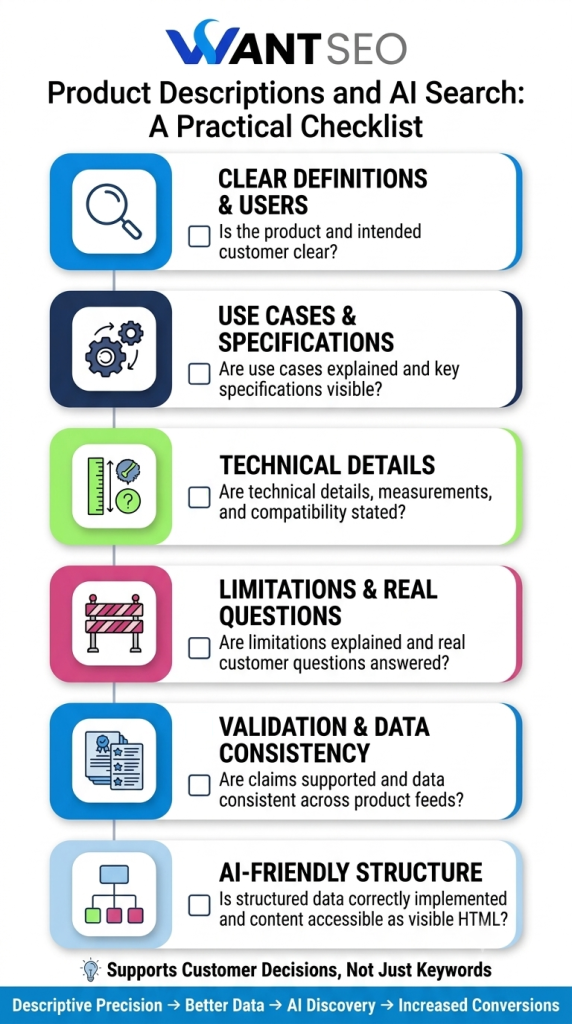
If the answer to these questions is yes, the product page is likely doing more than simply targeting a keyword. It’s supporting the decision a customer is trying to make.
Conclusion: Better Product Descriptions Start With Better Decisions
The future of e-commerce discovery isn’t about publishing more product descriptions; it is about providing better product context. As shoppers rely on conversational AI to compare options, your pages must deliver fast clarity, precise specs, structured data, and authentic trust to help both humans and machine algorithms make confident decisions. This intersection is where traditional search, AEO, and GEO converge. At Want SEO, we help brands ask the right question: What exact information does a buyer or AI engine need to make a decision about this product? Tackling this directly resolves thin data, inconsistent specs, and missed citations.
If your inventory is being ignored in the changing search landscape, Want SEO provides the clarity and strategy needed to build true commercial visibility. Whether you need a top local SEO company, the best local SEO company in UK, or the best search engine optimisation expert, choose a partner focused on real impact rather than empty promises. Contact Want SEO today to optimise your catalogue for modern search.
Start with clarity. Prioritise what matters. Build product visibility that supports the wider commercial decision.
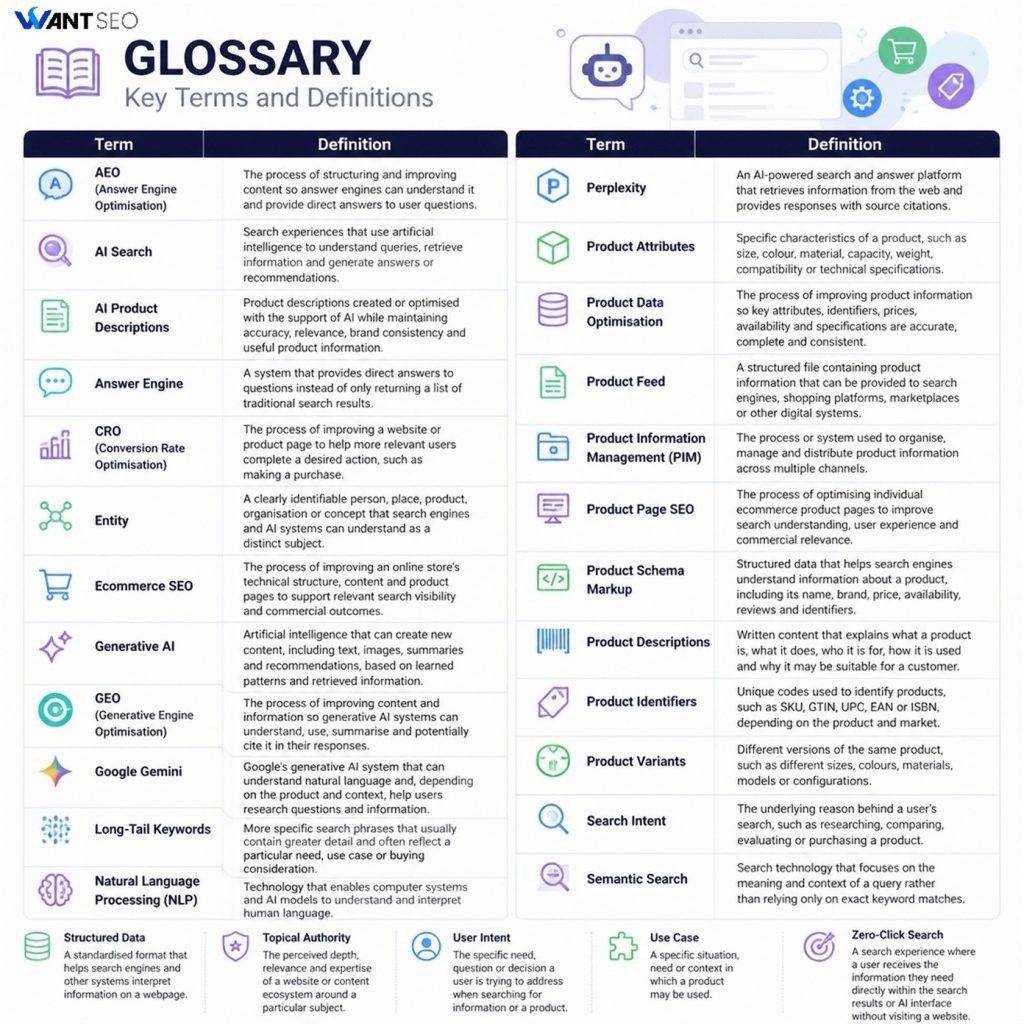
Product Descriptions and AI Search Glossary
FAQs
1. How do you write Product Descriptions for AI search?
Write clear, specific and context-rich descriptions that explain what the product is, who it is for, how it is used and which attributes matter. Support the visible content with accurate product data and structured data.
2. Can Perplexity cite product pages?
Yes. Perplexity provides source citations in its answers, and product pages can be used as sources when they contain relevant and useful information. However, citation is not guaranteed and depends on the query, retrieval process, source quality and competing information.
3. How can Product Descriptions help with GEO?
Product Descriptions can support GEO by providing clear, specific information that AI systems can interpret when researching product-related questions. The strongest approach combines product content with structured data, reviews, authoritative external sources and consistent product information.
4. Should Product Descriptions include keywords?
Yes, but keywords should reflect genuine product relevance and customer intent. Keyword repetition should not replace clear explanations of product attributes, use cases and buying considerations.
5. Do I need separate Product Descriptions for Google, Perplexity and Gemini?
Usually, no. Creating completely separate versions for each platform can create unnecessary complexity. A better approach is to create accurate, accessible and well-structured product content that can support multiple search and AI systems.
6. How do AI search engines pick which products to cite?
AI platforms analyse structured schema data, direct factual answers, named entity density, and third-party review consensus to select the most reliable source for a query.
7. Should I change my existing product descriptions for GEO?
Yes, updating legacy content to include direct answer openings, concise specification tables, and clean JSON-LD markup drastically improves AI discoverability without harming traditional organic rankings.
8. Does keyword density still matter for modern e-commerce stores?
Keyword context remains relevant, but overusing keywords is ineffective; generative systems prioritise semantic clarity, authoritative facts, and structured formatting over exact keyword repetition.
9. How quickly can an e-commerce site see AI citations after updating copy?
Search-native tools like Perplexity can index and cite updated pages within days of recrawling, whereas training-based models incorporate updates during scheduled index refreshes.
10. Why are structured FAQs important on product pages?
Structured FAQs directly mirror conversational user queries in tools like Gemini and ChatGPT, making it simple for AI engines to extract and credit your exact answers.