
How Can Product Description Optimisation Boost Your Sales?
If your ecommerce store attracts traffic but struggles to convert visitors into customers, your product descriptions could be the missing link. Product Description Optimisation helps improve both search visibility and conversions by creating content that answers customer questions, builds trust and encourages purchasing decisions. Modern search extends beyond traditional search engines. AI-powered search, answer engines and generative AI platforms increasingly summarise information directly from websites. As a result, product descriptions should support not only SEO but also Answer Engine Optimisation (AEO), Generative Engine Optimisation (GEO) and AI search visibility.
Well-optimised product descriptions do more than improve rankings. They help search engines and AI systems understand your products while giving shoppers the confidence to buy. By focusing on benefits, answering common questions and matching buyer intent, businesses can improve both visibility and sales.
At Want SEO, our experts have researched modern search behaviour, analysed ecommerce trends and worked with businesses to understand how Product Description Optimisation drives stronger commercial outcomes. This guide combines SEO, conversion optimisation, AI Search and content strategy to help ecommerce businesses increase sales and stay competitive in the evolving search landscape.
Key Takeaways
- Product Description Optimisation improves both search visibility and conversion rates by creating content that serves customers and search engines.
- Modern product pages should be optimised for SEO, AI Search, AEO and GEO, not just traditional Google rankings.
- Well-written descriptions reduce customer uncertainty, improve trust and increase purchase confidence.
- Combining strategic keyword research, structured content and customer-focused messaging creates product pages that perform across multiple search experiences.
What Is Product Description Optimisation?
Product Description Optimisation is the process of improving product page content so it communicates value clearly while increasing visibility in search engines and AI-powered search platforms. Rather than stuffing keywords into short paragraphs, modern optimisation focuses on understanding customer intent. Every product description should answer questions buyers naturally ask before purchasing while helping search engines understand exactly what the product offers.
Effective optimisation considers several objectives simultaneously:
- Improving search engine rankings
- Increasing ecommerce conversion rates
- Supporting AI-generated answers
- Enhancing user experience
- Reducing product returns through clearer information
- Building trust and authority
Today’s product descriptions have become commercial assets rather than simple product summaries.
Why Product Description Optimisation Matters More Than Ever
Consumer behaviour has changed significantly over the past few years. Customers rarely purchase after reading only a product title. Instead, they compare multiple websites, consult AI assistants, read reviews and ask conversational questions before making buying decisions. For example, instead of searching “running shoes”, a customer may now ask “What are the best waterproof running shoes for beginners under £150?”.
Large Language Models and AI search engines generate answers using trusted sources across the web. Businesses that produce comprehensive, well-structured product descriptions are far more likely to become part of those AI-generated recommendations.
This makes Product Description Optimisation an important part of both SEO and modern digital commerce.
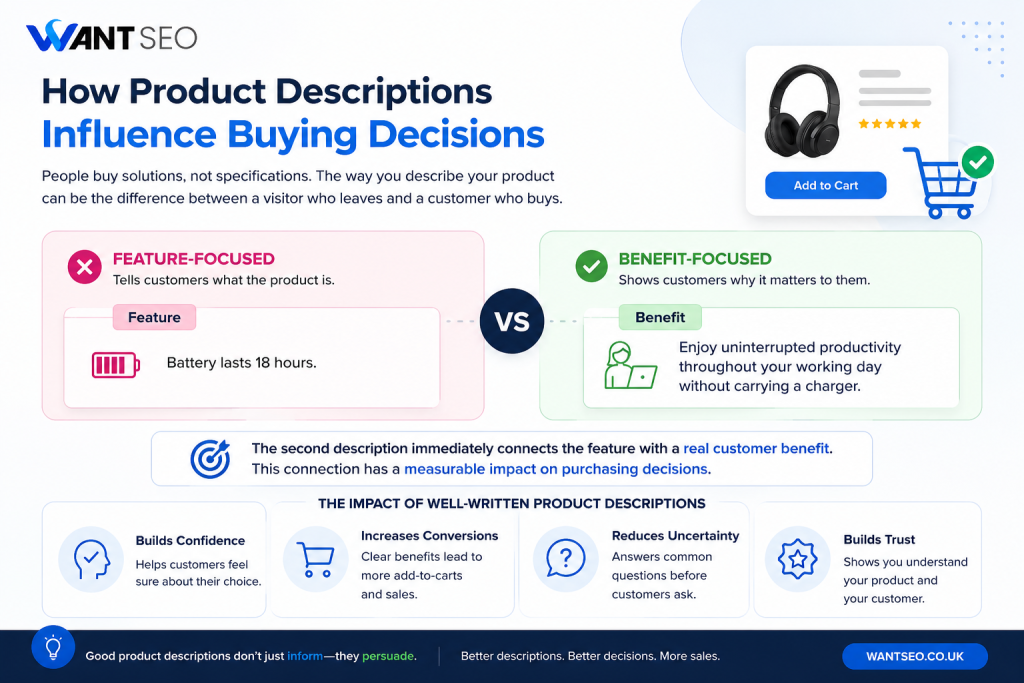
How Product Descriptions Influence Buying Decisions
The Relationship Between Product Description Optimisation and SEO
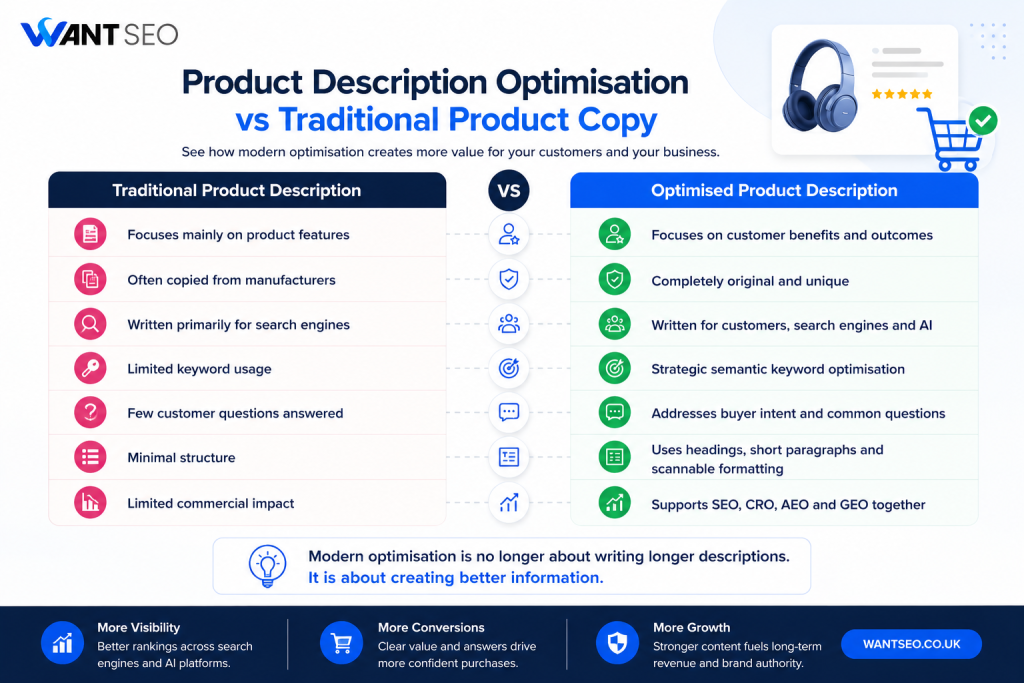
Search engines rely on page content to understand products. When descriptions are duplicated from manufacturers or copied across multiple websites, search engines struggle to identify unique value. Optimised descriptions provide:
- Original content
- Relevant keywords
- Semantic relationships
- Clear headings
- Logical page structure
- Better crawlability
This improves indexing while helping pages compete for valuable commercial search queries. Rather than targeting only one keyword, modern ecommerce SEO uses topical relevance. For example, a product page for wireless headphones may naturally include phrases such as Bluetooth headphones, noise-cancelling headphones, wireless audio, long battery life, travel headphones, and premium sound quality. This creates richer semantic signals for search engines.
Why Duplicate Product Descriptions Hurt Rankings
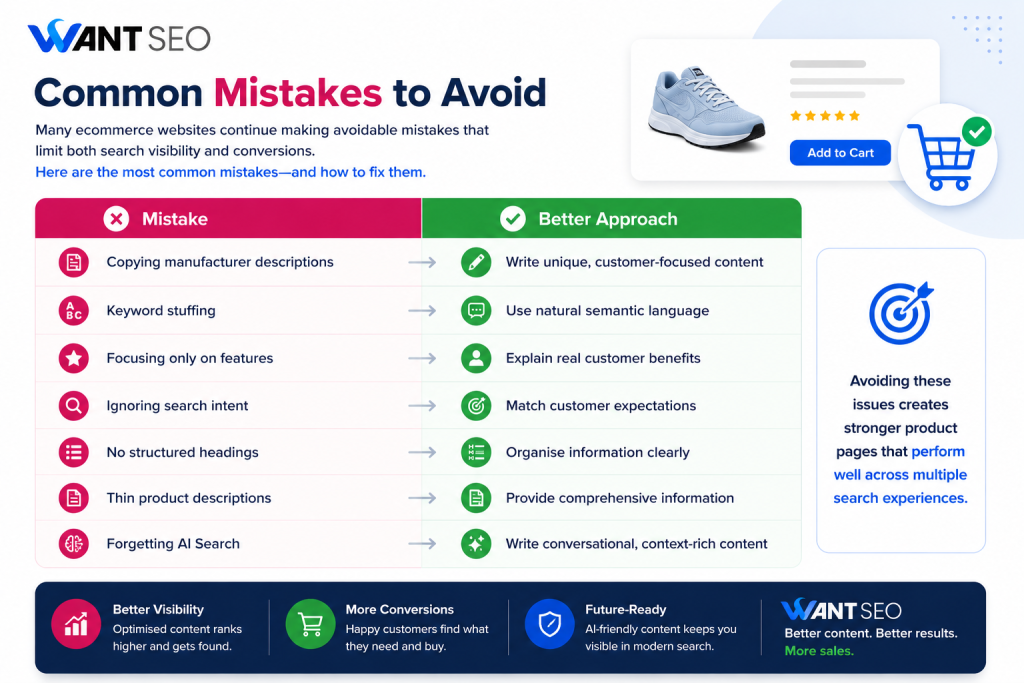
One of the biggest mistakes ecommerce businesses make is copying manufacturer descriptions. If hundreds of retailers publish identical content, Google has little reason to prioritise one page over another. Duplicate content also limits opportunities to target additional keywords and answer customer questions. Instead, every product description should be written specifically for your audience.
Unique content creates opportunities to explain benefits, demonstrate expertise, build authority, improve AI visibility, and increase conversions. Original content is becoming increasingly valuable as AI search platforms reward trustworthy and informative sources.
Product Description Optimisation for AI Search
Search is becoming increasingly conversational. AI assistants now generate complete answers instead of presenting only lists of websites. To improve AI visibility, product descriptions should include natural language, complete explanations, context, common questions, product comparisons, clear benefits, and supporting specifications. Large Language Models understand relationships between ideas rather than isolated keywords. This means writing naturally has become more valuable than excessive keyword repetition.
How AEO Changes Product Content
Answer Engine Optimisation (AEO) focuses on making information easier for AI systems and answer engines to extract. Product descriptions should directly answer questions such as:
- Who is this product designed for?
- What problem does it solve?
- What makes it different?
- How should it be used?
- What are the key specifications?
- Is it suitable for beginners?
- What materials are used?
Providing concise answers within product content increases the likelihood of appearing in featured answers and AI summaries.
Why GEO Matters for Ecommerce
Generative Engine Optimisation (GEO) expands beyond search rankings. Generative AI combines information from multiple trusted sources before producing responses. Content that demonstrates expertise, clarity and credibility is more likely to be referenced by AI systems. Strong GEO practices include clear factual statements, supporting evidence, helpful explanations, consistent terminology, and comprehensive product information. Businesses investing in GEO today are preparing their content for how customers will search tomorrow.
Product Description Optimisation vs Traditional Product Copy
Understanding Search Intent Before Writing
Every product page should satisfy a specific type of search intent. Someone searching “buy ergonomic office chair” expects very different information from someone searching “best ergonomic office chair for back pain”. The first query demonstrates transactional intent. The second indicates research before purchasing.
Understanding these differences allows businesses to produce descriptions that match customer expectations while naturally improving SEO performance. Intent-led writing also supports AI search because conversational systems attempt to answer complete customer questions rather than isolated keywords.
Essential Elements of High-Converting Product Descriptions
Successful ecommerce brands rarely rely on generic descriptions. Instead, they combine several elements that encourage purchasing decisions. A strong product description usually includes:
- A compelling opening that immediately explains the product’s primary value.
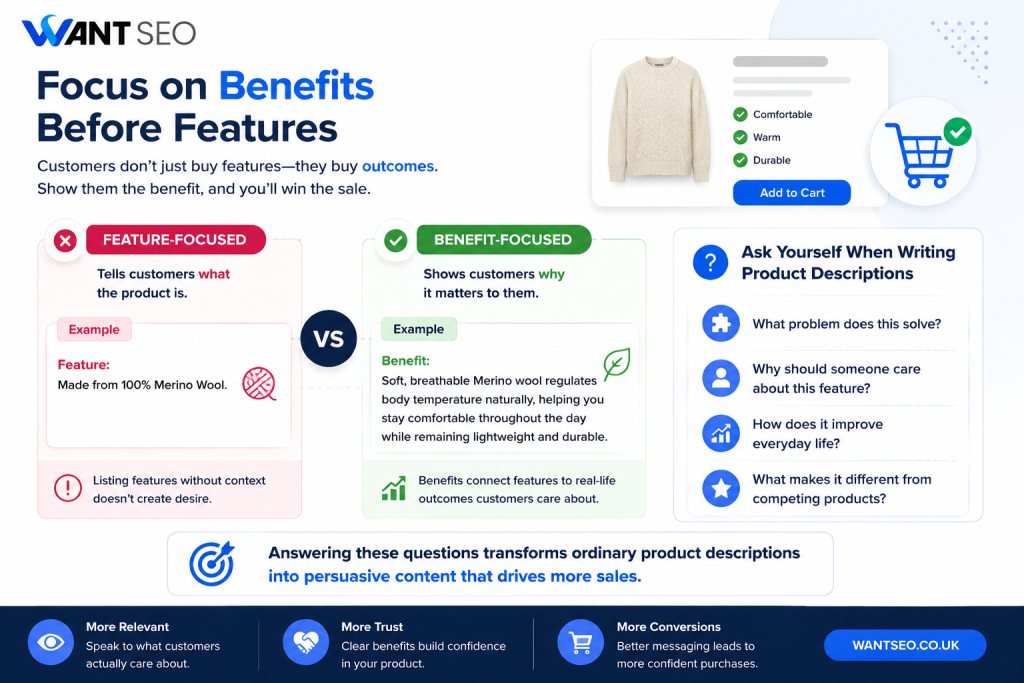
- Clear explanations of benefits rather than simply listing specifications.
- Practical examples showing how customers use the product.
- Natural keyword integration supporting Product Description Optimisation.
- Trust signals including guarantees, certifications or compatibility where relevant.
- Information organised into clear sections that are easy to scan.
- Language that reflects how customers naturally search and ask questions.
These elements improve readability while helping search engines and AI systems understand the page.
Keyword Research for Product Description Optimisation
Successful Product Description Optimisation begins long before writing. Keyword research helps identify how potential customers search during different stages of their buying journey. Rather than focusing on one primary keyword, modern ecommerce SEO builds topical relevance using related search terms. For example, if you sell standing desks, supporting keywords may include adjustable standing desk, height adjustable desk, ergonomic office desk, home office furniture, sit stand desk, office workstation, standing desk benefits, and desk for remote working.
Using related keywords naturally throughout the page improves semantic relevance while avoiding keyword stuffing. Modern AI search also benefits from descriptive, context-rich language because Large Language Models understand relationships between concepts instead of relying only on exact keyword matches.
How to Write Product Descriptions That Increase Sales
Writing effective product descriptions is about much more than adding keywords. Every sentence should move the customer closer to making a confident purchasing decision. The best ecommerce brands understand that product descriptions are sales tools first and SEO assets second. A well-optimised product description should immediately explain what the product is, who it is for and why it is worth buying. Instead of overwhelming shoppers with technical information, guide them through the value the product offers.
An effective structure often includes:
- A compelling introduction explaining the product’s purpose.
- The primary benefits for the customer.
- Key features supported by practical explanations.
- Specifications presented clearly.
- Common questions answered naturally.
- A strong call to action encouraging purchase.
This approach improves readability for users while making the page easier for search engines and AI systems to understand.
Focus on Benefits Before Features
Optimise Product Descriptions for AI Without Losing Authenticity
Artificial intelligence tools can help generate first drafts, but publishing AI-generated content without review often results in generic copy that fails to build trust. Instead, use AI to support your writing process by brainstorming product benefits, creating initial content structures, identifying related keywords, suggesting frequently asked questions, and improving readability.
Human expertise should always refine the final content by adding product knowledge, customer insights and brand personality. This combination supports product description optimisation while ensuring originality and credibility.
Use Semantic SEO Instead of Keyword Stuffing
Search engines understand topics much better than they once did. Rather than repeating the exact phrase product description optimisation excessively, include related terms naturally throughout your content.
Examples include ecommerce SEO, product page optimisation, conversion rate optimisation, product page SEO, buyer intent, SEO copywriting, ecommerce content strategy, online store optimisation, semantic SEO, AI Search, Generative AI, and conversational search.
These supporting keywords help search engines understand the wider topic while improving visibility across multiple related searches.
Structure Product Descriptions for Better Readability
Customers rarely read every word on a page; instead, they scan, which makes formatting just as important as the content itself. You can significantly improve readability by using short paragraphs, clear subheadings, ample white space, bullet points where appropriate, and tables for technical specifications. A well-structured page not only increases engagement and reduces bounce rates, but it also makes key information far easier for AI systems to extract into clear summaries.
The Role of Schema Markup in Product Description Optimisation
Structured data provides crucial additional context that helps search engines fully understand your product pages. Product schema can encompass details such as the product name, brand, price, availability, reviews, ratings, images, SKU, and GTIN. Although schema does not directly boost search rankings on its own, it increases eligibility for eye-catching rich search results and provides valuable signals for modern, AI-powered search experiences. When combined with strong written content, structured data strengthens your overall product description optimisation considerably.
Build Trust Through Helpful Content
Trust plays a significant role in e-commerce conversions, as customers naturally want reassurance before spending their money. Product descriptions should proactively reduce uncertainty by addressing customer concerns openly with helpful information, including delivery expectations, product dimensions, compatibility, warranty details, materials, care instructions, sustainability information, and clear return policies. Ultimately, the more uncertainty you remove for the buyer, the easier their purchasing decisions become.
Support Product Pages with Internal Linking
Product pages should never exist in isolation. Internal links help users continue their buying journey while strengthening your website’s topical authority. Useful internal links may point to:
- Buying guides.
- Category pages.
- Comparison articles.
- Frequently Asked Questions.
- Related accessories.
- Complementary products.
- Installation guides.
For example, if you sell coffee machines, linking to a guide comparing different brewing methods adds valuable context for both users and search engines.
Product Description Optimisation and Conversion Rate Optimisation (CRO)
SEO brings visitors to your website. Conversion Rate Optimisation helps those visitors become customers. The two disciplines should work together rather than independently. Optimised product descriptions improve conversions by building trust, reducing uncertainty, answering objections, highlighting value, explaining benefits, and encouraging action. Small improvements across hundreds of product pages can generate significant revenue growth over time.
Common Mistakes to Avoid
Measuring Success
Improving product description optimisation is not simply about search rankings; performance should be monitored using a balanced combination of commercial and behavioural metrics. Useful metrics include organic traffic, product page conversion rate, average order value, revenue per visitor, click-through rate, time on page, bounce rate, add-to-cart rate, AI search visibility, featured snippets, rich results, and returning customers. Ultimately, focusing on these comprehensive metrics provides a much clearer picture of overall business impact than tracking rankings alone.
Future Trends in Product Description Optimisation
The future of e-commerce content will be shaped by artificial intelligence, conversational search, and highly personalised shopping experiences. Businesses should prepare for AI-generated product recommendations, voice commerce, visual search, personalised shopping assistants, conversational e-commerce, improved semantic search, real-time product comparisons, and more sophisticated answer engines. As search technology evolves, product descriptions will become increasingly important as trusted sources of structured, factual information, meaning businesses that invest in quality content today will be far better positioned for long-term success.
Why Product Description Optimisation Should Be Part of Your Wider SEO Strategy
Product descriptions should not be treated as isolated pieces of content. They should support a broader ecommerce strategy that combines technical SEO, content marketing, CRO, structured data, AI Search optimisation and customer experience. When every product page contributes to topical authority, your website becomes a stronger source of information for Google, Bing, ChatGPT, Gemini, Perplexity and other AI-powered search platforms. This integrated approach creates long-term commercial value rather than chasing short-term ranking improvements.
Businesses looking for a top local SEO company, the best local SEO company in UK, or the best search engine optimization expert can contact Want SEO today. We help you evaluate more than rankings alone. We enable you to look for strategic thinking, commercial understanding and an ability to optimise content for modern search experiences. Product description optimisation is just one part of a wider growth strategy that aligns SEO, CRO, AEO and GEO to help businesses make better decisions and achieve sustainable results.
Conclusion
Product Description Optimisation is now a strategic growth driver for e-commerce, far beyond standard keyword insertion or length. Modern product pages must clearly communicate value, answer questions, drive conversions, and deliver content that search engines and AI systems can seamlessly process. By integrating SEO, CRO, AI Search, Answer Engine Optimisation (AEO), and Generative Engine Optimisation (GEO), businesses can boost visibility and build lasting authority. As AI-powered search reshapes product discovery, high-quality, original descriptions offer a distinct competitive advantage.
At Want SEO, our refined strategies help e-commerce brands make data-backed growth decisions focused on real commercial outcomes over vanity metrics. Contact Want SEO today to future-proof your content with smarter Product Description Optimisation and AI-ready strategy.
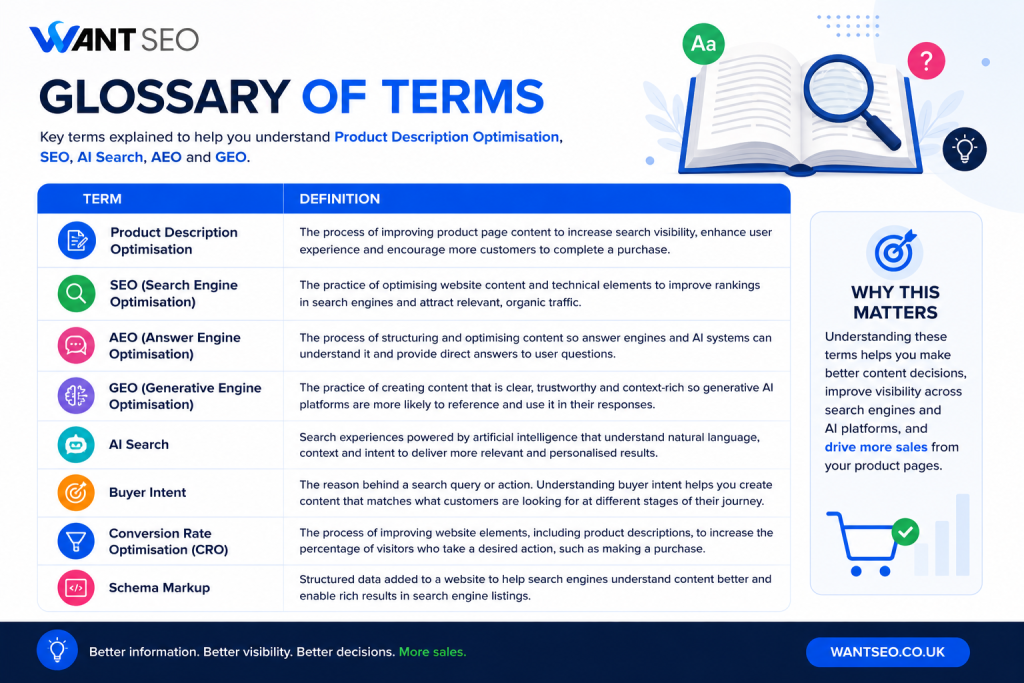
Glossary of Terms
FAQs
1. What is Product Description Optimisation?
Product Description Optimisation is the process of improving product page content to increase search visibility, enhance user experience and encourage more customers to complete a purchase. It combines SEO, conversion optimisation and modern AI search principles.
2. Does Product Description Optimisation improve SEO?
Yes. Unique, informative and well-structured product descriptions help search engines understand your products, target relevant keywords and improve visibility for commercial search queries while also supporting AI-powered search results.
3. How long should a product description be?
There is no fixed word count. The ideal length depends on the product’s complexity, but descriptions should include enough detail to answer customer questions, explain benefits and provide useful context without unnecessary filler.
4. Can AI write product descriptions?
AI can create useful first drafts and generate ideas, but human review is essential. Product descriptions should reflect your brand, demonstrate expertise and provide accurate information that builds customer trust.
5. Why are AEO and GEO important for ecommerce?
Answer Engine Optimisation (AEO) and Generative Engine Optimisation (GEO) help product content appear in AI-generated responses, conversational search and answer engines. As more people use AI to research products, these strategies improve visibility beyond traditional search engines.