

What Is AI SEO and How to Optimise for AI Search Results?
AI SEO is the process of improving a website so its content can be discovered, understood, selected and referenced across AI-powered search experiences such as Google AI Overviews, Google AI Mode, ChatGPT, Gemini and Perplexity, while still performing well in traditional search. The most important point is that AI SEO is not a replacement for SEO. Google’s latest guidance makes this clear: AI Overviews and AI Mode are built on Google’s existing Search ranking and quality systems, with techniques such as retrieval-augmented generation and query fan-out used to retrieve and assemble relevant information. There is no separate “AI SEO algorithm” or special markup that guarantees inclusion.
So, how do you optimise for AI search results? Create genuinely useful, non-commodity content, strengthen the technical foundations that allow search engines to access it, demonstrate first-hand expertise, structure information clearly, build authority around important topics and measure how your brand appears in AI search. That is the practical definition of AI SEO in 2026.
This guide, researched and worked out by the Want SEO team, brings together Google’s latest guidance with current developments in AI search, AEO and GEO. It focuses on what is actually worth doing, rather than the growing list of AI SEO “hacks” that create more activity than value.
Key takeaways
- AI SEO builds on traditional SEO rather than replacing it.
- Useful, original and experience-led content is more valuable than content created at scale.
- Clear site structure, crawlability, internal linking and accurate information remain essential.
- AEO and GEO should support SEO as part of one wider search strategy.
- There is no guaranteed method for getting a website cited by AI search engines.
- Focus on commercially important topics rather than chasing every possible AI query.
What is AI SEO?
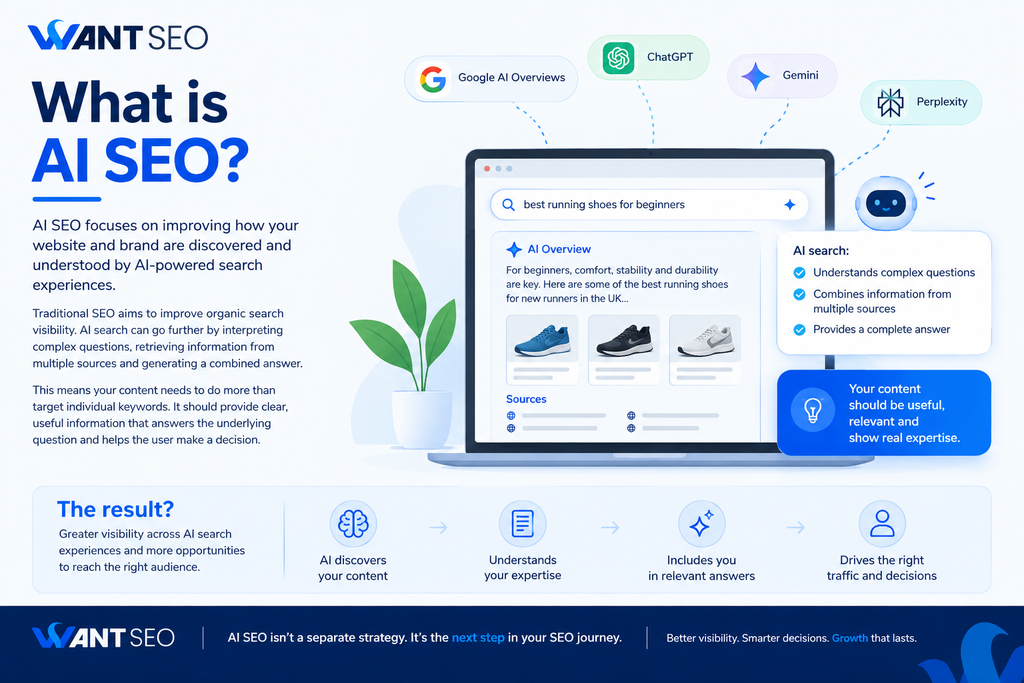
AI SEO focuses on improving how your website and brand are discovered and understood by AI-powered search experiences. Traditional SEO aims to improve organic search visibility. AI search can go further by interpreting complex questions, retrieving information from multiple sources and generating a combined answer. This means your content needs to do more than target individual keywords. It should provide clear, useful information that answers the underlying question and helps the user make a decision.
How does AI search work?
AI-powered search can interpret a user’s question, explore related searches and retrieve information from relevant websites before generating an answer. For example, someone might search:
“What are the best running shoes for beginners in the UK?”
Their next question could be about price, durability, sizing or suitability for different types of running. This makes topical depth increasingly important. Rather than creating separate pages for every variation, build useful resources that cover the important aspects of a subject.
How to optimise for AI search results
Optimising for AI search results starts with the same fundamentals as good SEO, but with greater focus on clarity, usefulness and context. The aim is to make your content easy for AI systems to discover, understand and confidently use when answering relevant queries.
The following areas are the most practical places to focus your efforts.
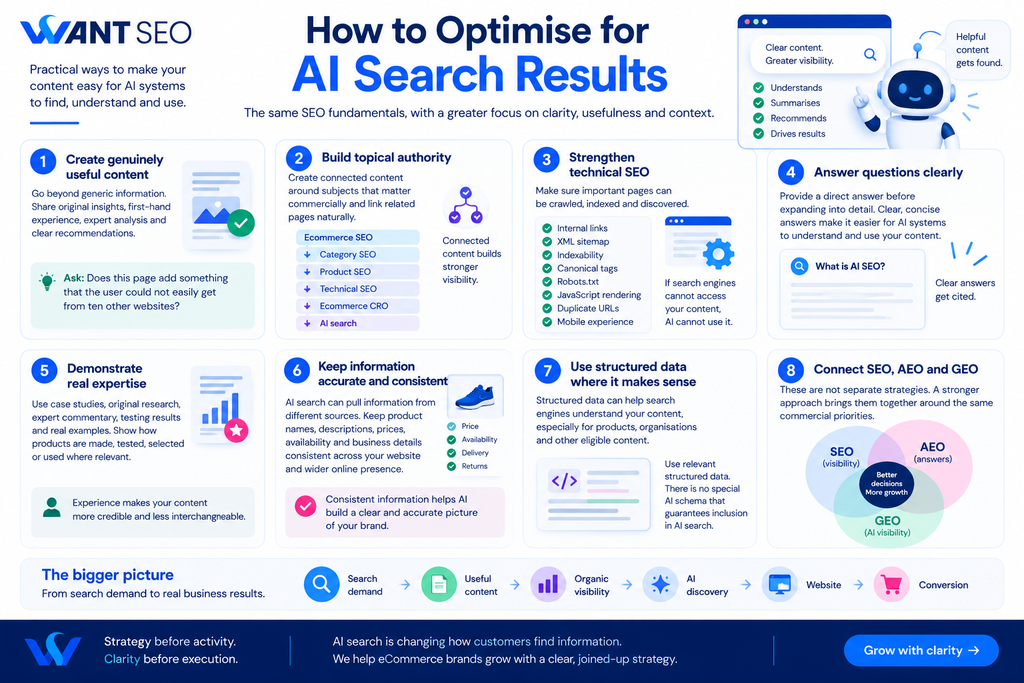
1. Create genuinely useful content
Do not create content simply because a keyword has search volume. AI systems can easily reproduce generic information. Your advantage comes from providing something more useful, such as original research, first-hand experience, expert analysis, real examples or clear recommendations. Ask:
Does this page add something that the user could not easily get from ten other websites?
If the answer is no, improving the content may be more valuable than publishing another article.
2. Build topical authority
Create connected content around subjects that matter commercially. For example, an ecommerce business might build depth around:
Ecommerce SEO → Category SEO → Product SEO → Technical SEO → Ecommerce CRO → AI search
Link these resources naturally so users and search engines can understand how they relate.
3. Strengthen technical SEO
AI search still depends on accessible content. Make sure important pages can be crawled, indexed and discovered. Review your:
- Internal links
- XML sitemap
- Canonicals
- Robots.txt
- Indexability
- JavaScript rendering
- Duplicate URLs
- Mobile experience
There is little value in optimising content for AI search if search engines cannot access the page properly.
4. Answer questions clearly
This is where AEO, or Answer Engine Optimisation, becomes useful. Answer important questions directly before expanding into supporting detail. For example:
What is AI SEO?
Start with a concise definition, then explain how it works, why it matters and how businesses can apply it. Clear answers make content easier for both people and search systems to understand.
5. Demonstrate real expertise
Experience is difficult to replicate. Use case studies, original research, expert commentary, testing results, examples and genuine insights wherever possible. For businesses, this can also mean demonstrating how products are made, tested, selected or used. The objective is to make your content less interchangeable with everything else online.
6. Keep information accurate and consistent
AI search can draw information from different parts of your digital presence. For ecommerce businesses, keep product names, descriptions, prices, availability, specifications, delivery, and returns information accurate. For local businesses, make sure business details, locations, and services are consistent. Conflicting information makes it harder to build a clear picture of your business.
7. Use structured data where it makes sense
Structured data can help search engines understand specific types of information, particularly for products, organisations and other eligible content. However, there is no special AI schema that guarantees inclusion in AI search. Use structured data where it accurately represents the visible content on the page. Do not add it simply because you believe an AI system requires it.
8. Connect SEO, AEO and GEO
SEO focuses on organic search visibility. AEO focuses on providing clear answers to questions. GEO, or Generative Engine Optimisation, focuses on improving visibility and representation within generative AI experiences. These should not become three separate strategies. A stronger approach connects them around the same commercial priorities.
Search demand → useful content → organic visibility → AI discovery → website → conversion
What AI SEO tactics should you avoid?
AI SEO has created plenty of tactics that sound sophisticated but often distract from the fundamentals.
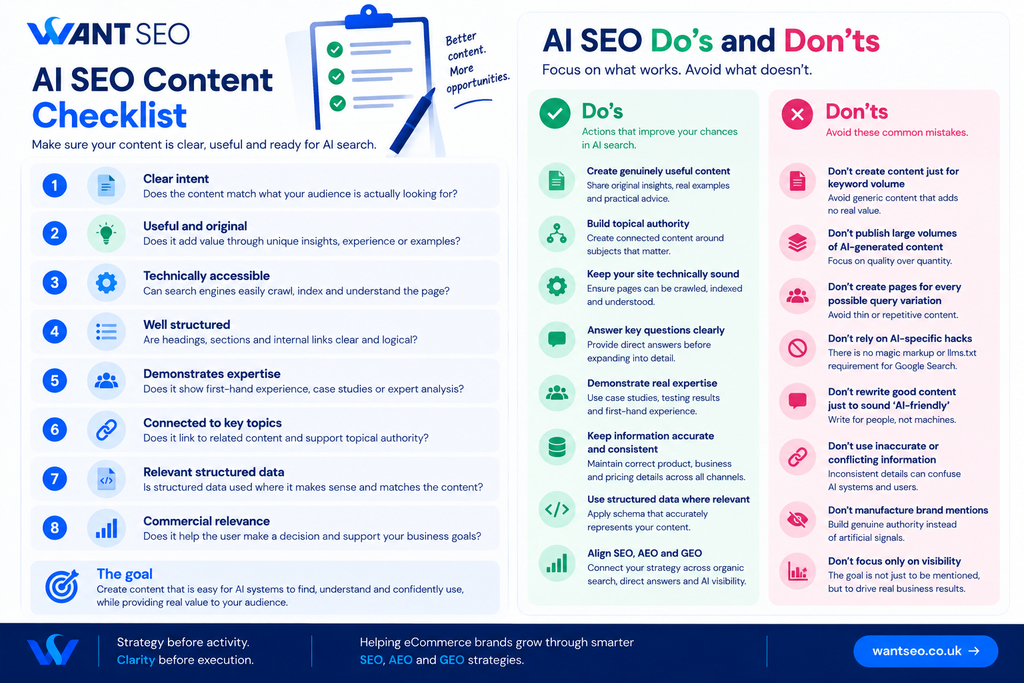
- Do not create hundreds of pages for every possible AI query.
- Do not publish generic AI-generated content at scale.
- Do not manufacture brand mentions.
- Do not rewrite good content simply to make it sound “AI-friendly”.
- Do not rely on llms.txt or supposed AI-specific hacks as a substitute for proper SEO.
- Do not create unnecessary content simply to increase the number of pages on your website.
The better question is always: What information would genuinely help our customer make a better decision?
AI SEO for ecommerce
AI search is particularly relevant to ecommerce because customers increasingly research products through conversational search. A customer might ask:
“What are the best waterproof walking boots for UK winters?”
They may then ask about price, sizing, durability, materials or where to buy them. Your product and category content should therefore provide more than keyword-focused descriptions. Useful product information, reviews, specifications, imagery, comparisons, FAQs, availability and accurate commercial details all contribute to a stronger search experience. This is where SEO, GEO, AEO and CRO increasingly overlap.
Being discovered is useful. Being represented accurately is better. Converting that attention into a commercial outcome is the real objective.
How Want SEO can help with AI Search Optimisation
At Want SEO, we do not treat AI SEO as another checklist of technical tasks.
We start by identifying where AI search could actually affect your business. That means understanding your most valuable search topics, competitors, content gaps, technical limitations and opportunities across SEO, AEO and GEO. We then prioritise the work that has the strongest commercial case. That could mean improving existing content rather than creating more, fixing technical barriers, strengthening topical authority, improving product information or connecting organic search with CRO.
There are no guarantees about which pages an AI system will cite. What you can control is whether your website provides useful, credible and accessible information. At Want SEO, we help businesses make better decisions about AI search, without adding unnecessary complexity or activity.
Conclusion
AI SEO is not about gaming AI search engines. It is about becoming a better source of information. The fundamentals remain straightforward: create useful content, demonstrate genuine expertise, maintain strong technical SEO, organise information clearly and build authority around the topics that matter to your customers. AEO and GEO can strengthen this approach, but they should support your wider SEO strategy rather than operate as disconnected projects.
For businesses preparing for the next stage of search, the priority should not be producing more content or chasing every new AI tactic. It should be understanding where your customers are searching, what information they need and where your brand can provide the most useful answer. That is where Want SEO can help.
Talk with our experts at Want SEO today and know about building a practical AI search optimisation strategy focused on visibility, clarity and commercial value.
FAQs
1. Is AI SEO different from traditional SEO?
AI SEO builds on traditional SEO. The main difference is that content increasingly needs to be useful and understandable across both traditional search results and AI-generated search experiences.
2. How can I get my website into AI search results?
There is no guaranteed method. Focus on crawlable technical foundations, useful original content, clear answers, topical authority and accurate information across your website.
3. What is the difference between GEO and AI SEO?
GEO focuses specifically on visibility within generative AI experiences. AI SEO is a broader approach that combines these considerations with traditional SEO, content and technical optimisation.
4. Does AI-generated content hurt SEO?
Not automatically. The important issue is whether the content provides genuine value. Low-quality, repetitive or mass-produced content created primarily to manipulate search visibility can create problems.
5. Does llms.txt improve AI SEO?
It should not be treated as a core Google SEO requirement. Strong technical SEO, useful content and clear information are more important priorities.
6. Will SEO still matter with AI search?
Yes. AI search still relies heavily on search indexes, content quality and established search systems. SEO remains the foundation, while AEO and GEO extend the strategy into newer search experiences.