
Want SEO
Can ChatGPT Perform an SEO Audit?
Yes, ChatGPT can perform parts of an SEO audit, but it should not be treated as a complete replacement for an experienced SEO analyst. ChatGPT can help analyse website content, identify potential technical SEO issues, review page structure, assess search intent, suggest improvements and organise findings into a useful audit framework. It can also make SEO data easier to understand and help turn a large amount of information into practical recommendations. The important distinction is between using ChatGPT as an SEO analysis tool and relying on ChatGPT to perform the entire audit independently.
A proper SEO audit requires technical evidence, website data, crawling, search performance analysis, competitor research, commercial context and human judgement. ChatGPT can contribute to many of these areas, but the quality of its conclusions depends heavily on the data it receives and how those findings are interpreted.
For businesses that depend on organic search for sustained growth, the objective should not simply be to find as many SEO issues as possible. It should be to identify which issues matter commercially, what should be prioritised and where SEO effort is most likely to compound over time.
Key takeaways
- ChatGPT can support an SEO audit, but it cannot independently see and understand an entire website without the right data and access.
- It is useful for analysing content, search intent, page structure, technical findings and SEO data when those inputs are available.
- AI-generated recommendations still need validation because ChatGPT can misunderstand context, miss technical relationships or recommend changes that are not commercially important.
- A strong SEO audit is not just an issue list. It turns evidence into priorities, trade-offs and a practical plan for improving long-term organic performance.
What is an SEO audit?
An SEO audit is a structured assessment of a website’s ability to be discovered, understood, and successfully serve users through organic search. It can cover technical SEO, content, information architecture, internal linking, on-page optimisation, structured data, indexation, performance, search intent, backlinks and other areas that influence organic visibility.
However, an effective audit should go further than identifying problems. A website can have hundreds of technically imperfect pages and still perform well. Equally, one structural issue affecting thousands of commercially important pages can be far more significant than dozens of smaller technical warnings. This is why prioritisation matters more than the number of issues discovered.
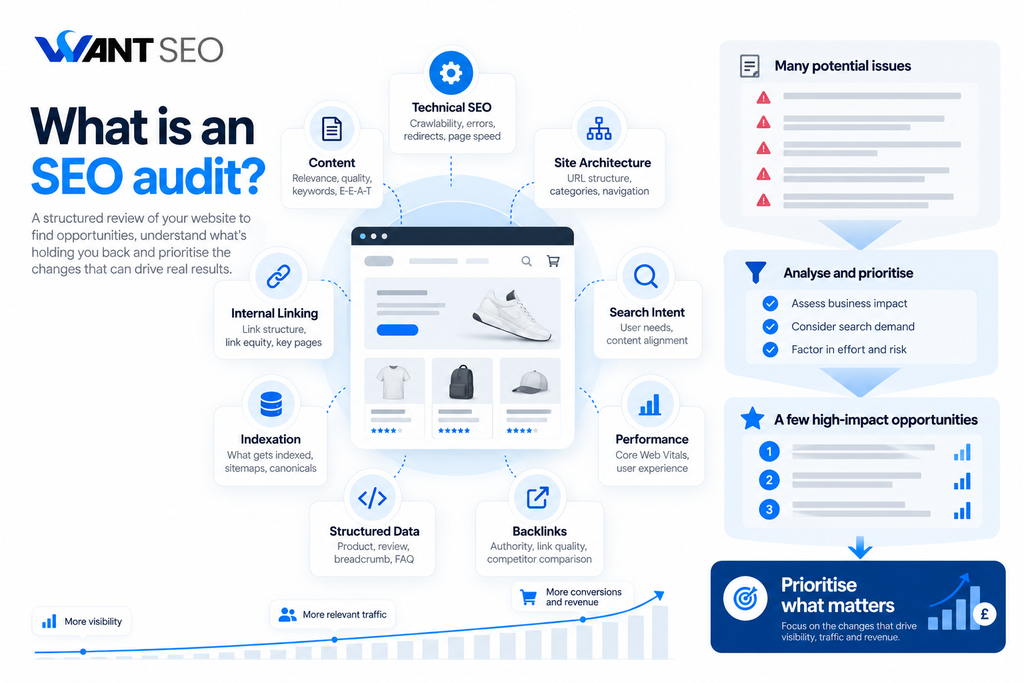
For an eCommerce business, an SEO audit should ultimately help answer questions such as:
- Where are we losing valuable organic opportunities?
- Which problems affect commercially important pages?
- What should we fix first?
- What should we leave alone?
- Which SEO improvements are likely to support revenue?
- Where are technical, content and conversion issues connected?
That decision-making layer is where a traditional SEO audit differs from simply asking an AI tool to find problems.
Can ChatGPT really audit a website?
Yes, but there are important limitations. ChatGPT can analyse information supplied to it, such as website URLs when appropriate access is available, crawl exports, Search Console data, keyword data, page content, structured data, technical audit reports and other SEO datasets. It can then help identify patterns and explain what those findings could mean. For example, if you provide a crawl containing thousands of URLs, ChatGPT can help identify patterns involving duplicate titles, missing metadata, thin pages, inconsistent canonicalisation, broken links or indexability problems.
It can also help review groups of pages rather than analysing every page manually. The limitation is that analysis is only as reliable as the underlying evidence. ChatGPT should not be treated as though it automatically has complete visibility into Google’s index, your server configuration, historical technical changes, Search Console behaviour, crawl behaviour or your business priorities. A useful SEO audit therefore combines AI-assisted analysis with reliable first-party and third-party data.
What can ChatGPT analyse during an SEO audit?
ChatGPT can analyse a wide range of SEO data and help identify patterns, opportunities and potential issues. However, its usefulness depends on the quality of the information provided and how the findings are interpreted. Here are some of the key areas it can support.
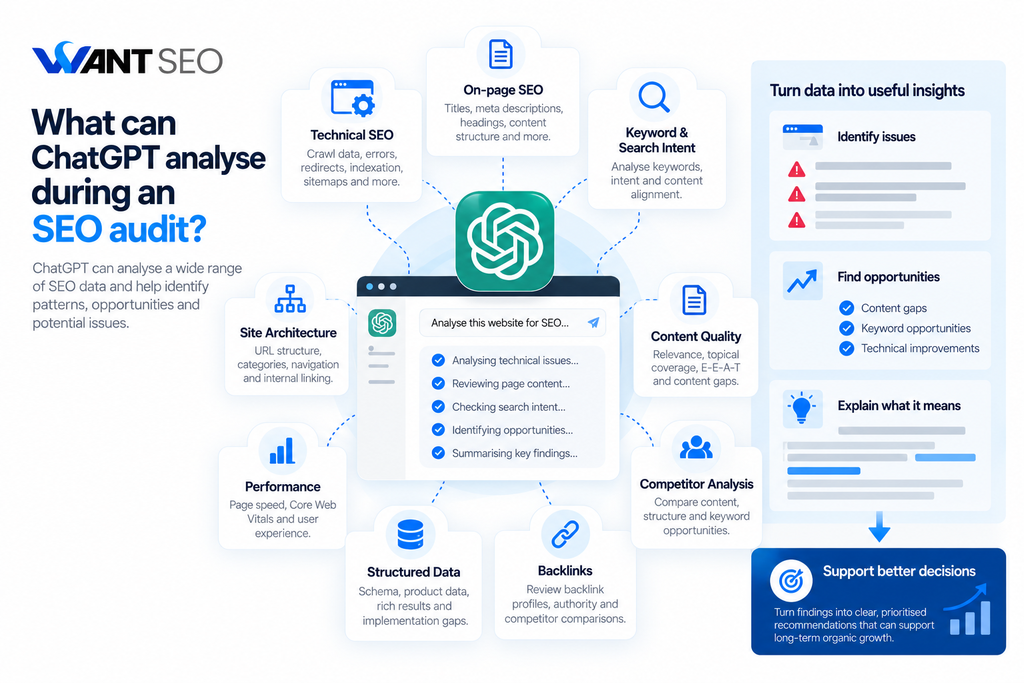
1. Technical SEO findings
ChatGPT can help interpret technical SEO data and explain what individual issues mean. For example, you could provide crawl data showing:
- 404 errors
- redirect chains
- canonical inconsistencies
- duplicate URLs
- missing metadata
- orphan pages
- incorrect status codes
- indexability problems
- XML sitemap issues
- internal linking problems
ChatGPT can then group related issues, explain their potential impact and help determine what deserves further investigation. The important word is potential. A reported technical issue is not automatically a business problem. The next step is to establish whether the issue affects important pages, users, search engines or revenue.
2. On-page SEO
ChatGPT is particularly useful for reviewing page-level content. It can assess whether a page appears aligned with its intended search intent, whether the headings create a logical hierarchy and whether the content answers the questions a searcher is likely to have. It can also identify opportunities involving:
- title tags
- meta descriptions
- headings
- content structure
- topical coverage
- internal links
- product and category copy
- FAQs
- calls to action
For eCommerce brands, this can be particularly useful across category, collection and product pages. The goal should not be to make every page longer or add keywords repeatedly. The better question is whether the page provides the information users need to make the next decision.
Can ChatGPT perform a keyword and search intent analysis?
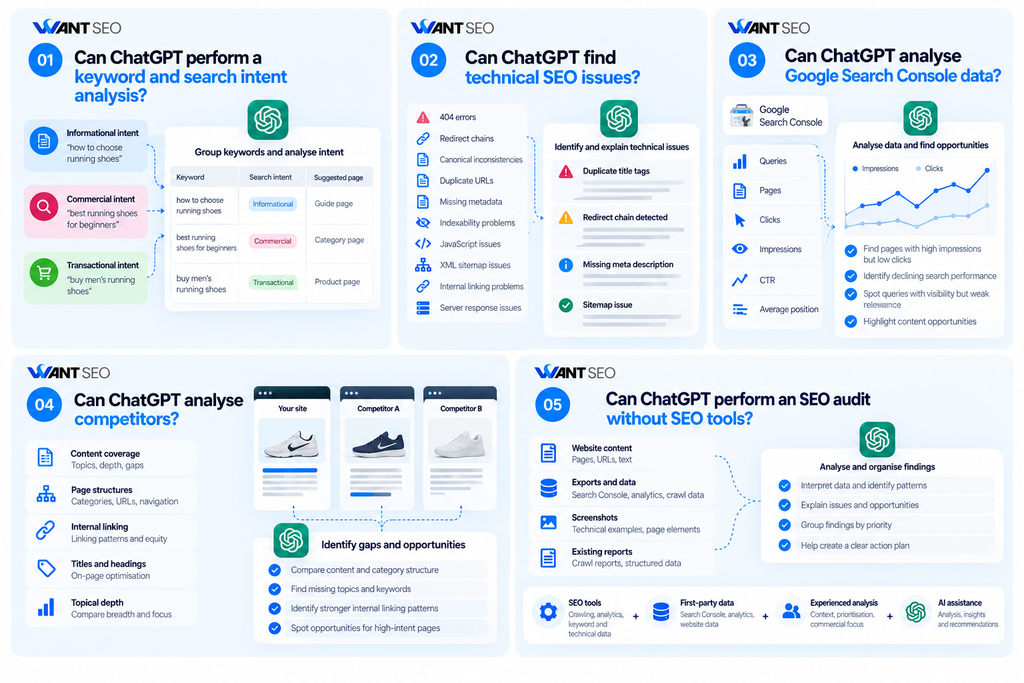
Yes. Given appropriate keyword and page data, ChatGPT can help group keywords according to search intent and identify relationships between queries and pages. For example, it may distinguish between informational searches such as “how to choose running shoes”, commercial investigation searches such as “best running shoes for beginners”, and transactional searches such as “buy men’s running shoes”.
It can then help determine whether the current page targeting those queries matches the likely intent. This is useful because keyword targeting without intent alignment can create unnecessary content. A business does not necessarily need a separate page for every closely related keyword. Several queries may represent the same underlying need. This is another area where prioritisation matters. The aim is not to create more URLs simply because more keyword variations exist.
Can ChatGPT find technical SEO issues?
It can help identify and interpret many technical SEO issues, but it should not be assumed to detect everything. A technical SEO audit can involve areas such as crawling, rendering, indexation, redirects, canonicalisation, JavaScript behaviour, structured data, site architecture, page experience and server responses. Some of these require direct technical evidence.
For example, ChatGPT may explain why a JavaScript-rendered page could create an SEO problem, but that does not mean the website actually has that problem. Similarly, it can explain why duplicate URLs can create unnecessary crawling or indexing complexity, but you still need evidence that duplication exists and that it is materially affecting the website.
This distinction prevents a common problem with AI-assisted audits: turning theoretical SEO problems into assumed problems.
Can ChatGPT analyse Google Search Console data?
Yes, and this can be one of its more useful applications. If you provide Search Console exports, ChatGPT can help analyse queries, pages, clicks, impressions, CTR and average positions. It can identify patterns such as pages receiving substantial impressions but relatively few clicks, queries where the website has visibility but weak relevance, or pages that appear to have declining search performance.
However, the numbers need context. A page ranking lower for a highly competitive commercial query is not necessarily an SEO failure. Likewise, a page receiving fewer clicks may still be strategically valuable if it supports an important part of the customer journey. The data should therefore be used to support decisions rather than become the decision itself.
Can ChatGPT analyse competitors?
Yes, provided the relevant competitor information is available. ChatGPT can compare areas such as content coverage, page structures, category architecture, internal linking patterns, titles, headings and topical depth. It can also help identify gaps between a website and competitors. But competitor analysis should not become a copying exercise.
A competitor ranking for a particular query does not automatically mean your business should create an equivalent page. The more useful question is why that page exists, which customer need it serves and whether that need is commercially relevant to your business. Competitor analysis should inform strategy, not dictate it.
Can ChatGPT perform an SEO audit without SEO tools?
This is where expectations need to be realistic. ChatGPT can provide useful SEO analysis without specialist tools if you give it enough information, such as page content, URLs, exports or screenshots. However, a complete SEO audit generally benefits from specialist crawling, analytics and search performance tools. Those tools provide evidence that an AI model cannot simply invent.
For example, a crawler can systematically inspect thousands of URLs and identify technical patterns. Search Console can provide first-party search performance data. Analytics can provide behavioural and commercial information. ChatGPT can then help interpret and organise that information.
The strongest approach is therefore not ChatGPT versus SEO tools. It is SEO tools + first-party data + experienced analysis + AI assistance.
How to use ChatGPT for an SEO audit
A practical workflow can look like this.
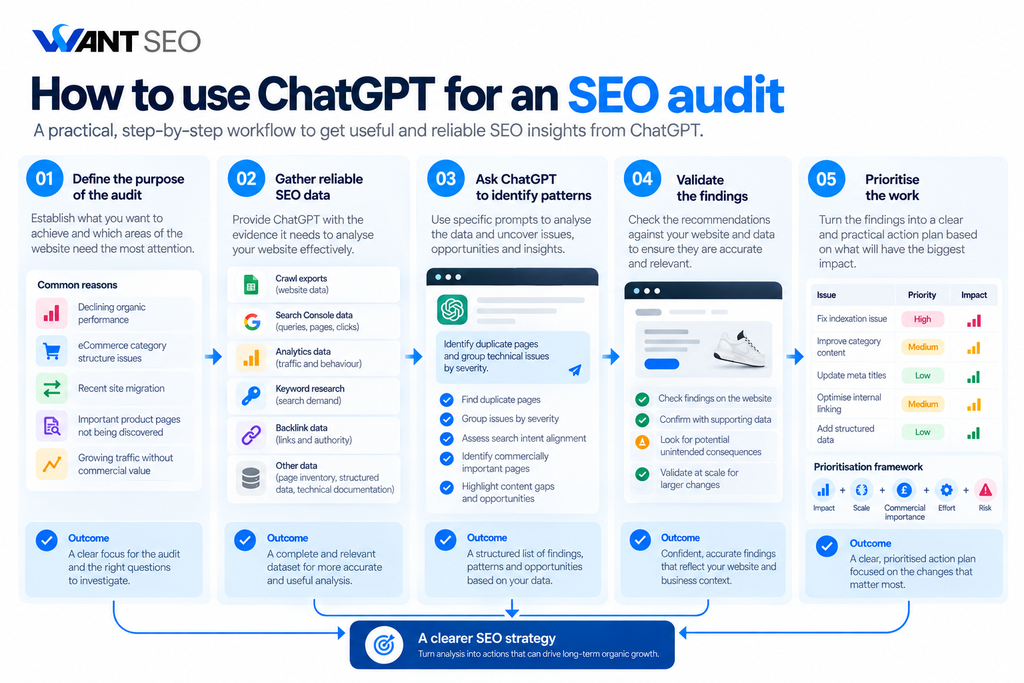
Step 1: Define the purpose of the audit
Before collecting data, establish what the audit is supposed to achieve. Is the website experiencing declining organic performance? Is an eCommerce category structure holding back growth? Has the site recently migrated? Are important product pages not being discovered? Is organic traffic growing without corresponding commercial value?
The answer changes what you should investigate. Without a defined purpose, an SEO audit can quickly become a long list of technical observations with no clear priority.
Step 2: Gather reliable SEO data
Provide ChatGPT with the evidence it needs. This could include crawl exports, Search Console data, analytics information, keyword research, backlink data, page inventories, structured data findings and relevant technical documentation. The more complete and relevant the dataset, the more useful the analysis becomes.
Step 3: Ask ChatGPT to identify patterns
Rather than simply asking: “Audit my website.” Give the analysis a specific task. For example, ask ChatGPT to identify duplicate pages, group technical issues by severity, assess search intent alignment or identify commercially important pages affected by technical problems. Specific questions produce more useful analysis than broad prompts.
Step 4: Validate the findings
Every significant recommendation should be checked against the website and supporting data. This is especially important when an AI-generated recommendation could affect large numbers of pages. A change that looks sensible in isolation could create unintended consequences elsewhere.
Step 5: Prioritise the work
The final output should not simply say that 17 issues are critical, 42 are medium and 86 are low priority. It should explain what should happen first and why. A useful prioritisation framework considers factors such as:
Impact + scale + commercial importance + effort + risk
This helps separate changes that genuinely matter from technically interesting issues that can safely wait.
What are the limitations of using ChatGPT for SEO audits?
The biggest limitation is that ChatGPT does not automatically understand your entire SEO environment. It may not know:
- why a technical decision was originally made
- which products generate the most revenue
- which categories have the highest commercial value
- what has recently changed on the website
- which pages the business wants to prioritise
- how competitors perform outside the data supplied
- what is happening in Google’s systems beyond the available evidence
It can also produce confident-sounding recommendations that require validation. This is particularly important when analysing technical SEO. A recommendation can sound perfectly reasonable while being inappropriate for a specific website architecture. AI can accelerate analysis, but it does not remove the need for judgement.
Should you rely solely on ChatGPT for an SEO audit?
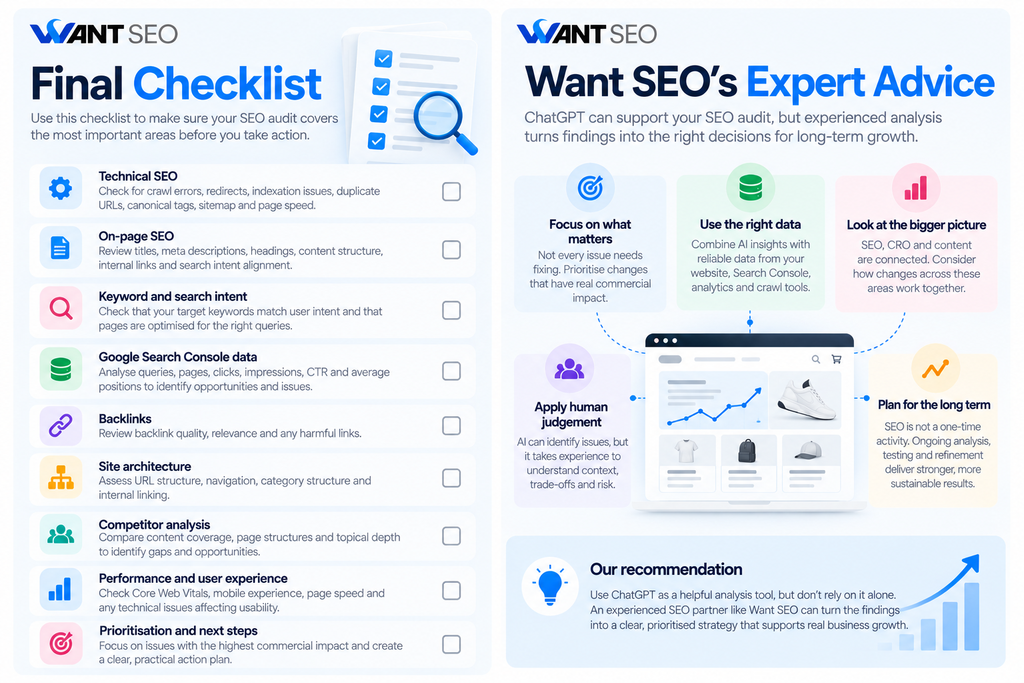
No. This is perhaps the most important distinction in the entire discussion. ChatGPT can be an effective part of an SEO audit process, but businesses should not rely solely on it to diagnose, prioritise and execute their SEO strategy. SEO is not a one-time activity where a list of problems is fixed, and the work is finished.
Search behaviour changes. Competitors change. Products change. Websites change. Google changes. New content creates new internal linking opportunities. Technical decisions can have consequences months later.
For that reason, SEO needs ongoing analysis and strategic decision-making. An experienced SEO analyst can connect technical findings with search intent, commercial priorities, website architecture and customer behaviour. They can also question whether a recommendation is actually worth implementing. That is often more valuable than simply identifying another SEO issue.
Where does human SEO expertise add value?
Human expertise becomes particularly important when the available evidence is ambiguous. Suppose an audit identifies 10,000 pages with similar content. The answer is not automatically to delete, merge or rewrite all 10,000. An experienced SEO analyst will ask what those pages represent, whether they have search demand, whether they generate revenue, whether they are required for users, whether they have backlinks, how they fit into the site’s architecture and what would happen if they were changed.
The same applies to technical issues. The best SEO recommendation is not necessarily the one that fixes the largest number of warnings. It is the recommendation that addresses the most meaningful constraint with an appropriate level of effort and risk. That is where strategy turns an audit into a growth decision.
How Want SEO approaches SEO audits
At Want SEO, the purpose of an SEO audit is not to produce the longest possible list of problems. It is to help eCommerce businesses make better growth decisions through SEO, CRO and strategy that prioritises clarity over activity. That means starting with intent rather than activity, prioritising what not to do and treating SEO, CRO and AEO as part of the same wider system. For an eCommerce business, this matters because not every SEO issue deserves the same attention.
Our experts at Want SEO focus on the relationship between technical health, search intent, content, commercial priorities and conversion opportunities. The objective is to understand where effort can compound rather than create more marketing activity for its own sake. The approach is deliberately grounded in prioritisation, trade-offs and commercial context. The brand philosophy is to optimise for clarity over complexity, confidence over certainty and long-term performance over short-term spikes. That is why an SEO audit should finish with clear decisions.
What should we fix? What should we improve? What should we test? What should we leave alone? And what should happen next?
ChatGPT can help with parts of that process. An experienced SEO analyst is responsible for making sure the resulting decisions make sense for the business.
Conclusion
So, can ChatGPT perform an SEO audit? Yes, but with an important qualification. ChatGPT can analyse SEO data, identify potential issues, review content, assess search intent, organise findings and help explain recommendations. Used properly, it can make SEO analysis faster and easier to understand. But it should not be treated as a complete SEO strategy or as a substitute for experienced analysis.
A reliable SEO audit combines evidence from the website and relevant SEO tools with commercial context, prioritisation and human judgement. More importantly, SEO does not end when an audit is complete. It is an ongoing technical and strategic discipline that requires monitoring, testing, refinement and adaptation. For businesses serious about sustainable organic growth, the goal is not to find everything that could be improved.
It is to understand what matters, decide what to prioritise and know why.
FAQs
Can ChatGPT audit my website for SEO?
ChatGPT can help audit a website when it has access to suitable website information and SEO data. It can analyse content, technical findings, search intent and other inputs, but important recommendations should be validated by an SEO professional.
Is ChatGPT good for technical SEO?
ChatGPT can explain technical SEO concepts and analyse technical audit data effectively. However, it should not be relied upon to independently diagnose every technical issue because some problems require crawling, testing, server-level information or specialist tools.
Can ChatGPT replace an SEO consultant?
No. ChatGPT can support SEO consultants and automate parts of analysis, but it does not replace the strategic judgement required to understand business context, prioritise opportunities and manage SEO over the long term.
What data should I give ChatGPT for an SEO audit?
Useful inputs can include website crawl data, Google Search Console exports, analytics data, keyword research, page inventories, technical SEO reports, backlink information and relevant competitor data. The quality of the recommendations depends heavily on the quality and completeness of the information provided.
How often should an SEO audit be performed?
There is no universal schedule. A comprehensive audit may be appropriate when launching a new website, completing a migration, experiencing significant performance changes or reviewing SEO strategy. Ongoing monitoring and smaller technical and content reviews should happen more regularly because SEO is an ongoing process rather than a one-time task.