Want SEO
Is Claude Better Than ChatGPT for SEO?
AI tools have become useful assistants for SEO professionals, helping with everything from keyword research and content writing to competitor analysis and technical audits. Two popular options are Claude, developed by Anthropic, and ChatGPT, developed by OpenAI. But which one is better for SEO?
Claude can be a strong choice for long-form content, detailed document analysis and maintaining a consistent writing style. ChatGPT is useful for research, brainstorming, data analysis and developing structured SEO strategies. Both can support effective SEO workflows, but neither guarantees better rankings simply because you use it. The right choice depends on your objectives, the type of work you need to complete and how much human review the output requires.
In this guide, we compare Claude and ChatGPT for SEO, explore their strengths and limitations, and explain how to decide which tool deserves a place in your workflow.
What Is the Difference Between Claude and ChatGPT for SEO?
Claude and ChatGPT are general-purpose AI assistants that can support a wide range of SEO tasks. You can use both to generate content ideas, analyse information, create article outlines, review website copy and develop recommendations. The main differences emerge when you consider how each tool fits into your workflow.
Claude is often a useful option for working with lengthy documents, developing detailed written content and refining a consistent brand voice. ChatGPT offers research capabilities, file analysis and tools that can help organise information into structured outputs. The exact features available depend on the model, plan and tools enabled.
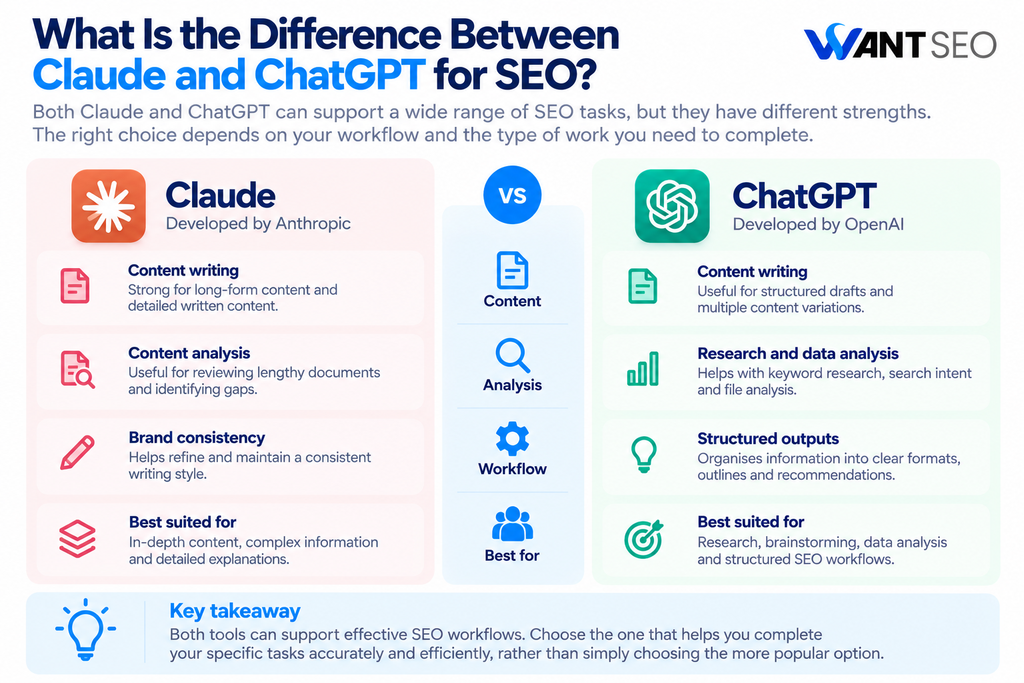
For SEO professionals, this means the decision should not be based on which AI sounds more intelligent. It should be based on which tool helps you complete a specific task accurately and efficiently.
1. Claude for SEO
Best for: Long-form content, content analysis and brand consistency.
Claude can help SEO teams develop blog posts, improve existing content, analyse competitor articles and organise large amounts of written information.
Content writing and optimisation
Claude can be particularly useful when a piece of content needs a consistent tone, clear explanations and logical progression across several sections. For example, an eCommerce brand could provide Claude with its brand guidelines, target audience, keyword research and an existing article. The tool could then help identify gaps in the article, improve its structure and produce a revised draft that follows the supplied requirements.
This can be useful for businesses that publish detailed buying guides, category content and educational articles. However, the output still needs editorial review to ensure it reflects the brand’s expertise and provides information that genuinely helps readers.
Content gap analysis
Claude can review supplied competitor articles and compare them with your existing content. It can identify topics that appear to be missing, questions that remain unanswered and areas where your explanations could be more useful. This is most valuable when you provide relevant source material rather than asking the AI to guess what competitors cover.
Remember that identifying a content gap does not automatically make it a worthwhile SEO opportunity. You still need to consider search intent, keyword demand, commercial relevance and whether the proposed content adds something new.
Working with lengthy documents
Claude can also help organise information from extensive content briefs, research documents and website copy. Depending on the model and available context limits, it may be possible to review substantial amounts of material within a single workflow. This can be useful for content audits, editorial planning and reviewing consistency across related pages.
The limitation: Claude can still invent facts, overlook important technical details or recommend changes that do not suit your website. Its writing quality should not be mistaken for factual accuracy or sound SEO judgement.
2. ChatGPT for SEO
Best for: Research, brainstorming, data analysis and structured SEO workflows.
ChatGPT supports a broad range of SEO activities, from planning content to analysing spreadsheets and researching competitors.
Keyword research and search intent
ChatGPT can help generate keyword ideas, identify related questions, group terms into topic clusters and suggest possible search intents. For example, an online retailer selling running shoes might use ChatGPT to organise keywords around product categories, shoe types, buying considerations and informational questions. It can also help distinguish between searches that indicate an interest in learning and those that suggest a user is comparing products or preparing to buy.
However, AI-generated keyword suggestions are hypotheses, not verified keyword data. You should use dedicated SEO tools to validate search volumes, keyword difficulty and commercial opportunities before deciding what to prioritise.
SEO content planning
ChatGPT can turn keyword research and business objectives into a structured content plan. It can suggest article outlines, heading structures, supporting topics, frequently asked questions and potential internal links. It can also help create content briefs that give writers a clearer understanding of the audience, search intent and purpose of each page.
For an eCommerce business, this can help connect informational content with product and category pages rather than publishing disconnected articles without a clear commercial purpose.
Data analysis and technical support
ChatGPT can analyse supported spreadsheet files, summarise datasets and help identify patterns that deserve further investigation. For example, you could use it to review exported keyword data, compare landing-page performance or organise findings from a technical SEO audit. It can also assist with generating and reviewing code, including structured data examples. However, generated code should be validated before implementation, and technical recommendations should be checked against the website’s actual configuration.
The limitation: ChatGPT can produce incorrect keyword assumptions, misleading interpretations of data and technically flawed recommendations. Its ability to research current information does not remove the need to verify sources and evidence.
Claude vs ChatGPT for SEO: Which Is Better for Each Task?
Neither tool is consistently better across every SEO activity. The following comparison provides a practical starting point.
| SEO task | Claude | ChatGPT |
| Long-form blog writing | Useful for detailed drafts and consistent tone | Useful for structured drafts and content development |
| Keyword brainstorming | Useful for grouping themes and interpreting supplied lists | Useful for generating ideas and organising keyword clusters |
| Search intent analysis | Can analyse supplied search results and content | Can support research and intent classification |
| Competitor content analysis | Useful for reviewing lengthy documents | Useful for research, comparison and structured summaries |
| Content gap analysis | Useful for identifying missing explanations in supplied material | Useful for comparing topics and developing content plans |
| Meta titles and descriptions | Can draft and refine options | Can generate and compare multiple variations |
| Spreadsheet analysis | Depends on available features and workflow | Supports file and data analysis through available tools |
| Technical SEO | Can help interpret reports and review code | Can analyse exports, explain issues and assist with code |
| Brand voice refinement | Useful for reviewing consistency across longer drafts | Useful for following detailed brand instructions and revising copy |
These are practical use cases, not benchmark results. Performance varies by model, prompt, supporting information and task complexity. The best way to compare them is to test both against the same real SEO brief.
Does Claude or ChatGPT Produce Better SEO Content?
Content quality matters more than the AI tool used to produce the first draft. Claude may suit projects where natural writing, detailed explanations and consistent tone are priorities. ChatGPT may suit workflows where research, structured outputs and multiple content variations are important.
However, neither tool automatically produces content that deserves to rank. Google’s guidance focuses on the quality, usefulness and purpose of content rather than whether it was generated using AI. Producing large volumes of pages without adding value can create problems regardless of which tool you use.
For stronger SEO content, both tools need a clear brief that explains the target audience, primary keyword, search intent, required evidence, brand voice and commercial objective. The final article should also include accurate information, useful examples and relevant expertise. AI can accelerate drafting, but it cannot replace the judgement needed to decide what the reader actually needs.
Can You Use Claude and ChatGPT Together for SEO?
Yes. Using both tools can be sensible when each has a clear role in the workflow. For example, you could use ChatGPT to organise keyword research, review search results and develop a content brief. You could then use Claude to help develop the article, refine its structure and improve the consistency of the writing. After drafting, either tool could assist with checking the article against your brief, identifying unanswered questions and reviewing proposed internal links.
However, using two tools for every task can create unnecessary work. If one tool already produces a satisfactory result, introducing another may add time without improving the outcome. The decision should depend on whether the second tool contributes something meaningful, such as better analysis, fewer editing rounds or more accurate information.
Which AI Tool Should Your Business Choose?
The answer depends on your existing workflow and the problems you need to solve. If your main challenge is producing clear, detailed content that follows established brand guidelines, Claude is worth testing. If you need help with research, keyword brainstorming, structured planning and data analysis, ChatGPT is a practical option. For an eCommerce business, neither should be selected purely because it is popular or widely discussed in SEO communities.
Instead, test each tool using a real task from your business. Provide the same brief and source material, then compare the results against criteria that matter to you: factual accuracy, search intent alignment, brand consistency, editing time and commercial relevance. You should also consider the cost of the workflow. A tool that produces a slightly better first draft may not be the best choice if it requires more verification or does not fit your existing processes. The aim is to find the approach that helps your team make better decisions and produce more useful work.
Conclusion
So, is Claude better than ChatGPT for SEO? Not in every situation. Claude is worth considering for long-form writing, detailed document analysis and content refinement. ChatGPT is useful for research, keyword brainstorming, data analysis and structured SEO planning. Both can support an effective SEO workflow, but neither replaces dedicated keyword research tools, technical validation or human expertise.
For businesses, the most important question is not which AI tool wins the comparison. It is which tool helps you identify the right opportunities, improve content quality and focus resources where they are most likely to make a difference. Choose based on the work that needs to be done, verify the output and keep your SEO strategy grounded in user intent and commercial priorities.
FAQs
1. Is Claude better than ChatGPT for SEO?
Claude can be useful for long-form writing and content analysis, while ChatGPT supports research, planning and data analysis. The better choice depends on the task and the quality of the output.
2. Which AI is best for SEO content writing?
Both Claude and ChatGPT can produce SEO content. Compare them using the same brief and assess accuracy, readability, search intent alignment and the amount of editing required.
3. Can Claude do keyword research?
Claude can generate keyword ideas, group related terms and analyse supplied keyword lists. Use dedicated SEO tools to verify search volumes, competition and keyword opportunities.
4. Can ChatGPT help with technical SEO?
ChatGPT can explain technical SEO concepts, analyse supplied reports and assist with code. Its recommendations and generated code should be checked before implementation.
5. Does Google penalise AI-generated SEO content?
Google does not automatically penalise content simply because AI was used to create it. Content that manipulates rankings or provides little value may violate Google’s spam policies, regardless of how it was produced.
6. Should I use Claude and ChatGPT together for SEO?
You can use both when their strengths complement each other. However, start with the tasks you need to improve and use a second tool only when it adds measurable value.