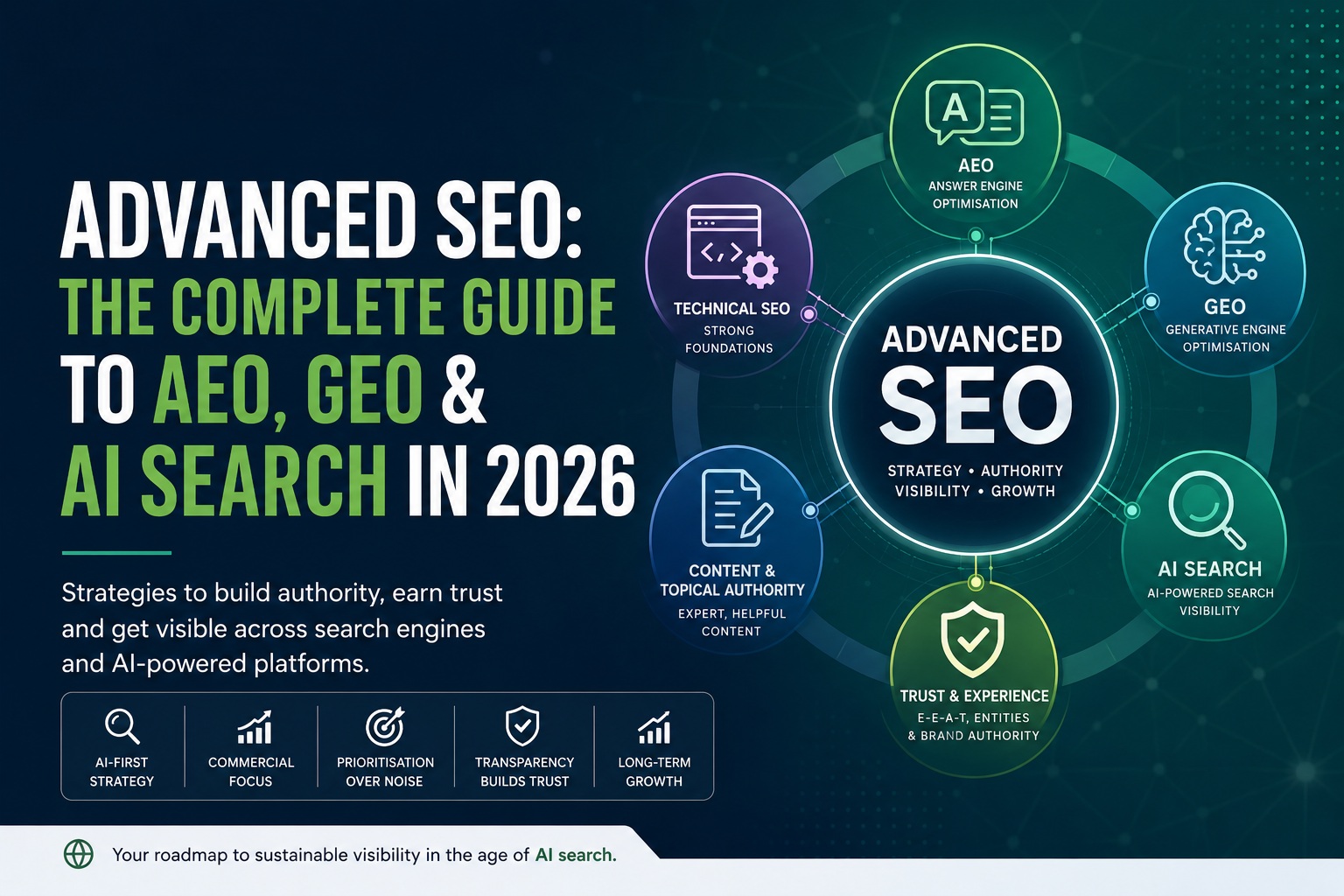
Advanced SEO: The Complete Guide to AEO, GEO & AI Search in 2026
Search engine optimisation has evolved far beyond optimising pages for Google’s ten blue links. Artificial intelligence is changing how people discover information, compare products, and make purchasing decisions. Today, users increasingly receive direct answers from AI assistants, search generative experiences, and large language models before they ever click through to a website. This shift means businesses need a broader strategy that extends beyond traditional rankings. Advanced SEO now combines technical excellence, high-quality content, semantic optimisation, structured data, entity building, topical authority, and AI-ready content that can be understood, cited, and surfaced by search engines and AI systems alike.
Whether your audience searches through Google, AI Overviews, ChatGPT, Gemini, Perplexity, Claude, or future AI search platforms, the objective remains the same. Your business needs to become the most trusted source of information for a given topic.
At Want SEO, our team researched the latest developments in AI search, answer engines, search engine documentation, and real-world optimisation strategies to create this guide. Rather than focusing on outdated tactics, we explain how Advanced SEO helps businesses build sustainable visibility across traditional search, answer engines, and generative AI.
Key Takeaways
- Advanced SEO now includes Answer Engine Optimisation (AEO), Generative Engine Optimisation (GEO), semantic SEO, entity optimisation, and AI search visibility.
- Traditional rankings still matter, but AI search rewards websites that demonstrate expertise, topical authority, and structured information.
- Technical SEO, content quality, user experience, and structured data work together to improve visibility across Google and AI-powered search.
- Businesses that invest in Advanced SEO today will be better positioned as AI becomes a larger part of how users discover brands online.
What Is Advanced SEO?
Advanced SEO is the process of optimising a website for both traditional search engines and modern AI-powered search systems. Rather than focusing only on keywords and backlinks, it considers how search engines interpret meaning, relationships between entities, user intent, content quality, technical performance, and trust signals.
In the past, SEO campaigns often revolved around ranking a page for a single keyword. While keywords remain important, modern search algorithms understand context far better than before. They analyse topics, entities, relationships, user behaviour, content quality, and authority before deciding which pages deserve visibility.
This means Advanced SEO is no longer a collection of isolated tactics. It is a complete optimisation framework where technical SEO, content strategy, user experience, information architecture, semantic relevance, and AI optimisation all support one another.
Businesses that continue relying solely on traditional optimisation methods risk becoming less visible as AI search becomes more widely adopted.
Why Advanced SEO Has Changed in 2026
Artificial intelligence is transforming how search works. Instead of presenting users with a list of links, search engines increasingly provide summarised answers generated from multiple trusted sources. AI assistants also allow users to ask complex questions conversationally without needing to perform multiple searches.
For example, instead of searching:
“best running shoes”
Users may ask:
“What are the best running shoes for marathon training under £150 with good arch support?”
Answer engines interpret the entire question, identify trusted sources, compare products, summarise information, and provide recommendations. For businesses, this changes how visibility is earned. Your content now needs to answer questions clearly, demonstrate expertise, include supporting evidence, use structured headings, and establish authority across an entire topic rather than targeting individual keywords alone. This evolution explains why Advanced SEO increasingly overlaps with:
- AI Search Optimisation
- Answer Engine Optimisation (AEO)
- Generative Engine Optimisation (GEO)
- Semantic SEO
- Entity SEO
- Technical SEO
- User Experience Optimisation
- Content Strategy
Rather than replacing traditional SEO, these disciplines build upon its foundations.
Traditional SEO vs Advanced SEO
| Traditional SEO | Advanced SEO |
| Focuses primarily on rankings | Focuses on overall search visibility |
| Individual keyword optimisation | Topic and entity optimisation |
| Backlink-first strategies | Authority and trust-first strategies |
| Search engines only | Search engines plus AI assistants |
| Basic technical optimisation | Comprehensive technical and AI readiness |
| Individual pages | Connected topic clusters |
| Keyword matching | Semantic understanding |
| Click optimisation | Visibility across multiple discovery channels |
Traditional SEO remains valuable because search engines still crawl, index, and rank pages. However, Advanced SEO expands the objective from appearing in search results to becoming a trusted source that search engines and AI systems reference confidently.
The Three Pillars of Advanced SEO
While Advanced SEO includes many specialist disciplines, most successful strategies are built around three core pillars.
Technical Excellence
Search engines and AI systems must first be able to discover, crawl, understand, and access your content efficiently. Technical SEO includes:
- Fast page speed
- Core Web Vitals
- Mobile usability
- Crawl optimisation
- XML sitemaps
- Clean site architecture
- Canonicalisation
- Structured data
- Secure HTTPS implementation
Without strong technical foundations, even exceptional content may struggle to reach its potential.
Content Authority
Modern search engines reward websites that demonstrate deep expertise. Rather than producing dozens of disconnected articles, Advanced SEO encourages businesses to develop comprehensive topic clusters covering an entire subject. For example, an agency specialising in AI search could create supporting content around:
- AI Search
- AEO
- GEO
- Semantic SEO
- Entity SEO
- Schema Markup
- AI Overviews
- Technical SEO
- Topical Authority
Together, these articles strengthen overall authority while helping users navigate related subjects.
Trust and Experience
Search engines increasingly evaluate signals that indicate whether content is trustworthy. These include:
- Demonstrated expertise
- Real experience
- Author credibility
- Accurate information
- Consistent branding
- Positive reputation
- High-quality citations
- Helpful content
Google’s emphasis on Experience, Expertise, Authoritativeness, and Trustworthiness continues to influence how high-quality websites are evaluated.
How AI Search Is Changing SEO
AI search represents one of the biggest changes the industry has experienced. Instead of matching pages to keywords, AI systems attempt to understand user intent, compare multiple sources, evaluate confidence, and generate helpful responses. Large language models do not simply retrieve pages. They interpret information. As a result, businesses should think beyond rankings alone. The question becomes:
“Can AI understand our expertise well enough to recommend us?”
Answering that question requires several improvements beyond traditional optimisation. Your content should explain concepts clearly instead of relying on jargon. Important questions should be answered directly. Headings should follow a logical hierarchy. Information should be supported with evidence where appropriate. Related topics should reinforce one another through internal linking. Structured data should help search engines understand page content.
This is why Advanced SEO increasingly focuses on making content understandable by both humans and machines.
Understanding Answer Engine Optimisation (AEO)
Answer Engine Optimisation, commonly called AEO, is the practice of creating content that answers user questions clearly enough to be selected by answer engines and AI assistants. Instead of optimising solely for rankings, AEO focuses on becoming the source behind direct answers. Examples include:
- AI Overviews
- Voice assistants
- ChatGPT
- Gemini
- Perplexity
- Microsoft Copilot
These systems look for information that is well organised, trustworthy, factual, and easy to interpret. Unlike older SEO tactics that encouraged lengthy introductions before answering a question, AEO prioritises immediate clarity.
For example, if someone searches:
“What is Advanced SEO?”
The strongest AEO content provides a concise definition immediately before expanding into greater detail.
This structure helps both readers and AI systems understand the page quickly. Good AEO content usually includes:
- Direct definitions
- Question-based headings
- Concise summaries
- Logical formatting
- Structured data
- Supporting evidence
- Consistent terminology
- Internal links to related topics
Businesses that invest in AEO improve their chances of appearing in featured snippets, AI-generated answers, voice search results, and conversational search experiences. Importantly, AEO does not replace traditional optimisation. It strengthens Advanced SEO by making valuable information easier for AI systems to identify, interpret, and reference. In the next section, we’ll explore Generative Engine Optimisation (GEO), semantic SEO, entity optimisation, and how businesses can build visibility across AI-powered search platforms.
What Is Generative Engine Optimisation (GEO)?
Generative Engine Optimisation (GEO) is the process of optimising content so that AI-powered search engines and large language models can confidently reference, summarise, and cite it when generating responses. Unlike traditional search engines that return a list of links, generative AI combines information from multiple trusted sources before presenting a single answer. This means your website is competing not only for rankings but also for inclusion in AI-generated responses.
For businesses investing in Advanced SEO, GEO has become an essential discipline. It helps ensure your expertise is recognised across emerging search experiences where users may never click through ten blue links. GEO does not involve manipulating AI systems. Instead, it focuses on making your content easy to understand, well-structured, authoritative, and supported by evidence.
Successful GEO content usually has several characteristics:
- Comprehensive topic coverage
- Clear factual explanations
- Logical heading structure
- Strong semantic relationships
- High topical authority
- Reliable external references where appropriate
- Consistent terminology throughout the content
When AI systems evaluate content, they are more likely to trust pages that thoroughly explain a subject instead of providing shallow answers.
AEO vs GEO vs Traditional SEO
Although these disciplines overlap, each serves a different purpose within an Advanced SEO strategy.
| SEO Discipline | Primary Goal | Focus |
| Traditional SEO | Rank in search results | Keywords, backlinks, crawling, indexing |
| AEO | Become the best direct answer | Question optimisation, featured snippets, AI answers |
| GEO | Become a trusted AI source | Semantic understanding, entities, authority, context |
The most successful businesses do not choose one over another. They combine all three into a unified optimisation strategy.
Semantic SEO: Helping Search Engines Understand Meaning
Search engines have become remarkably good at understanding language. Instead of matching exact keywords, they evaluate relationships between words, concepts, entities, and user intent. This is known as semantic search. For example, a page discussing Advanced SEO may naturally include related concepts such as:
- AI Search
- AEO
- GEO
- Technical SEO
- Search intent
- Topical authority
- Schema markup
- Structured data
- User experience
- Internal linking
- Crawlability
- Indexability
- Large language models
- AI Overviews
- Conversational search
These related concepts help search engines understand the breadth and depth of your expertise. Semantic SEO also reduces the need for unnatural keyword repetition. Instead of forcing exact-match keywords into every paragraph, businesses should build content that comprehensively answers a topic from multiple angles. This creates stronger topical relevance while improving the overall reading experience.
Why Entities Matter More Than Keywords
One of the biggest developments in Advanced SEO is the growing importance of entities. An entity is a clearly identifiable person, business, place, product, concept, or organisation that search engines can recognise independently of keywords. For example:
- Want SEO
- ChatGPT
- Schema.org
- Search Console
- Artificial Intelligence
- Core Web Vitals
Search engines use entities to build knowledge graphs that understand relationships between topics. Instead of viewing content as isolated keywords, they interpret how entities relate to one another. For businesses, this means creating content that consistently reinforces expertise around specific subjects. Every article should contribute to a broader knowledge base rather than existing in isolation.
Building Topical Authority
Topical authority has become one of the strongest indicators of expertise. Rather than publishing hundreds of unrelated articles, businesses should create interconnected resources covering an entire subject. For example, a complete AI search cluster might include detailed guides covering:
- Advanced SEO
- AI Search
- Answer Engine Optimisation
- Generative Engine Optimisation
- Technical SEO
- Entity SEO
- Semantic SEO
- AI Overviews
- Schema Markup
- Structured Data
- Information Gain
- E-E-A-T
- Content Optimisation
Each article supports the others through internal links, creating a stronger understanding of expertise. This approach benefits both search engines and users by making information easier to discover.
E-E-A-T and Why Trust Matters More Than Ever
Google continues to emphasise Experience, Expertise, Authoritativeness, and Trustworthiness when evaluating content quality. Although E-E-A-T is not a direct ranking factor, it influences how search engines assess the reliability of information. AI systems also benefit from trustworthy content because they aim to reduce misinformation. Businesses should demonstrate trust by:
- Publishing original insights.
- Explaining complex topics clearly.
- Showing real experience where appropriate.
- Keeping information accurate and up to date.
- Building consistent author profiles.
- Citing reputable sources when discussing research.
- Maintaining transparent business information.
The goal is not simply to appear authoritative but to genuinely become a trusted source within your industry.
The Growing Role of Structured Data
Structured data helps search engines interpret content more accurately. Although users rarely see schema markup directly, it provides valuable context about pages, organisations, products, FAQs, reviews, articles, and many other content types. For Advanced SEO, structured data plays an important supporting role. It allows search engines to understand:
- What the page is about.
- Who published it?
- How different entities relate.
- Which questions are answered?
- Whether products, services, reviews, or events are discussed.
Common schema types include:
| Schema Type | Purpose |
| Article | Defines blog and editorial content |
| FAQ | Identifies frequently asked questions |
| Organization | Describes your business |
| Local Business | Supports local SEO signals |
| Breadcrumb | Improves site structure understanding |
| Product | Helps ecommerce visibility |
| Review | Supports product and service reviews |
Schema does not guarantee higher rankings, but it improves machine readability, which supports both search engines and AI systems.
AI Overviews and Zero-Click Search
Google’s AI Overviews have changed how users interact with search results. Instead of clicking multiple websites, users often receive summarised answers directly within the search. This has increased the importance of becoming one of the sources AI chooses when generating responses. Businesses should avoid seeing zero-click searches as a threat. Instead, they should optimise content that provides complete answers, covers related follow-up questions, includes expert insights, demonstrates authority and builds brand recognition. Even when users do not click immediately, appearing within AI-generated responses strengthens credibility and brand awareness.
Information Gain: Going Beyond What Already Exists
Publishing another version of existing content is becoming less effective. Search engines increasingly reward pages that add genuine value. This concept is often referred to as information gain. Examples include original research, industry observations, proprietary frameworks, practical case studies, expert commentary, first-hand experience, unique comparisons, and updated statistics.
For our experts at Want SEO, this could include sharing practical observations from client campaigns, technical audits, or AI search optimisation projects. Original insights help differentiate your content from competitors while improving trust.
How Technical SEO Supports AI Search
Many businesses assume AI search is primarily about content. In reality, technical SEO remains fundamental. AI systems still rely on search engines to discover and understand websites. A technically healthy website improves crawl efficiency, indexing, and overall accessibility. Important technical priorities include:
- Fast loading pages.
- Mobile-first optimisation.
- Core Web Vitals.
- Clean URL structures.
- Internal linking.
- Crawl budget optimisation.
- XML sitemaps.
- Canonical tags.
- HTTPS security.
- Accessible navigation.
These improvements make it easier for both search engines and AI systems to evaluate your content accurately. Without technical foundations, even excellent content can struggle to gain visibility.
Why User Experience Is Now Part of Advanced SEO
User experience has become inseparable from advanced SEO. Search engines increasingly evaluate how users interact with websites after arriving from search. Clear navigation, readable layouts, logical page structures, and fast performance all contribute to better engagement.
Content should also be written for humans first. Short paragraphs, descriptive headings, helpful visuals, comparison tables, and concise explanations improve readability while making information easier for AI systems to interpret. The objective is simple. If users can quickly understand your expertise, AI systems are more likely to understand it too.
Local SEO Still Matters in an AI Search World
While AI search is transforming online discovery, local intent remains one of the strongest signals for businesses serving specific regions. For agencies like Want SEO, combining Advanced SEO with local SEO creates a stronger competitive advantage. Businesses searching for a top local SEO company or the best local SEO company in UK are no longer evaluating rankings alone. They want strategic partners who understand technical SEO, AI search, AEO, GEO, content strategy, and commercial growth. This is where modern optimisation differs from traditional local SEO.
Instead of focusing solely on Google Business Profile optimisation and local citations, businesses should build comprehensive expertise that demonstrates why they deserve to be recommended by both search engines and AI assistants. The future belongs to businesses that combine local relevance with recognised topical authority.
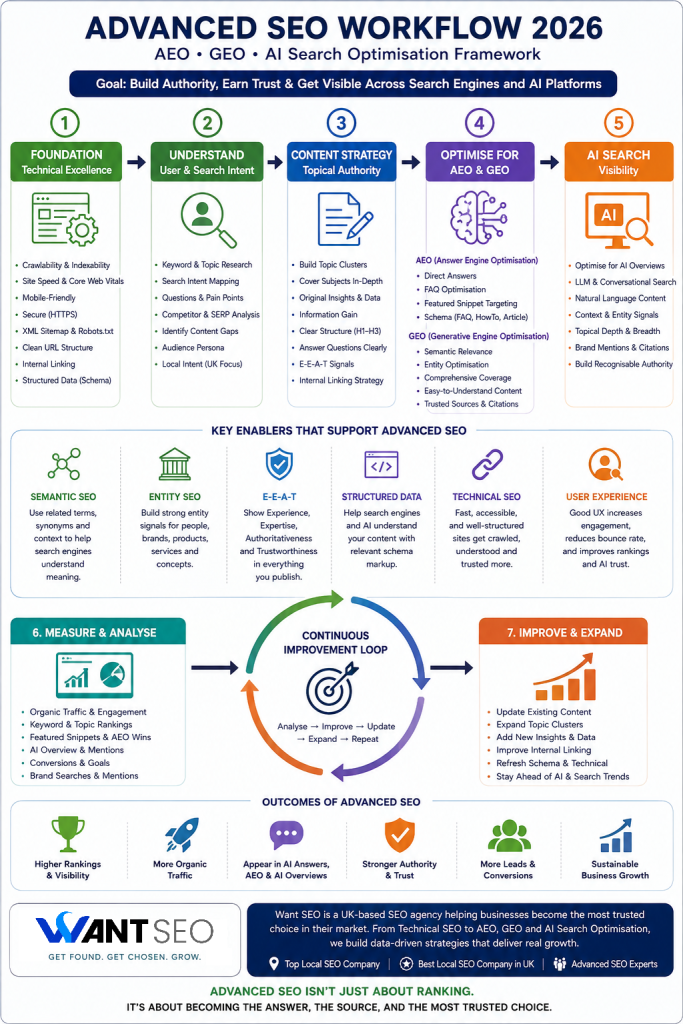
An Advanced SEO Framework for 2026
Businesses often ask where they should begin with Advanced SEO. The answer is not to adopt every new AI tool or chase every algorithm update. Instead, build a strategy that strengthens your website as a trusted source of information across traditional search engines and AI-powered search platforms.
An effective Advanced SEO framework starts with technical health. Search engines must be able to crawl, index, and understand your website efficiently. Once these foundations are in place, the focus should shift to creating authoritative content that satisfies user intent, answers real questions, and demonstrates expertise.
The next layer involves semantic optimisation. Rather than targeting isolated keywords, your content should cover entire topics, connect related concepts, and establish clear entity relationships. Structured data then provides additional context that helps search engines and AI systems interpret your pages more accurately.
Finally, continuous improvement is essential. Analyse search behaviour, monitor AI visibility, update existing content, strengthen internal linking, and refine your topical clusters as your industry evolves. Businesses that follow this framework build long-term visibility instead of chasing short-term ranking gains.
How to Optimise Content for AI Search
AI search platforms reward content that is genuinely useful rather than simply keyword-rich. When writing content, begin by understanding the user’s primary intent. Every page should answer the main question quickly before exploring related topics in greater depth. This structure improves readability for people while helping AI systems identify the most important information.
Your content should also anticipate follow-up questions. If someone wants to understand Advanced SEO, they will probably also want to learn about AI Search, AEO, GEO, structured data, semantic SEO, entity optimisation, and topical authority. Covering these related subjects naturally increases the value of the page.
Formatting also matters. Short paragraphs, descriptive headings, comparison tables, numbered processes where appropriate, and concise summaries make information easier to consume. Original insights provide another competitive advantage. AI models are trained on publicly available information, but they favour trustworthy sources that contribute something new. Sharing practical observations, unique frameworks, or expert commentary can help differentiate your content from hundreds of similar articles.
Common Advanced SEO Mistakes
Many businesses still approach SEO using outdated assumptions.
One common mistake is treating AI search as completely separate from traditional SEO. In reality, AI systems rely heavily on search engines to discover trustworthy information. Ignoring technical SEO or content quality because AI is becoming more important is likely to reduce visibility rather than improve it.
Another mistake is publishing large volumes of low-value content generated without clear editorial oversight. Quantity alone rarely builds authority. Search engines increasingly reward websites that demonstrate depth, expertise, and consistency.
Businesses also underestimate the importance of topical authority. Publishing one excellent article about AI search is unlikely to establish expertise. Building an interconnected library of resources creates stronger signals of authority over time.
Finally, many websites still overlook technical foundations such as crawlability, internal linking, structured data, page speed, and mobile usability. These elements remain essential components of any successful advanced SEO strategy.
Measuring Advanced SEO Success
Traditional SEO often focused on rankings and organic traffic. While these metrics remain useful, Advanced SEO requires a broader view of performance. Consider measuring:
| Metric | Why It Matters |
| Organic visibility | Measures overall search presence |
| AI search mentions | Indicates visibility in generative search experiences |
| Featured snippets | Supports Answer Engine Optimisation |
| AI Overview appearances | Demonstrates authority in Google’s AI experiences |
| Topic coverage | Shows depth across important subjects |
| Organic conversions | Connects SEO to business outcomes |
| Brand searches | Indicates growing awareness and trust |
| Engagement metrics | Reflect content usefulness and user satisfaction |
These indicators provide a more complete picture of how your optimisation efforts contribute to long-term growth.
The Future of Advanced SEO
SEO will continue evolving as artificial intelligence becomes more deeply integrated into search. Search engines are moving beyond keyword matching towards understanding intent, expertise, credibility, and user satisfaction. Businesses that adapt early will be better positioned as new search experiences become mainstream. Future optimisation is likely to place greater emphasis on:
- AI Search visibility
- Entity-based optimisation
- Semantic relationships
- Structured content
- Original research
- Information gain
- Brand authority
- Topical depth
- User experience
- Trust and transparency
The businesses that succeed will not necessarily publish the most content. They will publish the most helpful, reliable, and comprehensive content. That philosophy sits at the heart of advanced SEO.
Advanced SEO Checklist
Before publishing or updating important content, review the following checklist.
✅ Understand user search intent.
✅ Optimise for topics rather than individual keywords.
✅ Build comprehensive topical clusters.
✅ Use descriptive heading structures.
✅ Improve internal linking between related content.
✅ Implement relevant schema markup.
✅ Strengthen technical SEO foundations.
✅ Demonstrate expertise with original insights.
✅ Optimise for AI Search, AEO, and GEO.
✅ Regularly refresh content with new information.
Consistently applying these principles helps websites remain competitive as search continues to evolve.
Why Businesses Choose Want SEO
Modern SEO requires more than technical fixes or content production. It requires clear decision-making based on commercial priorities, user intent, and the direction of search technology.
At Want SEO, we believe the strongest strategies begin with understanding what matters most to your business. We combine technical SEO, content strategy, AI Search optimisation, Answer Engine Optimisation, Generative Engine Optimisation, and conversion thinking to help businesses build sustainable organic growth.
Whether you’re looking for a top local SEO company to improve regional visibility or the best local SEO company in UK to prepare your website for the future of AI-powered search, our approach focuses on clarity, prioritisation, and measurable business outcomes rather than vanity metrics.
Conclusion
Advanced SEO is no longer just about improving rankings. It is about building a website that search engines, AI assistants, and users trust as an authoritative source of information. As AI Search, Answer Engine Optimisation, and Generative Engine Optimisation continue reshaping digital discovery, businesses need strategies that combine technical excellence, semantic understanding, topical authority, structured data, and genuinely helpful content. The organisations that invest in advanced SEO today will be better prepared for tomorrow’s search landscape because they are building authority rather than chasing algorithms.
Our experts at Want SEO researched the latest developments across AI Search, search engine guidance, and modern optimisation practices to produce this guide. If your business is looking to improve visibility across Google, AI-powered search platforms, and future search technologies, our team can help you develop a strategy that supports long-term commercial growth with confidence and clarity.
FAQs
1. What is Advanced SEO?
Advanced SEO is a modern approach to search optimisation that combines traditional SEO with AI Search, Answer Engine Optimisation (AEO), Generative Engine Optimisation (GEO), semantic SEO, technical SEO, and topical authority to improve visibility across search engines and AI platforms.
2. Is traditional SEO still important in 2026?
Yes. Traditional SEO remains the foundation of online visibility. However, it should now be complemented with AI Search optimisation, structured data, entity optimisation, and high-quality topical content.
3. What is the difference between AEO and GEO?
AEO focuses on helping content become the best direct answer for user questions, while GEO focuses on helping AI systems understand, reference, and generate responses using your content. Both are essential parts of Advanced SEO.
4. Does AI Search replace Google SEO?
No. AI Search builds on many of the same signals used by traditional search engines. Strong technical SEO, helpful content, and authority remain fundamental to success across both environments.
5. How can businesses prepare for the future of search?
Businesses should invest in Advanced SEO by strengthening technical performance, creating authoritative topic clusters, implementing structured data, improving user experience, and producing original, trustworthy content that serves both users and AI systems.