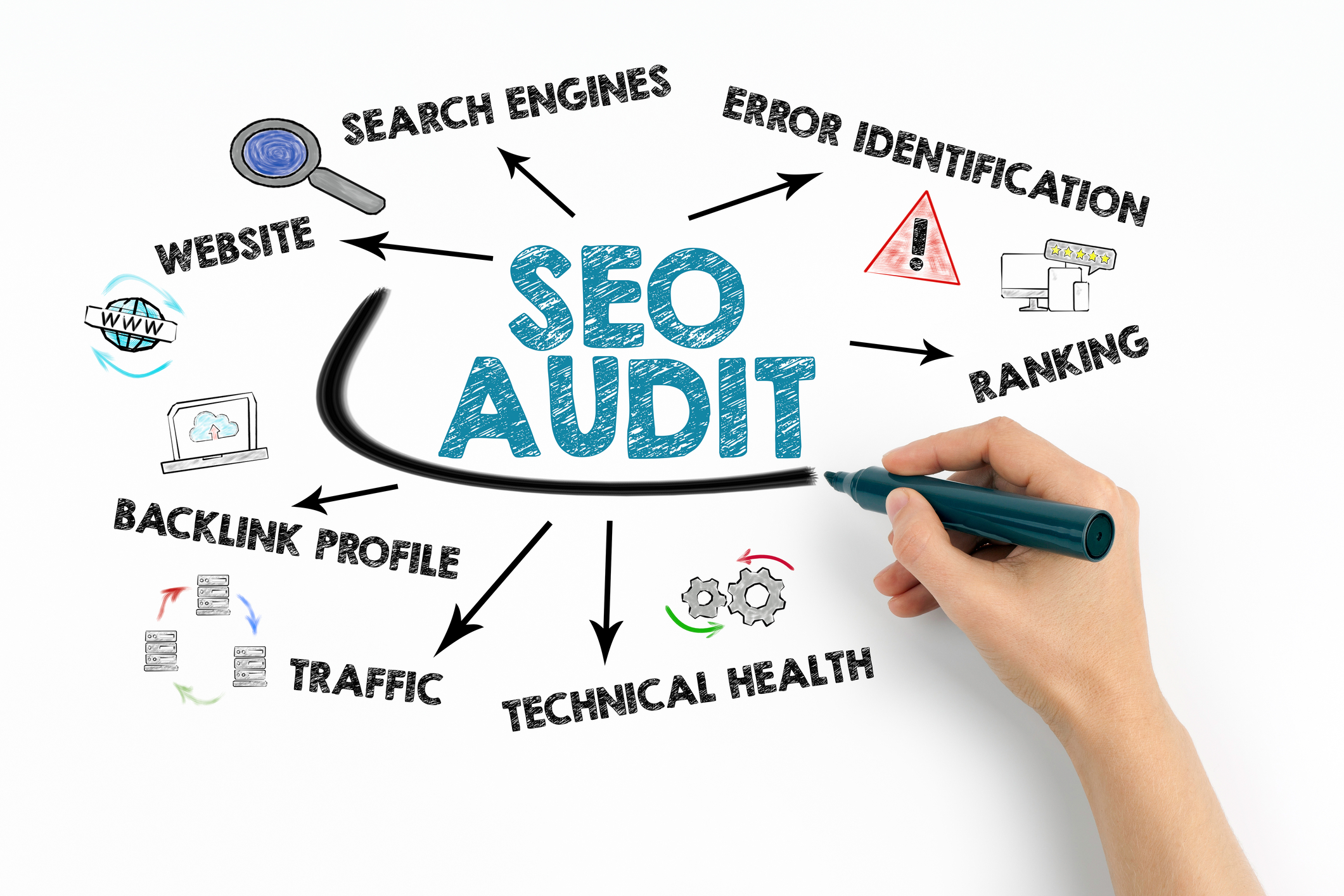
How to do a full SEO audit?
Have you ever wondered why your competitors’ websites consistently outrank yours despite your best efforts? The answer might lie in the hidden technical aspects of your website that are holding back your online visibility.
An astonishing 96.55% of all pages get zero search traffic from Google, yet businesses with strategic SEO approaches experience up to 14.6% conversion rates compared to just 1.7% for others.
The digital landscape is highly competitive, with search engines constantly evolving their algorithms, making it vital for business owners to adapt and optimise their online presence.
A comprehensive SEO audit is your roadmap to sustainable growth, identifying critical issues hampering your website’s performance while unlocking untapped potential. Whether you’re starting your SEO journey or looking to elevate your current strategy, mastering the art of conducting a full SEO audit could be the game-changer your business needs.
Key Takeaways:
- A comprehensive SEO audit examines your website’s technical foundation, content quality, user experience, and backlink profile, identifying critical issues that may be hindering your search performance.
- Regular audits can increase organic traffic by up to 53.3%, with 42% of UK consumers using search engines when looking for products or services.
- When implementing audit findings, focus on prioritising changes based on impact and resources required, ensuring the most effective use of your time and budget.
- Enterprise-level audits that incorporate competitor analysis and EEAT principles (Experience, Expertise, Authoritativeness, and Trustworthiness) can provide strategic advantages in highly competitive markets.
- A professionally conducted SEO audit serves as both a diagnostic tool and a strategic growth framework, with businesses experiencing an average ROI of £2.75 for every £1 spent on SEO improvements.
Understanding the SEO Audit Foundation
An SEO audit is much more than a simple website check—it’s a comprehensive assessment that examines the entire digital footprint of your business.
Think of it as a health check-up for your online presence, digging deep into the technical aspects, content quality, and structural elements that affect how search engines perceive and rank your website.
Studies show that 75% of users never scroll past the first page of search results, making proper optimisation not just beneficial but essential for business growth.
The goal of an SEO audit is to identify issues that may be preventing your website from achieving its full potential in search results. For instance, slow-loading pages can increase bounce rates by 32%, while mobile-unfriendly designs can reduce conversions by up to 61%.
By systematically evaluating these elements, an audit provides a clear picture of where your website stands and what specific improvements will yield the greatest impact on your search ranking, visibility, and ultimately, your bottom line.
The most effective audits follow a structured approach that examines three main areas: technical SEO (including site architecture, indexability, and performance), on-page SEO (content quality, keyword optimisation, and metadata), and off-page factors (backlink profile and online reputation). This holistic approach ensures no stone is left unturned in the quest for search engine visibility.
The Technical SEO Audit Components
A technical SEO audit forms the foundation of any comprehensive website evaluation, focusing on the behind-the-scenes elements that search engines use to crawl, index, and rank your site. This critical first step addresses the structural integrity of your website, ensuring search engines can effectively access and understand your content.
Crawlability assessment is where we begin, examining how search engine bots navigate through your site. Using tools like Screaming Frog or SEMrush, we analyse robots.txt files, XML sitemaps, and crawl stats to identify any barriers preventing search engines from discovering your content.
Research shows that properly optimised crawlability can increase indexed pages by up to 30%, directly impacting your search visibility.
Website performance metrics represent another crucial aspect of technical SEO. Page speed has become a significant ranking factor, with Google’s Core Web Vitals now formally incorporated into their algorithm. Studies indicate that improving page load times by just one second can increase conversions by 7%. We examine server response times, resource compression, render-blocking resources, and mobile responsiveness to ensure optimal performance across all devices.
Structural analysis delves into your website’s architecture, including URL structures, internal linking patterns, and navigation hierarchies. A logical site structure not only helps search engines understand the relationships between your content but also improves user experience. Consider that websites with clear, logical structures experience 18% lower bounce rates and 27% higher time-on-site metrics compared to those with confusing navigation systems.
Finally, a thorough technical audit examines indexing issues, duplicate content, canonicalisation problems, and proper implementation of structured data. These elements may seem minor individually, but collectively, they form the technical foundation upon which all other SEO efforts rest. Without addressing these issues, even the most brilliant content strategy or link-building campaign will fail to achieve optimal results.
Content and On-Page SEO Analysis
When conducting a content-focused SEO audit, we dive deep into the meat of your website—the actual words, images, and media that engage your visitors and communicate your value proposition. This analysis goes far beyond simply checking for keywords; it evaluates whether your content truly meets user intent and delivers real value.
Keyword strategy assessment forms a central component of this process. We analyse not just the presence of target keywords, but their contextual relevance and strategic placement. Modern SEO requires a natural, semantic approach that focuses on topical authority rather than keyword density.
Research shows that content that comprehensively covers a topic outperforms content that merely repeats keywords, with top-ranking pages typically covering a subject 20-30% more thoroughly than their lower-ranking competitors.
Content quality evaluation examines your material through the lens of E-E-A-T principles: Experience, Expertise, Authoritativeness, and Trustworthiness. Google’s search quality raters use these criteria to assess content value, particularly for YMYL (Your Money or Your Life) topics.
We look for demonstrations of first-hand experience, author credentials, factual accuracy, and proper citation of sources. Studies indicate that pages demonstrating strong E-E-A-T signals receive 35% more organic traffic than those lacking these quality markers.
User engagement metrics provide objective data about how visitors interact with your content. We analyse metrics like time on page, bounce rate, and scroll depth to determine whether your content keeps visitors engaged. Pages with high-quality content typically show engagement times 3-4 times longer than thin or poor-quality pages.
Additionally, we evaluate content structure, readability scores, and multimedia integration to ensure information is presented in the most accessible and engaging format.
Finally, metadata optimisation ensures your pages present themselves effectively in search results. Title tags, meta descriptions, and heading structures not only help search engines understand your content but also influence click-through rates from search results.
A well-crafted meta description can increase click-through rates by 5-10%, while proper heading hierarchy improves both accessibility and search engine comprehension of your content structure.
Competitor Analysis and Benchmarking
Understanding your competitive landscape is essential for contextualising your SEO audit findings and developing a truly effective optimisation strategy. By benchmarking your performance against industry leaders, you gain valuable insights into opportunities for improvement and potential competitive advantages.
A comprehensive competitor analysis begins by identifying who your true SEO competitors are—which often differs from your business competitors. We use advanced tools to discover which websites consistently rank for your target keywords, analysing their domain authority, content strategies, and technical implementations. Research shows that businesses conducting regular competitive analysis are 37% more likely to see year-over-year growth in organic traffic.
Keyword gap analysis reveals opportunities your competitors are capitalising on that you may be missing. By examining keyword portfolios across your competitive set, we identify high-value terms with reasonable competition levels where you can make meaningful ranking improvements.
Studies indicate that businesses focusing on these “opportunity keywords” typically achieve a 25% higher ROI on their content investments compared to those pursuing only the highest-volume terms.
Content benchmarking evaluates your material against top-performing competitor content. We analyse factors like content depth, format, update frequency, and user engagement signals to understand what resonates with your shared audience.
This process often reveals that top-ranking pages are 22% longer and include 17% more visual elements than lower-ranking alternatives, providing clear guidance for content improvement strategies.
Backlink profile comparison examines your link-building success relative to competitors. Since backlinks remain among the top three ranking factors, understanding where competitors source their links can reveal valuable outreach opportunities.
Our analysis typically shows that websites ranking in the top three positions have 3.8 times more quality backlinks than those ranking positions 4-10, highlighting the continued importance of strategic link acquisition.
Implementation and Monitoring Strategy
Translating your SEO audit findings into actual improvements requires a strategic approach that balances impact, resources, and timeline considerations. Without proper implementation and ongoing monitoring, even the most insightful audit becomes merely an academic exercise.
Prioritisation frameworks help determine which issues to address first based on potential impact and required effort. We recommend categorising audit findings into critical (affecting indexing or user experience), high-impact (directly influencing rankings), and optimisation opportunities (incremental improvements).
Research indicates that focusing on critical technical issues first typically yields a 15-20% improvement in organic visibility within the first 30-45 days, providing momentum for your broader SEO strategy.
Implementation scheduling creates a realistic timeline that accounts for available resources and technical dependencies. Rather than attempting to address everything simultaneously, we develop phased approaches that align with your development cycles and business priorities.
Case studies show that companies with structured implementation plans are 58% more likely to successfully complete their post-audit improvements compared to those taking an ad hoc approach.
Tracking mechanisms ensure you can measure the impact of your changes over time. We establish clear baselines before implementation and track key performance indicators like organic traffic, rankings, visibility scores, and conversion metrics.
Advanced implementation strategies incorporate controlled testing when appropriate, such as implementing changes on a subset of pages to validate impact before full deployment.
Regular reassessment completes the cycle, recognising that SEO is never truly “finished.” Search algorithms evolve, competitors adapt, and new opportunities emerge constantly. Establishing a cadence for regular mini-audits (quarterly) and comprehensive reviews (annually) ensures your SEO strategy remains relevant and effective.
Data shows that businesses conducting regular reassessments experience 31% more sustained organic traffic growth over a two-year period compared to those conducting one-time optimisation efforts.
When resources are limited, some organisations like Want SEO offer ongoing audit and implementation services, providing both the expertise and execution support needed to turn audit findings into tangible improvements in search visibility and business performance.
Conclusion:
A comprehensive SEO audit is not simply a technical exercise—it’s a strategic undertaking that provides a roadmap for sustainable organic growth. By systematically examining the technical foundation, content quality, and competitive positioning of your website, you gain the insights needed to make informed decisions about where to focus your optimisation efforts.
Remember that search engines are constantly evolving, with Google making over 4,000 algorithm changes annually, making regular audits not just beneficial but essential for maintaining and improving your search visibility.
The most successful businesses approach SEO audits as ongoing processes rather than one-time events. They understand that each audit reveals new opportunities for improvement while establishing benchmarks for measuring progress.
With organic search driving 53.3% of all website traffic across industries and 92.69% of UK users preferring Google as their search engine, the stakes for proper SEO implementation have never been higher.
Whether you choose to conduct audits in-house or partner with specialists like Want SEO for bespoke audit services, the critical factor is translating insights into action. By prioritising improvements based on impact and systematically addressing issues identified in your audit, you’ll build a stronger digital foundation that supports sustainable growth for your business.
Don’t let technical oversights or content gaps undermine your online potential—embrace the power of comprehensive SEO audits to unlock your website’s full potential in search results.