Traditional vs AI-Powered Search Engine Optimisation Pricing
Search engine optimisation pricing has changed significantly over the last few years. Traditional SEO pricing models were built around manual research, content production, technical audits, backlink acquisition, and ongoing optimisation. Today, artificial intelligence is influencing how agencies and consultants deliver SEO services, changing both costs and expectations.
Businesses evaluating SEO services are increasingly asking whether AI-powered SEO should be cheaper, more effective, or simply different. The answer is more nuanced. While AI can improve efficiency and automate certain tasks, successful SEO still depends on strategy, prioritisation, expertise, and commercial decision-making.
At Want SEO, our team has researched and worked extensively with both traditional and AI-assisted SEO processes to understand how pricing structures are evolving across the UK and international markets. This guide explains the key differences between traditional and AI-powered search engine optimisation pricing, what influences SEO cost, and how businesses can evaluate value rather than simply comparing monthly fees.
Key Takeaways
- AI can reduce the time required for research, analysis, and content workflows, but it does not eliminate the need for strategic SEO expertise.
- Search engine optimisation pricing increasingly reflects outcomes, prioritisation, and business impact rather than hours worked.
- Modern SEO now overlaps with AEO (Answer Engine Optimisation), GEO (Generative Engine Optimisation), and AI search visibility.
- The lowest SEO price is rarely the best value if it does not contribute to sustainable website ranking and traffic growth.
- Businesses should evaluate SEO services based on expertise, process, and commercial impact rather than automation alone.
The Evolution of Structural Search Investments
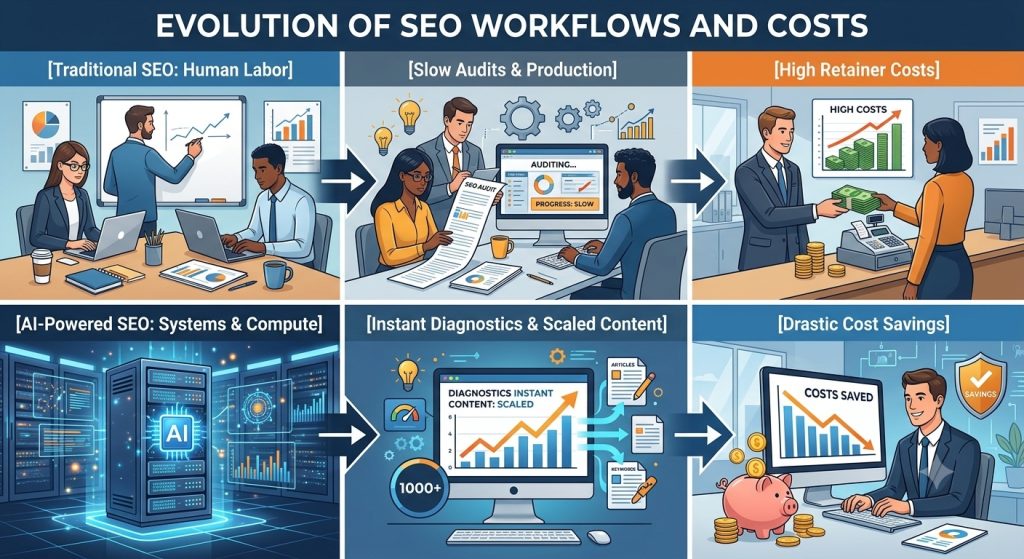
For more than two decades, corporate marketing campaigns relied on linear, human-driven models. Brands regularly retained a premium agency or hired a local SEO company to manage tasks like link acquisition, site monitoring, and manual page edits. This labour-heavy framework is why standard search engine optimisation pricing models remained tied to high monthly retainers.
Today, automated frameworks handle massive data processing in seconds. Modern protocols treat optimisation as a multi-layered process where technical precision, structural code, and algorithmic contextual relevance must match the technical requirements of LLM (Large Language Model) web crawlers.
The core difference in modern search engine optimisation pricing centres on the division between human labour hours and automated computing power. This structural change alters how marketing managers value tasks like an automated seo page analysis versus human strategic consulting.
While manual optimisation relies on slow production schedules, an advanced platform executes technical updates, schema adjustments, and complex content formatting instantly. For an enterprise looking to rank in highly competitive regions like the UK or globally, this difference in execution speed directly impacts visibility and return on investment.
Why Search Engine Optimisation Pricing Varies So Much
One of the biggest challenges when comparing SEO providers is the wide variation in pricing. A freelancer may charge a few hundred pounds per month, while a specialist agency may charge several thousand.
The difference is often not the deliverables themselves. Most providers offer keyword research, technical audits, content recommendations, on-page SEO and off-page SEO improvements, and reporting.
What changes is the depth of expertise, strategic involvement, and ability to prioritise actions that influence revenue.
Many businesses searching for terms such as seo cost, seo price, hire seo expert, or professional seo experts are often surprised by the range of options available. The reality is that SEO pricing reflects the complexity of the business, competition within the market, and the quality of decision-making behind the work.
Traditional SEO Pricing Explained
Traditional SEO pricing is generally based on human-led execution. Activities commonly include:
- Manual keyword research
- Content planning
- Technical audits
- Competitor analysis
- Backlink search and outreach
- SEO page analysis
- Homepage SEO improvements
- Internal linking optimisation
- Performance reporting
These tasks require significant time investment from specialists.
A traditional agency often allocates teams across technical SEO, content strategy, outreach, and account management. This structure creates higher operating costs, which are reflected in monthly retainers.
For businesses focused on search engine optimisation for ecommerce website growth, traditional SEO often involves extensive category optimisation, product page improvements, web optimisation projects, and platform-specific work such as BigCommerce SEO.
The Rise of AI-Powered SEO
Artificial intelligence has introduced new efficiencies into SEO workflows. AI tools can now assist with:
- Keyword clustering
- Content briefs
- Competitor analysis
- Site analyser SEO reporting
- Technical issue detection
- Internal linking suggestions
- SERP analysis
- Content optimisation
Tasks that previously required several hours can often be completed in minutes.
However, AI does not automatically produce better SEO outcomes. The challenge is that search engines increasingly reward expertise, relevance, and user value. Publishing large volumes of AI-generated content without a strategy often creates mediocre results.
This is why AI-powered SEO is not replacing experts. Instead, it is allowing professional SEO experts to spend less time on repetitive tasks and more time on strategic decision-making.
Traditional vs AI-Powered Search Engine Optimisation Pricing: Deconstructing the Hybrid Model
As modern search technology becomes more fragmented, budgeting requires a clear understanding of exactly where your funds are allocated. Traditional frameworks often bundle account management overhead into a single generic fee.
In contrast, modern pricing separates human strategic oversight from scalable automated workflows. This approach allows brands to invest significantly more of their capital directly into market-facing activities rather than administrative management.
| Operational Focus Area | Traditional Agency Pricing Framework | AI-Powered & Algorithmic Pricing Tier |
| Core Retainer Range | £2,500 – £10,000+ per month (Based on human hours) | £300 – £2,500 per month (Driven by computing resources) |
| Technical Site Analysis | Manual site analyzer seo review (Takes 2 to 4 weeks) | Programmatic real-time technical page diagnostics |
| Content Production | Human copywriting at £150 – £300 per single article | Automated content seeding with human expert review |
| Search Framework Focus | Standard Google SEO optimisation and keyword ranking | Full AEO, GEO, and multi-model AI answer citation tracking |
| E-Commerce Scaling | High manual workload per SKU for platforms like BigCommerce | Automated search engine optimisation for e-commerce websites |
| Delivery Turnaround | Standard 6 to 12 week rollout schedules | High-speed, real-time optimization updates |
While AI reduces operational effort, businesses should not assume search engine optimisation pricing will fall proportionally. Much of the value comes from interpreting data, prioritising actions, and aligning SEO with commercial objectives.
How AI Is Changing SEO Cost Models
Historically, SEO pricing was often tied to hours worked. Today, many agencies are moving towards value-based pricing. Instead of charging purely for activities completed, agencies increasingly price based on:
- Strategic oversight
- Business complexity
- Market competitiveness
- Revenue opportunities
- Ecommerce growth potential
- GEO and AEO implementation
This shift reflects a broader industry trend where AI reduces production costs while increasing the importance of expertise. The businesses benefiting most are often those looking beyond rankings and focusing on website ranking and traffic quality, conversion opportunities, and long-term growth.
The Impact of GEO and AEO on SEO Pricing
Modern search is no longer limited to traditional Google rankings. Generative Engine Optimisation (GEO) focuses on visibility within AI-generated search results. Answer Engine Optimisation (AEO) focuses on appearing in direct answers, featured snippets, and AI summaries. These developments are influencing search engine optimisation pricing because they require additional work beyond traditional SEO.
Businesses now need:
- Structured data implementation
- Entity optimisation
- Semantic content development
- Authority building
- AI citation optimisation
- Content designed for answer engines
As AI search adoption increases, SEO services that incorporate GEO and AEO are becoming more valuable than conventional ranking-focused approaches.
Ecommerce SEO Pricing in the AI Era
For ecommerce brands, pricing considerations become even more complex. Large catalogues require product page optimisation, category page optimisation, homepage SEO improvements, internal linking structures, technical SEO enhancements, schema implementation, and conversion-focused content.
Platforms such as BigCommerce create additional requirements around site architecture and scalability. BigCommerce SEO and BigCommerce search engine optimisation projects often require a combination of technical expertise and ecommerce strategy. AI can speed up analysis and content planning, but strategic oversight remains critical.
For ecommerce businesses, SEO should support customer acquisition, category visibility, and conversion performance rather than focusing solely on site traffic rankings.
Should AI-Powered SEO Be Cheaper?
This is one of the most common questions businesses ask. The answer depends on what is being delivered. If a provider simply uses AI to generate content and automate reports, costs may be lower. However, lower pricing often comes with reduced strategic involvement.
If AI is used to improve efficiency while experienced consultants focus on planning, prioritisation, and execution, pricing may remain similar while delivering greater value. The better question is not whether AI reduces SEO cost. The better question is whether AI allows your SEO investment to achieve more meaningful outcomes.
How to Evaluate SEO Pricing Properly
Businesses comparing search engine optimisation pricing should assess:
- Strategic Expertise: Technology is becoming widely available. Strategic thinking remains the differentiator.
- Technical Capability: Strong technical SEO supports indexing, crawling, and user experience.
- Ecommerce Understanding: Search engine optimisation for ecommerce website growth requires understanding customer journeys, conversion pathways, and category structures.
- GEO and AEO Readiness: Future-focused SEO should include visibility beyond traditional search engines.
- Measurement Framework: Metrics should focus on business performance rather than vanity metrics.
Website traffic rating, organic visibility, customer acquisition, and revenue impact often provide more useful insights than rankings alone.
The Future of Search Engine Optimisation Pricing
The future of SEO pricing will likely move further away from activity-based billing. As AI continues automating repetitive tasks, businesses will increasingly pay for strategic direction, prioritisation, commercial insight, technical expertise, cross-channel optimisation, GEO and AEO implementation.
The providers that combine human expertise with AI efficiency are likely to deliver the strongest outcomes. This creates an environment where search engine optimisation pricing reflects business value rather than simply hours worked.
Conclusion
Search engine optimisation pricing is evolving as artificial intelligence changes how SEO work is delivered. While AI can reduce the time required for research, content workflows, SEO page analysis, site analyser SEO reviews, and web optimisation activities, it does not replace the expertise needed to make effective growth decisions. The strongest SEO strategies combine technology with human judgment, helping businesses improve website ranking and traffic quality, strengthen Google SEO optimisation, support SEO page rank performance, and build visibility across traditional search, GEO, and AEO environments.
At Want SEO, we believe SEO should help businesses make better growth decisions, not simply create more activity. Our team combines technical expertise, ecommerce experience, AI-assisted workflows, and commercial reasoning to identify where effort compounds and where it does not. Whether you need SEO for a new site, want to improve BigCommerce SEO performance, or are looking for a top local SEO company in the UK, we help prioritise the actions most likely to support sustainable growth.
If you are reviewing your current search engine optimisation pricing or considering AI-powered SEO, speak with Want SEO to explore the opportunities, trade-offs, and priorities that matter most.
FAQs
1. What is the average search engine optimisation pricing in the UK?
SEO pricing varies based on competition, scope, and expertise. Small businesses may invest a few hundred pounds monthly, while larger ecommerce brands often require more comprehensive retainers.
2. Does AI reduce SEO cost?
AI can reduce the time required for research, reporting, and content workflows. However, strategic planning and expert oversight remain essential, so pricing does not always decrease significantly.
3. How does AI integration change standard search engine optimisation pricing structures?
AI integration shifts the primary pricing metric from human billing hours to computing resource scale. This allows platforms to lower the costs of repetitive technical audits, metadata generation, and content formatting, letting agencies focus human expertise on high-level strategy and digital PR.
4. What is the core difference between traditional search optimisation and GEO?
Traditional optimisation focuses on improving visibility within standard organic link listings on search engines like Google. Generative Engine Optimisation (GEO) formats and structures your digital content so it can be cleanly read, analysed, and cited as a trusted source inside generative AI responses.
5. How do automated optimisation tools impact large-scale e-commerce platforms?
For platforms like BigCommerce, automation allows you to execute mass updates across thousands of product SKUs simultaneously. Systems can dynamically optimise product page text, fix broken link paths, and implement clean schema formatting without requiring slow, manual page-by-page edits.
6. Should a business completely replace human strategies with automated platforms?
No, the most effective approach is a hybrid model. While automated tools excel at processing data, tracking search engine positions, and executing structural updates, human oversight remains essential for creative brand positioning, complex planning, and building authentic industry relationships.