What is Keyword Density & How Important is it for SEO in 2026?
Keyword Density has been part of SEO conversations for more than two decades. It was once considered one of the most important ranking factors, leading many websites to obsess over percentages and repeat keywords excessively in an attempt to rank higher. Today, search engines have become significantly more sophisticated.
In 2026, Keyword Density still has a role in helping search engines understand page relevance, but it is no longer something that should be optimised in isolation. Google’s algorithms, AI-powered search experiences, Generative Engine Optimisation (GEO), and Answer Engine Optimisation (AEO) all prioritise context, intent, topical authority, and user experience over simple keyword repetition.
At Want SEO, our professional SEO experts have researched and refined this guide using current SEO practices, AI search developments, and real-world ecommerce optimisation projects. Rather than chasing outdated formulas, the focus should be on creating content that naturally answers user questions while remaining SEO friendly.
Key Takeaways
- Keyword Density still matters, but natural language and search intent matter much more.
- AI search engines evaluate context, entities, topical authority, and semantic relationships instead of keyword frequency alone.
- Good content balances Keyword Density with user experience, readability, and comprehensive topic coverage.
- Modern SEO combines Google SEO optimisation, GEO, AEO, technical SEO, and quality content rather than relying on keyword percentages.
What is Keyword Density?
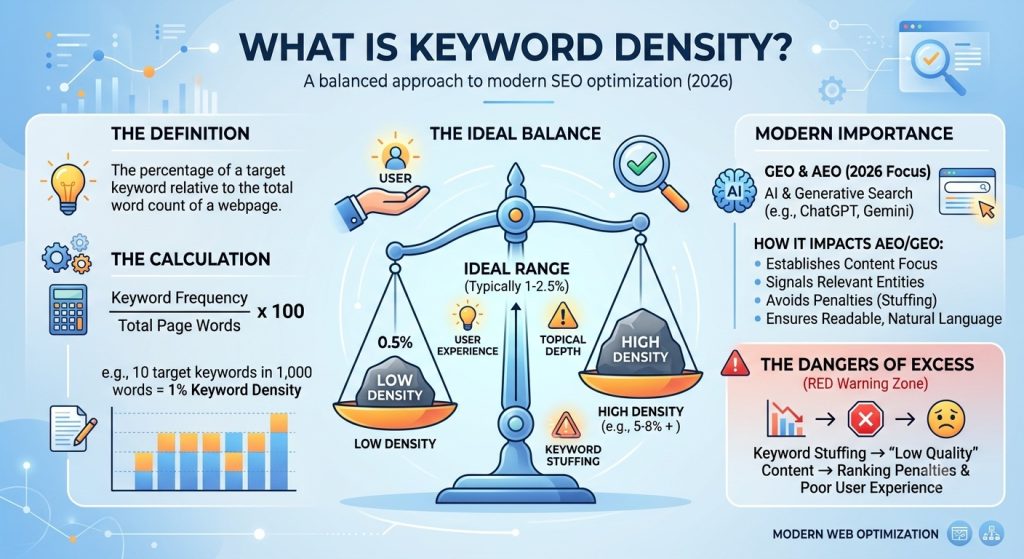
To fully grasp its role in modern web optimisation, one must understand how it is measured. Keyword Density is calculated by dividing the number of times a target keyword appears on a webpage by the total number of words on that page, then multiplying the result by 100.
For instance, if your target term, perhaps something specific like BigCommerce search engine optimisation, appears 10 times in a 1,000-word blog post, the density for that specific term is 1%. Keyword Density refers to how often a target keyword appears on a webpage compared to the total number of words. The traditional formula is:
Keyword Density = (Number of Keyword Occurrences ÷ Total Number of Words) × 100
For example:
| Total Words | Keyword Uses | Keyword Density |
| 1,000 | 10 | 1% |
| 1,500 | 15 | 1% |
| 2,000 | 20 | 1% |
| 2,500 | 25 | 1% |
While this calculation remains accurate, Google no longer rewards pages simply because they achieve a particular percentage. Instead, search engines evaluate whether the content genuinely answers the user’s question.
Does Keyword Density Still Matter in 2026?
Yes, but not in the way it once did. Modern search engines understand language using Natural Language Processing (NLP), machine learning, semantic search, and AI models. Rather than counting exact keyword matches, Google evaluates:
- Topic relevance
- Search intent
- Entity relationships
- User satisfaction
- Content quality
- Internal linking
- Expertise and authority
Keyword Density now acts as a relevance signal instead of a ranking formula.
A page that naturally mentions its primary keyword throughout the content is generally easier for search engines to understand than one that never mentions it. However, excessive repetition often makes content less readable and can reduce overall quality.
Why Keyword Density Was Once So Important
In the early days of SEO, search engines relied heavily on exact keyword matching. Many websites attempted to manipulate rankings by repeating keywords dozens or even hundreds of times. This practice became known as keyword stuffing. Typical examples included:
“Looking for Keyword Density? Our Keyword Density guide explains Keyword Density because Keyword Density improves Keyword Density.”
While this may have worked years ago, modern algorithms recognise this behaviour immediately. Today, keyword stuffing damages user experience and may reduce search visibility.
What is the Ideal Keyword Density?
There is no official percentage recommended by Google. Many SEO professionals naturally achieve between 0.8% and 2%, but this happens because the topic is discussed thoroughly rather than because they are aiming for a specific number.
Instead of asking:
“What percentage should I use?”
A better question is:
“Does the page clearly demonstrate what it is about?”
If the answer is yes, your Keyword Density is usually sufficient.
How AI Has Changed Keyword Optimisation
Artificial intelligence has fundamentally changed search. Google’s AI systems understand synonyms, related concepts, user intent, context, and semantic relationships.
For example, an article about Keyword Density may naturally include phrases such as SEO page analysis, Google SEO optimisation, web optimisation, homepage SEO, SEO page rank, on-page SEO, off-page SEO, SEO-friendly content, and professional SEO experts.
Google recognises these relationships without requiring exact repetition. This is why modern content often performs better when it focuses on complete topic coverage rather than exact-match keywords.
Strategic Keyword Placement and Natural Language
The true art of google seo optimization in 2026 lies in the seamless integration of key terms. Strategic placement often yields better results than simply increasing frequency. Key areas to place primary keywords naturally include:
- Page Title (H1 Tag): Essential for both users and search engines.
- Title Tag: Critical for seo page rank.
- Subheadings (H2, H3): Helps structure content for readers and AI summaries.
- Introduction: Establishes the page topic early.
- Meta Description: Improves click-through rate from search results.
By integrating your target terms, such as professional seo experts, thoughtfully in these areas, you provide strong signals to search engines about the page’s core focus without relying on excessive frequency that might inflate your overall density metric. This natural, context-aware approach ensures your content remains both valuable to the reader and optimised for site traffic rankings. It’s about balance: acknowledging the role of Keyword Density while prioritising user experience and semantic depth.
For complex projects, such as optimising an online store, a professional may manage on page seo and off page seo with these contextual factors in mind, as BigCommerce search engine optimisation requires a specific approach that often requires a higher initial level of technical understanding and careful planning.
Keyword Density and Generative Engine Optimisation (GEO)
Generative AI search platforms do not simply retrieve webpages; they actively generate comprehensive answers by synthesising information from trusted online sources. Because of this architectural shift, Generative Engine Optimisation (GEO) heavily rewards content that demonstrates clear expertise, strong topical authority, structured headings, and helpful explanations.
While maintaining a natural Keyword Density helps establish initial thematic relevance, it is ultimately the depth, reliability, and structured clarity of your content that determine whether AI systems will choose to cite and display your website as an authoritative source.
Keyword Density and Answer Engine Optimisation (AEO)
Answer engines are engineered to deliver direct, instantaneous responses to user queries. Content that performs exceptionally well in Answer Engine Optimisation (AEO) typically incorporates concise definitions, logical heading structures, clear FAQs, and natural keyword placement.
Rather than repeating a target phrase excessively throughout every paragraph to artificially inflate Keyword Density, modern answer engines explicitly favour comprehensive pages that explain a concept thoroughly and structurally using fluent, natural language.
Keyword Density for Ecommerce SEO
For ecommerce businesses, Keyword Density becomes part of a much larger optimisation strategy. Whether you are investing in search engine optimisation for ecommerce website projects or BigCommerce search engine optimisation, your product pages should naturally include target keywords while remaining useful for shoppers.
For example, a BigCommerce SEO strategy should combine:
- Optimised product titles
- Helpful descriptions
- Internal linking
- Technical SEO
- Schema markup
- Fast loading pages
- Clear product information
This creates content that serves both users and search engines.
Should Every Page Target One Keyword?
No. Modern SEO focuses on topics rather than individual keywords. A page about Keyword Density may naturally rank for related searches, including keyword optimisation, SEO page analysis, homepage SEO, Google SEO optimisation, SEO page rank, web optimisation, SEO friendly writing, website ranking and traffic, and website traffic rating. Search engines understand these relationships without requiring separate pages for every variation.
How Keyword Density Supports On Page SEO
Keyword placement still matters. Your primary keyword should appear naturally in important areas, including:
- Title tag
- H1 heading
- Introduction
- Meta description
- One or more H2 headings
- Image alt text where relevant
- Conclusion
Beyond that, natural writing is far more valuable than forcing additional repetitions. Strong on-page SEO works alongside technical SEO, user experience, internal linking, and quality content.
The Dangers of Keyword Stuffing and Strict Benchmarks
One of the biggest pitfalls when managing website traffic rating is the temptation to artificially inflate keyword use. The practice known as “keyword stuffing” is not only ineffective but also a direct violation of quality guidelines. Google and other search engines are adept at identifying unnaturally repetitive content. This can lead to ranking demotions and, in severe cases, penalties.
The real importance of monitoring Keyword Density is to ensure your content is safe from these pitfalls. An incredibly high percentage (such as over 4-5%) is often a sign of forced language and is likely to degrade the user experience, negatively impacting your website ranking and traffic. It’s often helpful to think of a balanced approach as being “friendly” to both search engines and human readers.
Keyword Density vs Keyword Stuffing
| Good Optimisation | Keyword Stuffing |
| Natural language | Repetitive phrases |
| User focused | Search engine focused |
| Covers the topic fully | Repeats one keyword excessively |
| Includes related terms | Uses exact match repeatedly |
| Easy to read | Poor readability |
The goal is to make content useful first. Search rankings usually follow.
Modern Methods of Semantic Content Optimisation
As we’ve established, the best approach is holistic. Modern content strategy incorporates semantic optimisation by focusing on:
- Synonyms and Related Terms: Using language variation that naturally occurs in authoritative content.
- Topical Depth: Covering all necessary subtopics for comprehensive understanding.
- Structure and Readability: Formatting content with lists, subheads, and short paragraphs.
This approach often means your core density percentage will be moderate (typically below 2.5% for the main term), while the presence of dozens of other relevant terms builds the page’s authority.
Understanding Keyword Benchmarks
To help visualise how modern strategies approach this metric across different content types, the following table provides typical benchmarks for target Keyword Density.
| Content Type | Primary Target Term Focus | Typical Percentage Range | Core Optimisation Strategy |
| High-Volume Blog Post / Informational Guide | High (focused topic) | 1.0% – 2.5% | Direct term use in key headings; heavy semantic variation and related entity mentions to build topical depth. |
| Product Detail Page (E-commerce) | Moderate (specific product name) | 0.8% – 2.0% | Term used in page title and headings; focus on unique, non-repetitive product copy, specifications, and structured data for AEO. |
| Service Category Page | High (service type) | 1.2% – 2.8% | Clear definition of service; integration with related services, customer pain points, and geographic modifiers for local relevance. |
| Homepage SEO | Lower (brand-focused) | 0.5% – 1.5% | Brand name in primary positions; focus on a broad range of core services and establishing entity authority for web optimisation. |
| Informational Hub Page / Pillar Content | Moderate (broad topic) | 0.7% – 2.2% | Topic introduced early; emphasis on broad coverage of core subtopics and internal links rather than high density for one term. |
Measuring Keyword Density via Tools
Several SEO tools calculate Keyword Density automatically during SEO page analysis. However, these numbers should only be used as guidance. Instead, evaluate:
- Does the content answer the user’s question?
- Is the primary keyword used naturally?
- Are related entities included?
- Is the page easy to read?
- Does it demonstrate expertise?
These signals are significantly more valuable than chasing an exact percentage.
Keyword Density and Backlinks
Some marketers still believe backlinks alone determine rankings. In reality, quality content and authority work together. A strong backlink search may identify opportunities to earn links, but those links are far more valuable when pointing to genuinely helpful, comprehensive content. Keyword Density supports relevance, while backlinks support authority. Neither should be viewed independently.
Why User Experience Matters More Than Keyword Density
Google increasingly measures how users interact with content. Poor readability, confusing structure, and repetitive writing reduce engagement. Well-structured articles with logical headings, useful examples, and natural keyword usage are more likely to earn:
- Better engagement
- Longer session duration
- Higher trust
- More citations from AI search engines
- Improved visibility across traditional search
This is where web optimisation and content optimisation work together.
Should You Hire an SEO Expert?
Keyword Density is only one small component of SEO. Businesses that want sustainable growth usually benefit from working with experienced professionals who understand technical SEO, AI search, content strategy, ecommerce optimisation, and conversion optimisation together.
If you plan to hire SEO expert support, look for agencies that explain their reasoning rather than simply promising rankings. Effective SEO requires strategic thinking, not just keyword placement.
Why Choose Want SEO as Your Optimisation Partner
Choosing a digital partner in 2026 requires moving past agencies that still rely on outdated marketing playbooks. Want SEO has researched and developed the core framework of this guide, pioneering an analytical approach that treats optimisation as an advanced, multi-layered digital discipline. We bypass legacy keyword-stuffing tactics to deliver data-backed strategies built specifically for the era of AI-driven search models.
- Advanced Tech Integration: We align your digital assets with modern AEO, GEO, and generative search structures, turning your text into highly structured data that AI models readily cite.
- Deep E-Commerce Expertise: Our team executes scalable search engine optimisation for ecommerce website programs, programmatically managing complex platform demands like BigCommerce search engine optimisation without manual delays.
- Verified Analytical Auditing: Every campaign begins with a comprehensive, automated seo page analysis to clean up technical errors, improve homepage seo, and boost your overall website traffic rating.
- Dual Market Mastery: Whether you want to establish undeniable local dominance as the best local seo company in the UK or scale your digital operations to command international site traffic rankings, our workflows adjust perfectly to your growth targets.
Conclusion
Keyword Density remains relevant in 2026, but only as one signal within a much larger search ecosystem. Google, AI search platforms, GEO, and AEO all prioritise content that demonstrates expertise, answers user intent, and delivers genuine value. Rather than chasing a perfect percentage, businesses should focus on creating comprehensive, SEO friendly content that naturally incorporates important keywords while improving website ranking and traffic over time.
At Want SEO, our professional SEO experts help businesses make better growth decisions through data-driven SEO, AI-first content strategies, technical optimisation, and ecommerce SEO. Whether you’re looking for homepage SEO, Google SEO optimisation, or a complete search engine optimisation strategy, we focus on clarity before activity. If you’re ready to improve long-term visibility across traditional search and AI-powered discovery, contact Want SEO to build a strategy that delivers sustainable growth.
FAQs
1. What is a good Keyword Density for SEO?
There is no “perfect” or official ideal percentage. Most modern tools and professional seo experts suggest a natural approach, often yielding a density between 1% and 2.5% for primary terms, while prioritising context and user value rather than hitting a specific number.
2. Does Google use Keyword Density as a ranking factor?
Google uses keywords to understand page relevance, but modern algorithms place much greater emphasis on search intent, content quality, topical authority, and user experience.
3. Can Keyword Density improve AI search visibility?
Indirectly, yes. Natural keyword usage helps AI understand the topic, while GEO and AEO rely more heavily on comprehensive answers, semantic relevance, and authority.
4. Can a high Keyword Density penalize my website ranking?
Yes. Extremely high densities (keyword stuffing) are identified as manipulation attempts and will harm your google seo optimization efforts, reducing site traffic rankings and potentially leading to penalties.
5. How can I improve Keyword Density naturally?
Write comprehensive content around a topic, include related keywords and entities, optimise headings, and focus on answering user questions instead of repeating the same phrase unnecessarily.
6. Is it necessary to use exact-match keywords in 2026?
While useful in key areas like titles and headers, modern semantic search and GEO processes often understand context and related concepts, meaning exact matches are not always required for visibility.
7. How does search intent relate to density?
Search intent is paramount. If your page provides a direct, comprehensive answer to a user query (vital for AEO), the optimal keyword frequency will naturally align with providing that value, often making the overall density a secondary concern.