
10 Trust Signals That Persuade AI Engines to Surface Your Content
AI search has changed what it means to be visible online. A page can rank well in traditional search and still be overlooked when someone asks ChatGPT, Google AI Mode, Perplexity, Gemini or another AI engine for a recommendation. The reason is simple: trust signals matter. AI systems need to decide which information is credible enough to include in an answer, cite as a source or use when forming a recommendation. They can draw on your website, reviews, third-party publications, author profiles, business information, structured data and other signals across the web.
Google’s current guidance makes an important point here. The same foundational SEO principles that support traditional search also apply to AI Overviews and AI Mode. There is no separate piece of “AI markup” that guarantees inclusion. Instead, sites should focus on technically accessible, helpful, reliable, people-first content and make important information easy to understand.
That creates a more useful way to think about trust signals. They are not an AI SEO trick. They are evidence that helps search engines, answer engines and potential customers understand who you are, what you know and why your information deserves attention.
This guide, researched and worked through by the team at Want SEO, explains the 10 trust signals we believe modern businesses should prioritise if they want stronger SEO, AEO and GEO foundations.
Key takeaways
- AI engines increasingly need evidence of experience, expertise, authority and trust before confidently surfacing information.
- Strong trust signals come from both your website and your wider digital footprint, including reviews, mentions, authors, citations and consistent business information.
- There is no single AI ranking factor that guarantees visibility. The stronger approach is to build a connected ecosystem of credible signals.
- For eCommerce brands, trust signals should support commercial decisions, not simply chase rankings, mentions or traffic.
What are trust signals in SEO and AI search?
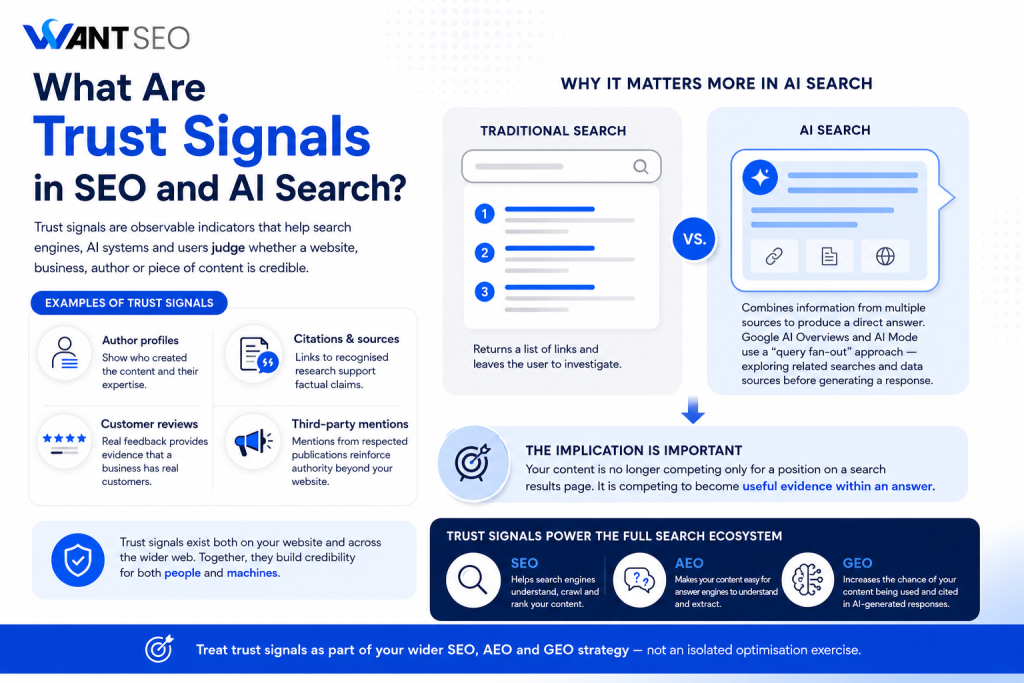
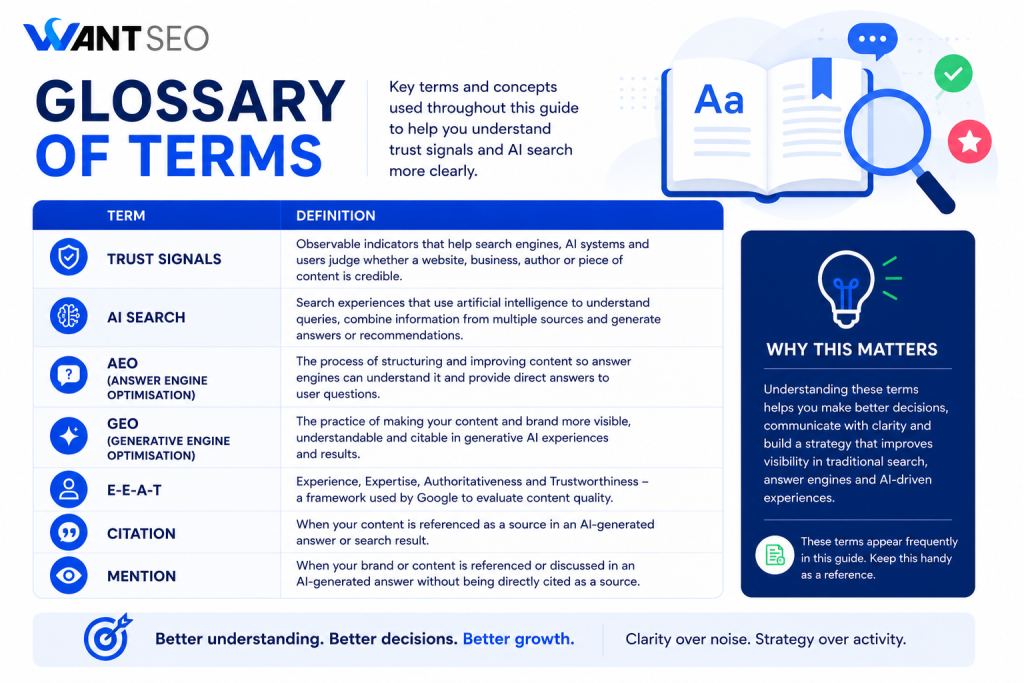
Trust signals are observable indicators that help search engines, AI systems and users judge whether a website, business, author or piece of content is credible. Some trust signals exist directly on your website. Others exist elsewhere. For example, a detailed author profile can demonstrate who created an article. A citation to a recognised research source can support a factual claim. Customer reviews can provide evidence that a business has real customers. A mention from a respected publication can reinforce authority beyond your own website.
This matters even more as search becomes conversational. Traditional search can return ten blue links and leave the user to investigate. AI search often does more of the interpretation itself. Google AI Overviews and AI Mode, for example, can combine information from multiple searches and sources to produce a response. Google says these experiences may use a “query fan-out” approach, exploring related searches and data sources before generating an answer.
The implication is important. Your content is no longer competing only for a position on a search results page. It is competing to become useful evidence within an answer. That is why trust signals should be treated as part of your wider SEO, AEO and GEO strategy rather than as an isolated optimisation exercise.
Why trust signals matter more for AI visibility
AI engines have to make decisions about sources at a different level from traditional search. They need to determine whether a source is relevant, whether its claims are credible, whether the information is sufficiently clear to extract and whether it fits the question being asked. Research and industry analysis increasingly point towards authority, citations, brand mentions, reviews, freshness and consistent digital presence as important parts of this wider picture.
Search Engine Land has highlighted how AI systems assess signals such as accuracy, authority, transparency and freshness when determining whether content appears trustworthy. Neil Patel’s recent research into AEO similarly points towards brand mentions, reviews, relevance, recommendations and authority as factors associated with whether brands are surfaced in AI-generated answers. There is an important distinction, however.
Trust signals do not mean there is a checklist you can complete and automatically earn AI visibility.
AI systems vary. ChatGPT, Google Gemini, Claude and Perplexity do not necessarily retrieve or evaluate information in exactly the same way. Search Engine Land’s analysis of AI citation data has found meaningful differences between platforms, industries and search intent. The better strategy is therefore to build a digital presence that remains credible across multiple retrieval systems.
The 10 trust signals that matter for AI search
Unlike traditional search algorithms that prioritise keyword density and backlinks, AI engines evaluate sources through a strict filter of safety, entity clarity, and real-world authority. Before a generative model will cite your brand as a definitive answer, it must first verify that your business is legitimate, reputable, and risk-free to recommend.
These 10 trust signals form the bedrock of machine confidence in generative search:
1. Demonstrable first-hand experience
Experience is one of the most important trust signals because it answers a basic question: “Have you actually done this?”
There is a significant difference between rewriting information found elsewhere and explaining something from genuine experience. For an eCommerce brand, first-hand experience could include explaining how a product is used, showing original testing, publishing customer research, sharing operational insights or documenting what happened when a particular strategy was implemented.
For an SEO consultancy, it could mean explaining why a technical recommendation was made, showing anonymised examples, discussing trade-offs or documenting lessons from real campaigns. Google’s E-E-A-T framework places experience alongside expertise, authoritativeness and trustworthiness. Neil Patel’s explanation of E-E-A-T also emphasises the value of first-hand experience when determining whether content demonstrates genuine knowledge of its subject.
This is particularly relevant to AI search because generic information is increasingly easy to produce. If ten websites repeat the same definition, the one that adds original evidence, examples or experience gives an AI system more useful information to work with.
2. Clear author expertise and accountability
An article should not feel as though it appeared from nowhere. A clear author name, relevant biography and evidence of expertise give readers and search systems additional context about who is responsible for the information. Google’s current Article structured data guidance recommends identifying authors clearly and using properties such as “url” or “sameAs” to help Google understand the author.
That does not mean adding an impressive-looking biography simply for SEO. The author needs to be relevant to the subject. If you publish an article about technical SEO, the author should have a credible connection to technical SEO. If the topic requires specialist knowledge, consider editorial review from a qualified subject matter expert.
This creates a stronger relationship between the content, the person behind it and the expertise being claimed. For AI visibility, that context can become another supporting layer in the overall trust picture.
3. Original research and evidence
Original evidence is one of the clearest ways to separate useful content from commodity content. Instead of saying: “Reviews are important for consumers.”
You could publish your own analysis of customer reviews, identify patterns across hundreds of responses and explain what those patterns mean for purchasing behaviour. Instead of saying: “AI search is changing SEO.”
You could analyse your own AI visibility data and explain what changed across a defined set of prompts. Original research creates something other websites can reference. That matters because AI search visibility is not only about publishing more pages. It is also about becoming a source that other information can build upon. Search Engine Land has highlighted the role of original data and influence in determining which brands are retrieved and cited by AI systems. The commercial principle is straightforward:
Create evidence that is worth citing, rather than content that merely deserves to rank.
4. Relevant third-party mentions
Your website can say whatever it wants about your business. Third parties provide a different form of evidence. Mentions from respected publications, industry organisations, expert communities and relevant websites can strengthen your wider digital footprint. This is particularly important for GEO because AI systems do not only understand brands through their own websites. They can encounter brands through publications, directories, reviews, forums, social platforms and other sources.
Search Engine Land’s analysis of millions of AI citations found that a significant proportion came from brand-controlled sources, but third-party sources remain part of the wider information ecosystem AI systems use to understand brands. The goal should not be to manufacture mentions. Instead, create something genuinely useful enough to earn them. Original research, expert commentary, useful tools, strong data, distinctive opinions and genuine thought leadership can all create reasons for other websites to reference your business.
5. High-quality customer reviews
Reviews are a particularly powerful trust signal because they connect your claims with customer experience. A business can describe itself as reliable, knowledgeable or high quality. Reviews provide another perspective. For eCommerce brands, this becomes even more important because customers often use reviews to validate product quality, service reliability and value before purchasing.
AI systems can also encounter review information outside your own website. Neil Patel’s AEO research identifies reviews as one of the factors associated with brand visibility in AI-generated recommendations. The important point is quality and consistency. A large number of vague reviews is not automatically more valuable than a smaller number of detailed reviews that explain what customers actually experienced.
Google’s reviews system also focuses on high-quality review content that provides insightful analysis and original information rather than thin summaries. For businesses with local intent, this becomes particularly relevant. Someone searching for a top local seo company or the best local seo company in UK is not simply looking for a page containing those phrases. They want evidence that the company is credible. Reviews, client experiences, relevant mentions and clear expertise provide that evidence.
6. Consistent business and brand information
AI systems need to understand what an entity is. If your website says one thing, your Google Business Profile says another, directory listings contain outdated information and third-party profiles use different descriptions, you create unnecessary ambiguity. Consistency should cover the fundamentals:
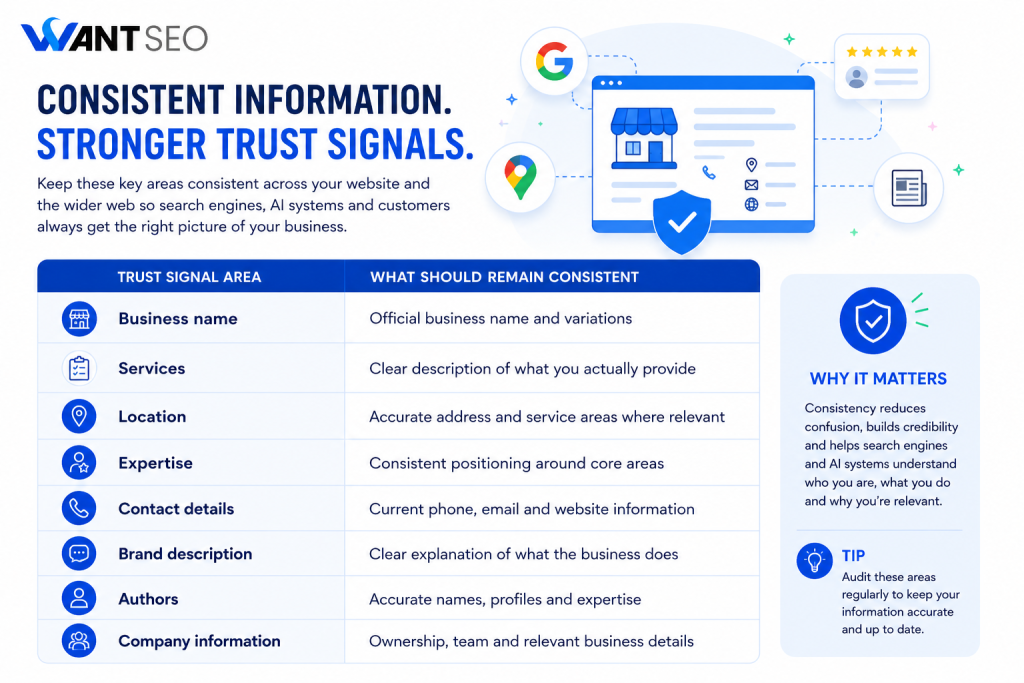
This does not mean every website needs identical wording. It means the underlying facts should tell the same story. Neil Patel’s AEO research makes a similar point when discussing business information and the importance of making it easy for AI systems to confirm who a business is and what it offers. For local SEO, this also matters because local search and AI search increasingly overlap. A company aiming to become recognised as the best search engine optimisation expert in a particular market needs more than a keyword-focused landing page. It needs a consistent, credible presence across the web.
7. Transparent sourcing and citations
If you make an important claim, show where it came from. Citations are useful for both users and machines because they make information easier to verify. This becomes particularly important when discussing statistics, research, market changes, technical standards or claims about how search engines operate. Strong sourcing should answer:
- Where did this information come from?
- Is the source credible?
- Is it current?
- Does the source actually support the claim?
- Can the reader investigate it further?
This is one reason why citations can become valuable trust signals in AI search. Search Engine Land’s recent research distinguishes between AI mentions and AI citations. A mention shows that a brand appears in an answer, while a citation indicates that content has been used as a source. The distinction matters. A brand can be recognised without being trusted as the underlying source. The stronger objective is to build content that is both recognisable and source-worthy.
8. Freshness and visible content maintenance
Trust is difficult to maintain when information becomes outdated. An article published three years ago may still be useful. But if it contains obsolete statistics, discontinued products, outdated SEO advice or references to old search features, its credibility weakens. Freshness is particularly important in areas such as:
- AI search
- SEO
- AEO
- GEO
- technology
- legislation
- finance
- products
- software
- industry research
This does not mean changing the publication date every few weeks. It means reviewing important content when the underlying information changes. Google’s guidance for AI features continues to emphasise helpful, reliable, people-first content and strong foundational SEO rather than shortcuts designed specifically for AI systems. A practical approach is to maintain a content review process that checks whether claims, statistics, links, examples and recommendations remain accurate.
9. Technical accessibility and structured data
Trust is not only about reputation. AI systems and search engines also need to access and understand your information. A technically excellent article that cannot be crawled, indexed or understood properly has limited visibility potential. Google specifically recommends foundational practices such as allowing crawling, making content discoverable through internal links, providing important information in text and ensuring structured data matches the visible content.
Structured data can provide explicit clues about what a page represents. Google explains that structured data helps it understand page content and can support enhanced search appearances. But there is an important distinction here. Structured data is not a trust shortcut.
Adding schema does not magically make weak content authoritative. It should accurately describe information already present on the page. Google explicitly states that structured data must represent visible content and that correct implementation does not guarantee a particular search appearance. Think of technical SEO as making your evidence easier to discover and interpret. It cannot substitute for having good evidence in the first place.
10. A consistent entity and brand footprint
The final trust signal brings everything together. AI systems need to understand not just individual pages, but the broader entity behind them. That means your brand should have a coherent digital footprint across your website, relevant publications, reviews, social profiles, directories, industry references and other credible sources. Search Engine Land describes this as brand depth, where AI systems can recognise and retrieve a brand through a connected presence across reviews, media coverage, search systems and related web entities.
This is why publishing hundreds of disconnected blog posts is unlikely to be the strongest long-term strategy. A better approach is to build depth around the subjects you genuinely want to be known for. For Want SEO, for example, that means creating a connected body of work around eCommerce SEO, CRO, AEO, GEO and AI search, while consistently explaining the commercial reasoning behind those disciplines. Over time, this creates a clearer association between the brand and the topics it understands.
How the 10 trust signals work together
The biggest mistake is treating these trust signals as isolated tasks. Adding an author bio will not suddenly make your content authoritative. Adding five reviews will not compensate for poor customer experience. Adding schema will not turn generic content into original research. Building backlinks will not fix inconsistent business information. The signals become more useful when they reinforce one another.
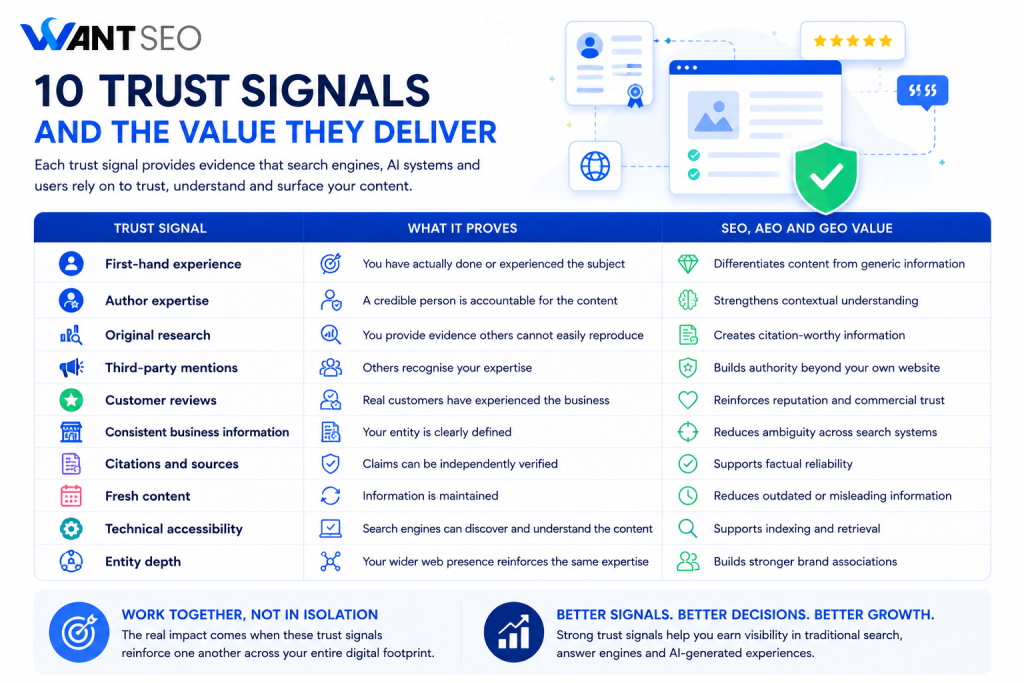
The commercial question is therefore not: “How many trust signals do we have?” It is: “Do the signals across our digital footprint tell a consistent and credible story?” That is a much more useful question.
Trust signals, E-E-A-T, AEO and GEO
These concepts are closely connected, but they are not interchangeable.
- E-E-A-T provides a useful framework for thinking about experience, expertise, authoritativeness and trustworthiness.
- SEO makes your website discoverable and understandable through search engines.
- AEO, or Answer Engine Optimisation, focuses more heavily on making information useful and accessible for answer-based search experiences.
- GEO, or Generative Engine Optimisation, considers how brands and content appear within generative AI experiences.
Trust signals sit underneath all four. For example, a strong author profile supports E-E-A-T. Clear question-and-answer structures can support AEO. Original research and third-party references can strengthen GEO. Technical accessibility supports traditional SEO and AI search alike. Google itself is clear that there is no separate technical requirement for AI Overviews or AI Mode. Existing SEO fundamentals remain important.
That means businesses should be cautious about anyone selling a secret AI optimisation formula. There isn’t one. The more durable strategy is to make your business easier to understand, easier to verify and more useful to the people and systems evaluating it.
What trust signals mean for eCommerce brands
For eCommerce businesses, trust signals should extend beyond the blog. A customer deciding whether to purchase a product may encounter your brand through Google Search, an AI assistant, a marketplace, a review platform, social media or a recommendation from another website. Each interaction contributes to the customer’s perception of the business. That means your product pages should provide clear information about the product, availability, pricing, delivery, returns and relevant specifications.
- Your reviews should reflect genuine customer experience.
- Your category pages should explain meaningful differences between products.
- Your editorial content should answer questions rather than simply insert keywords.
- Your brand should also be represented consistently outside your website.
This is particularly important as AI search increasingly becomes part of product discovery. Search Engine Land’s recent eCommerce analysis of Home Depot’s AI visibility found that strong visibility is connected to a broader strategy rather than one isolated SEO tactic. For an eCommerce founder, that leads to a practical priority:
Build the evidence that helps a customer make a decision.
That evidence is also more likely to help search engines and AI systems understand why your brand deserves consideration.
How Want SEO approaches trust signals
At Want SEO, we do not see SEO, AEO and GEO as separate activities that should be managed in isolation. The stronger approach is to understand the user’s intent first, identify what information is needed to make a decision and then determine where effort will have the greatest commercial impact. That means asking questions such as:
- What does the customer need to believe before buying?
- What evidence is currently missing?
- Which claims need stronger support?
- Where is the brand inconsistent?
- Which topics should the business genuinely be known for?
- Which content deserves to be updated rather than replaced?
- Which trust signals are already strong?
- Which gaps create the greatest commercial risk?
This is where strategy becomes more important than activity. A top local seo company may have hundreds of reviews but weak evidence of expertise. Another company may have excellent expertise but very little third-party recognition. A business positioning itself as the best local seo company in UK needs to demonstrate why that claim is credible rather than simply repeating it across landing pages.
Likewise, a business looking for the best search engine optimisation expert should be able to assess evidence of experience, expertise, results, reputation and independent recognition. The principle works in both directions. Customers use trust signals to evaluate businesses. AI systems use available evidence to understand businesses. Good SEO makes that evidence easier to find and interpret.
How to prioritise trust signals without creating more busy work
Not every business needs to work on all ten trust signals at once. Start with the gaps that create the greatest commercial risk. For example, if your brand has strong content but almost no third-party recognition, building authority may be more valuable than publishing another 30 articles. If your reviews are strong but your product information is inconsistent across the website, marketplaces and business profiles, information consistency may deserve priority. If your website has good authority but most articles have anonymous authors and no evidence of first-hand experience, strengthening authorship and editorial accountability may have a greater impact. This is the Want SEO approach to prioritisation:
Find the constraint before adding more activity.
That matters because modern search is not simply about producing more content. It is about building a digital presence that makes the right information easier for search engines, AI systems and customers to trust.
Conclusion: Trust is becoming part of the search strategy
The future of search isn’t just about ranking a page; it’s about whether generative AI and answer engines can confidently verify and surface your business. By shifting from unsubstantiated claims to verifiable evidence (from author expertise and original research to structured entity consistency), you build an authority profile that AI models trust. At Want SEO, we believe good outcomes start with better decisions. That means looking at the whole search ecosystem, identifying which trust signals actually matter for your audience, and prioritising the work most likely to compound over time.
If your brand is investing in SEO, AEO, or GEO but you are unsure whether your digital presence gives search engines and AI systems enough reasons to trust and surface your content, Want SEO can help you identify the gaps and decide what to prioritise next.
FAQs
1. What are the most important trust signals for AI search?
There is no single universal ranking of trust signals. Experience, expertise, original evidence, reviews, citations, third-party mentions, consistent business information and a strong entity footprint all contribute to a more credible digital presence.
2. Do trust signals directly improve Google rankings?
Trust signals should not be treated as individual guaranteed ranking factors. Google’s guidance focuses on helpful, reliable, people-first content and strong SEO fundamentals. E-E-A-T is a useful framework for evaluating quality, but it is not a single ranking score.
3. Do trust signals help with GEO and AEO?
Yes, they can support both. AEO and GEO depend on information being relevant, understandable and credible enough to be used in answer-based and generative search experiences. Strong evidence gives AI systems more reasons to consider your content.
4. Are reviews a trust signal for AI engines?
Reviews can contribute to a brand’s wider reputation and digital footprint. They are particularly useful for businesses where customer experience influences purchasing decisions. Quality matters more than simply accumulating large quantities of reviews.
5. Can AI-generated content still rank and appear in AI search?
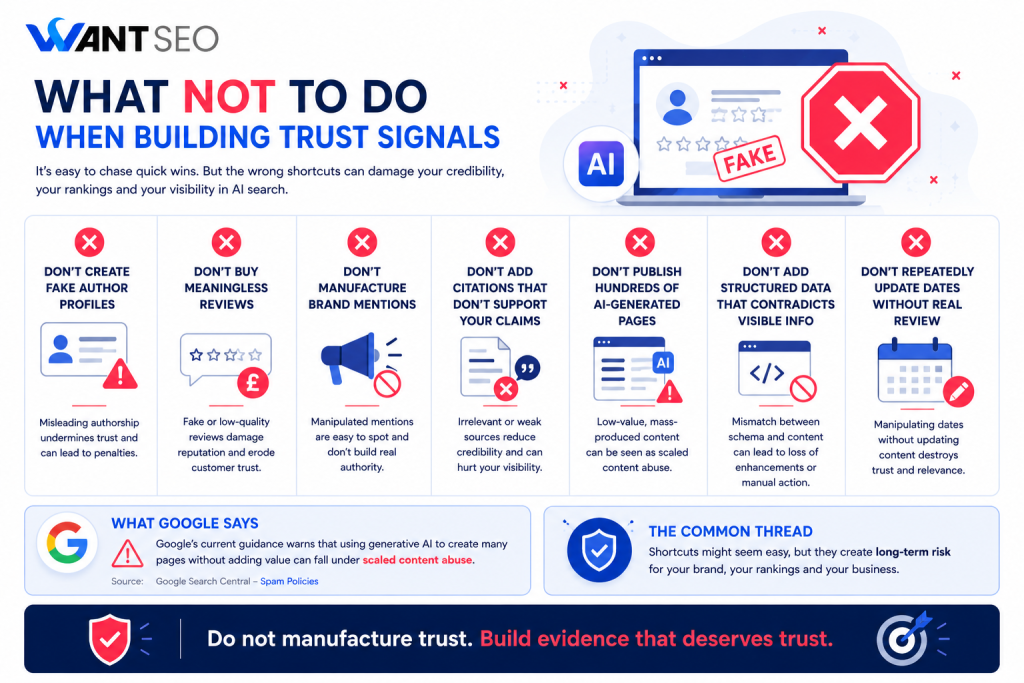
AI-assisted content can perform when it provides genuine value, but using AI to mass-produce low-value pages creates risk. Google states that generative AI can be useful for research and structuring original content, but generating many pages without adding value can violate its spam policies.