
8 Differences Between SEO Copywriting and SEO Content Writing
SEO writing is no longer simply about placing keywords on a page and hoping Google sends more visitors. For ecommerce businesses, the more useful question is: what does this page need to achieve? A product page may need to help someone choose and buy. A category page may need to capture commercial search demand and guide users towards products. A blog may need to answer a question, build topical authority and create a path towards a commercial page. That is where the difference between SEO copywriting and SEO content writing becomes important.
Both use SEO principles, search intent and audience research. However, they are usually designed around different jobs. SEO content writing tends to educate, answer questions and build topical relevance, while SEO copywriting combines search visibility with persuasive messaging designed to encourage a meaningful action. This distinction is also reflected in established industry guidance, although the terminology is not completely standardised across the industry.
At Want SEO, we have researched how these approaches fit into modern ecommerce search strategies and how the distinction becomes even more important as SEO increasingly connects with AEO, GEO, AI search, CRO and conversion-focused content.
Key takeaways
- SEO copywriting is primarily designed to help a page attract relevant searchers and move them towards an action, particularly on commercial and transactional pages.
- SEO content writing is generally more focused on education, information and topical authority, particularly for informational searches.
- The two approaches overlap. The strongest ecommerce strategies use both rather than treating them as competing disciplines.
- With AI search, AEO and GEO becoming part of the wider search landscape, clarity, useful information, search intent and first-hand expertise matter more than simply increasing keyword frequency.
What is SEO copywriting?
SEO copywriting combines search engine optimisation with persuasive copywriting. The objective is not simply to make a page visible. It is to make the page relevant to the searcher while helping them understand why the product, service or business is worth considering. That can include product descriptions, ecommerce category pages, service pages, landing pages, homepage copy, collection pages and other commercially important website content. For example, imagine someone searches for “women’s waterproof walking boots UK”.
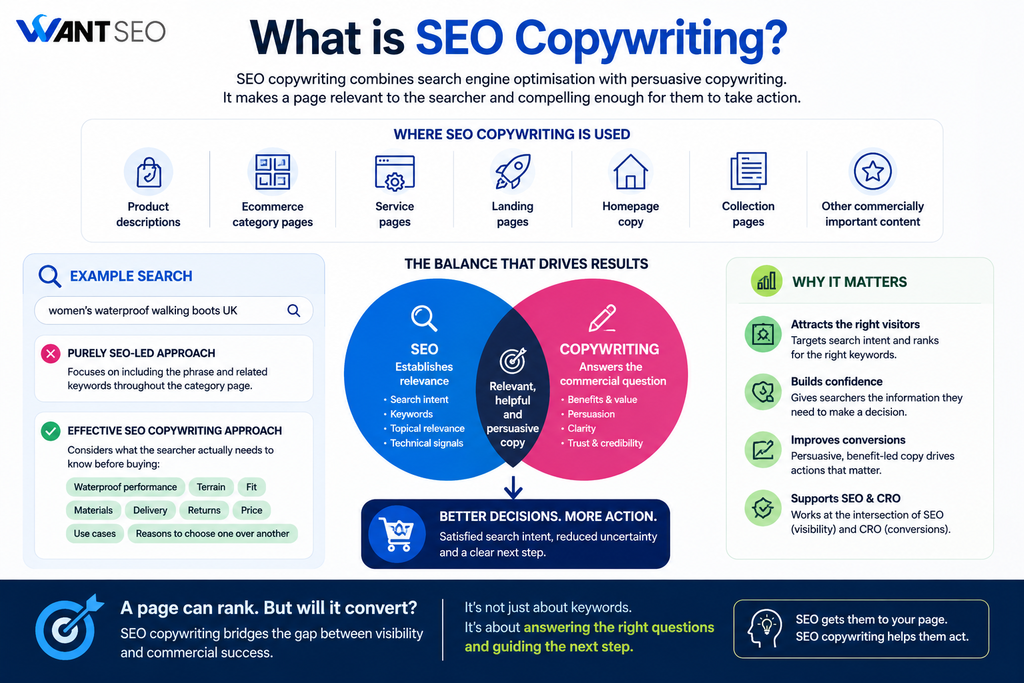
A purely SEO-led approach might focus heavily on including the phrase and related keywords throughout a category page. An effective SEO copywriting approach goes further. It considers what the searcher actually needs to know before buying: waterproof performance, terrain, fit, materials, delivery, returns, price, use cases and reasons to choose one product over another. The keyword helps establish relevance. The copy helps answer the commercial question.
That distinction matters because a page can attract organic visibility without doing enough to help the visitor make a decision. SEO copywriting therefore sits naturally between SEO and CRO. It needs to satisfy search intent while reducing uncertainty and making the next step clear.
What is SEO content writing?
SEO content writing is generally broader and more information-led. It is commonly used for blog posts, guides, educational resources, explainers, comparison content and other pages designed to answer questions or build topical authority. For example, an ecommerce outdoor retailer could create an article around “how to choose waterproof walking boots”. The purpose is not necessarily to sell a particular pair immediately. The content can explain the different waterproof ratings, materials, sole types and use cases, helping the reader understand what they should consider.
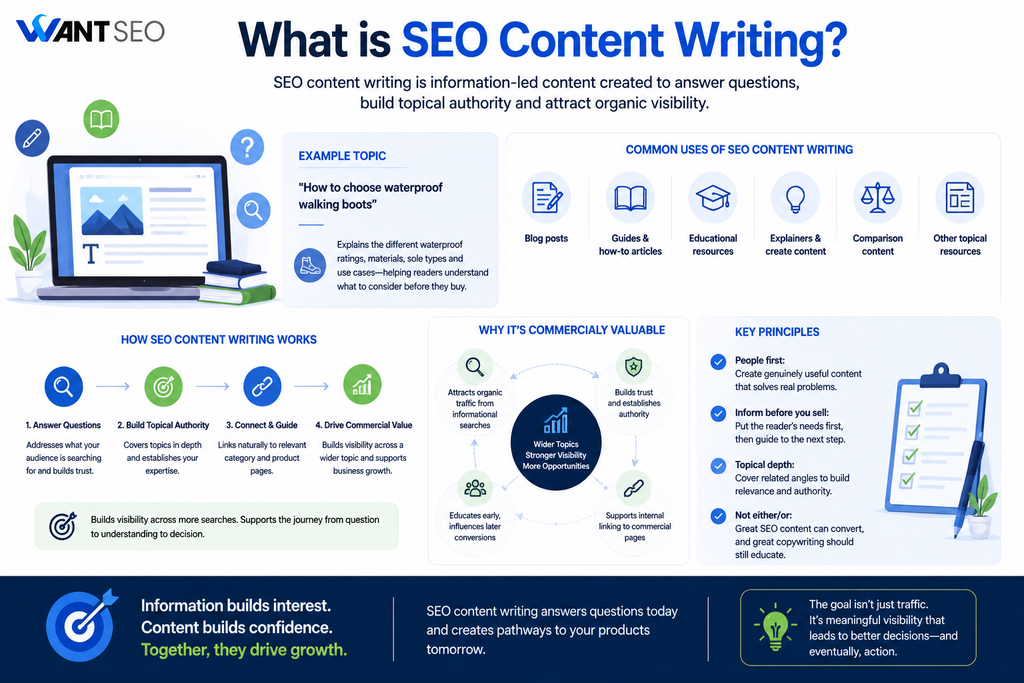
That content can then connect naturally to relevant category and product pages. This is where SEO content writing becomes commercially valuable. It can help a business build visibility around a wider topic rather than concentrating every page around a product or service keyword.
The distinction is not absolute. Good SEO content can generate conversions, and good SEO copywriting should still educate. The difference is primarily the job the page is expected to perform.
SEO copywriting vs SEO content writing: the 8 key differences
The following differences provide a practical framework rather than rigid definitions. In reality, the strongest pages often combine elements of both.
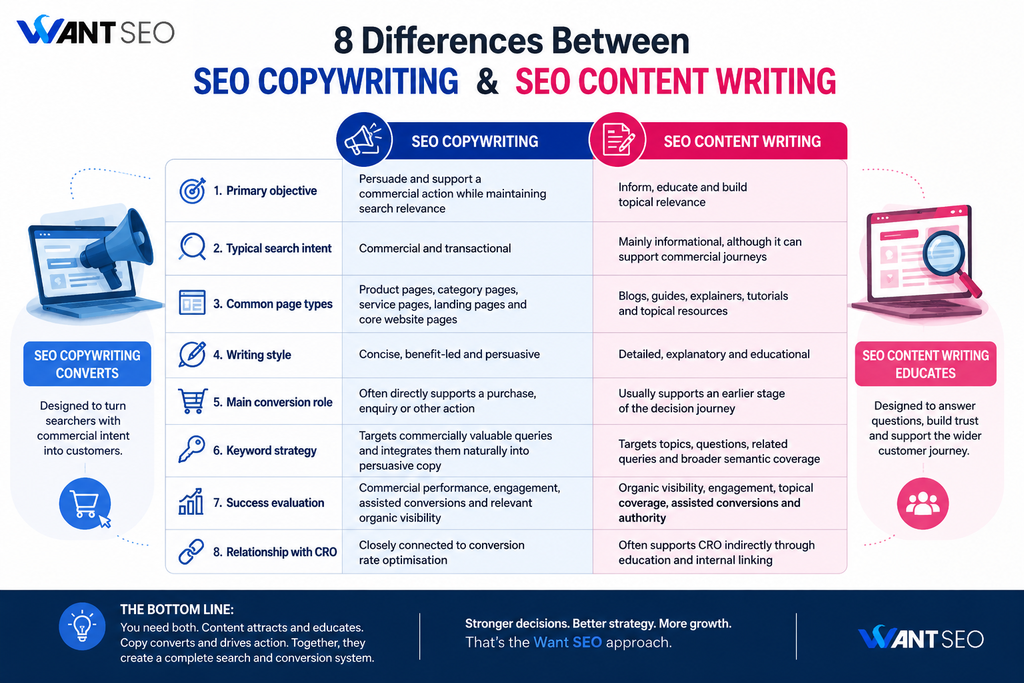
The important point is that neither approach is automatically “better”. The right choice depends on search intent, page purpose and where the user is in the buying journey.
1. SEO copywriting is more closely connected to conversion
The first major difference is the desired outcome. SEO copywriting typically has a stronger conversion objective. The reader may already be considering a product, service or solution, so the writing needs to help them decide what to do next. That does not mean every sentence should sound like a sales pitch. In fact, overly aggressive copy can make a commercial page less useful. Effective SEO copywriting is often about removing friction rather than adding persuasion.
For an ecommerce product page, that might mean explaining:
- What the product does
- Who it is suitable for
- Its key benefits
- Important specifications
- How it compares with alternatives
- Delivery and returns information
- Why the customer should trust the business
The copy should answer the questions standing between the visitor and a confident decision. This fits closely with CRO because the page is not judged solely by whether someone finds it. It needs to help them act.
2. SEO content writing usually has a stronger educational role
SEO content writing often begins further up the customer journey. Someone searching “how often should you replace running shoes” may not be ready to buy immediately. They may be researching, comparing options or trying to understand a problem. A useful article can answer that question properly, explain the relevant factors and introduce the reader to the brand. This creates an opportunity to build trust before the commercial decision happens.
The important distinction is that informational content should not be treated as a disguised sales page. If someone wants an answer, give them the answer first. Then, where relevant, provide a logical next step. This is particularly important for modern search because Google continues to emphasise helpful, reliable, people-first content rather than content created primarily to attract search engine visits.
3. They usually target different stages of search intent
Search intent is one of the clearest ways to decide whether you need SEO copywriting or SEO content writing. Consider these searches:
- Informational: “how to choose a standing desk”
- Commercial investigation: “best standing desks for home office”
- Transactional: “buy electric standing desk UK”
The first query naturally lends itself to educational SEO content. The second may benefit from comparison content that combines detailed information with commercial guidance. The third requires a commercially focused page where SEO copywriting becomes much more important.
This does not mean you need three completely separate strategies. A well-structured ecommerce website can connect these pages through internal linking so that the customer can move naturally from learning to comparing to buying. That is a more useful approach than producing large volumes of disconnected articles simply because keyword tools suggest them.
4. SEO copywriting tends to be tighter and more benefit-led
Copywriting usually has less room for unnecessary explanation. A product page needs to communicate value quickly. Instead of simply saying: “Made from 100% recycled polyester.” An effective product description might explain why that matters to the customer, where appropriate: “Made with recycled polyester for a lighter outer layer that is designed for everyday outdoor use.”
The exact wording depends on the product and available evidence, but the principle is consistent: features should be connected to customer relevance. SEO copywriting therefore requires an understanding of benefits, objections, differentiators and customer priorities. SEO content writing can be much more expansive because the reader may need context before they can make a decision. This is one reason why copying the same writing format across every page type can produce weak results.
5. Keyword usage has a different role
Both approaches should use keyword research, but the role of keywords changes. SEO copywriting usually focuses heavily on commercially relevant search terms and the language customers use when they are close to taking action. An ecommerce category page targeting “men’s leather wallets” should make its relevance obvious, while naturally covering useful variations such as men’s leather wallet, leather wallets for men, slim leather wallets and related product attributes where appropriate.
But the goal should not be to repeat those terms as frequently as possible. Keyword stuffing can make copy harder to read and does not create a better customer experience. Google recommends using the words people would use to search for the content while creating helpful, people-first pages.
SEO content writing usually has broader topical coverage. An article might naturally cover related concepts such as materials, sizing, maintenance, use cases, comparisons, common mistakes and buying considerations. The important shift is from keyword density to topic relevance. For modern SEO, that distinction is increasingly important because search systems can understand relationships between concepts rather than relying solely on exact-match phrases.
6. SEO copywriting and content writing use different page formats
The page itself often gives you a strong clue about the writing approach required. SEO copywriting is particularly valuable for pages where the business wants the visitor to take a specific action. These can include product pages, ecommerce category pages, service pages, landing pages and commercial comparison pages. SEO content writing is more common for blogs, guides, tutorials, FAQs and educational resources.
However, there is considerable overlap. An ecommerce category page may contain an educational section explaining how to choose the products. A buying guide may include comparison tables and calls to relevant products. A product page may contain genuinely useful information that answers informational questions.
The strongest websites do not force every page into a single writing category. Instead, they ask:
What does this page need to help the user accomplish?
That question is more useful than asking whether the page needs “SEO copy” or “SEO content”.
7. Their relationship with AEO and GEO is becoming more important
The SEO copywriting vs content writing distinction becomes more interesting when AEO and GEO enter the picture.
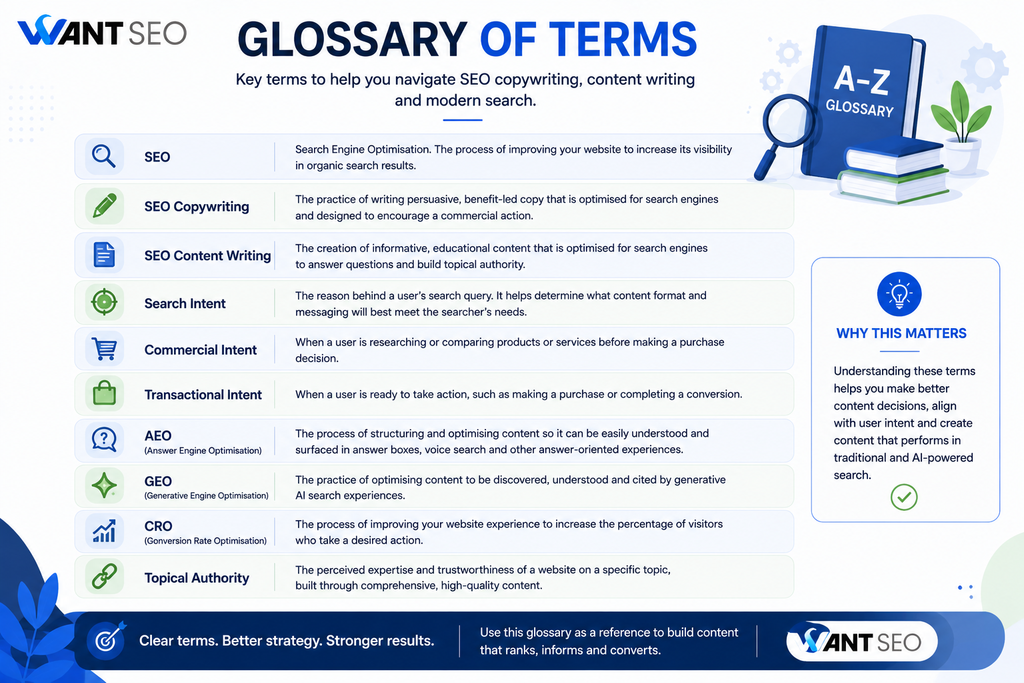
- AEO, or Answer Engine Optimisation, focuses on making information easier for answer-oriented search experiences to understand and surface.
- GEO, or Generative Engine Optimisation, is commonly used to describe optimisation for generative AI search experiences.
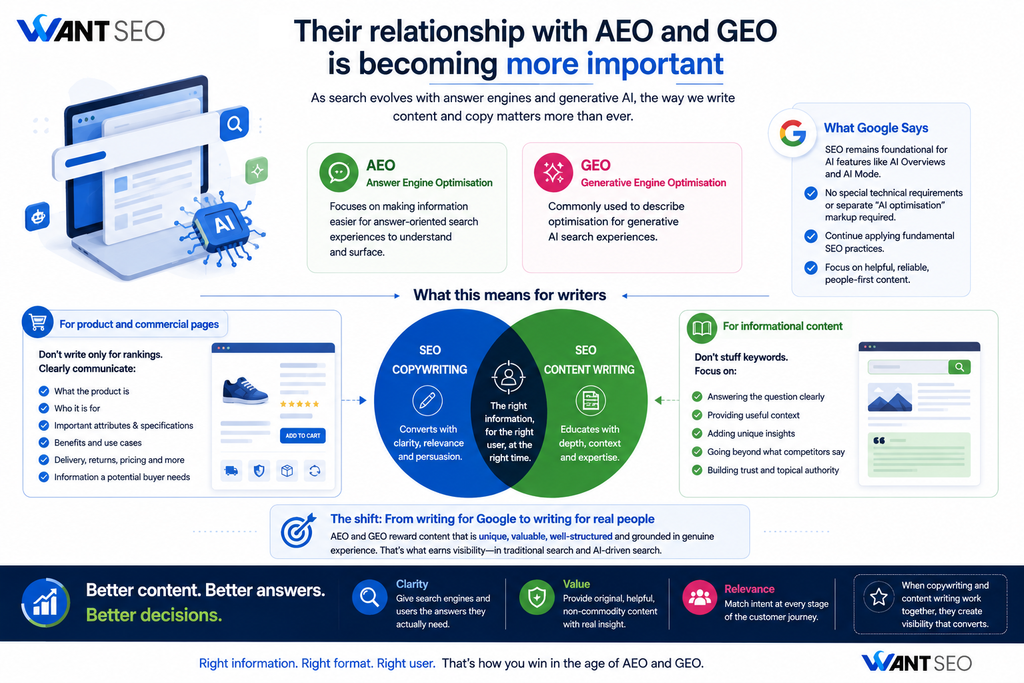
Google’s current guidance is important here: it states that SEO remains foundational for AI features such as AI Overviews and AI Mode. Google also explicitly says there are no special technical requirements or separate “AI optimisation” markup required to appear in those experiences. Instead, sites should continue applying fundamental SEO practices and focus on helpful, reliable, people-first content.
That changes how writers should think about both disciplines. A product page should not be written solely for traditional rankings. It should clearly communicate what the product is, who it is for, its important attributes and the information a potential buyer needs. Likewise, an informational article should not simply contain a large number of keywords. It should answer the underlying question clearly, provide useful context and add something beyond what every competing page already says.
Google’s guidance for generative AI search specifically highlights unique, valuable, non-commodity content, clear organisation and information that brings genuine experience or insight. This makes the distinction between SEO copywriting and content writing less about “writing for Google” and more about writing the right information for the right user at the right point in their decision journey.
8. The strongest strategy combines both
The biggest mistake is treating SEO copywriting and SEO content writing as competing strategies. They are better viewed as complementary parts of the same search system. Imagine an ecommerce business selling premium coffee equipment. A content strategy might include:
- “How to choose an espresso machine”
- “What is the difference between single boiler and dual boiler espresso machines?”
- “How to clean an espresso machine”
These pages can answer questions, establish topical relevance and help potential customers understand their options. The commercial architecture might then include:
- “Best espresso machines”
- “Dual boiler espresso machines”
- “Commercial espresso machines”
Individual product pages with detailed, persuasive copy. The content brings users into the topic. The commercial pages help them make a decision. Internal links connect the two. That creates a more coherent customer journey than publishing blog posts without considering where the reader should go next.
How SEO copywriting fits into modern ecommerce SEO
For ecommerce brands, the distinction is particularly important because product and category pages often have the greatest commercial significance. A business can spend months producing informational articles while its highest-value category pages remain weak. That is not necessarily a content problem. It may be a prioritisation problem.
Start with the pages closest to revenue. Look at your highest-value categories and products. Assess whether the page clearly matches search intent. Review the quality of the product information, benefits, specifications, internal links, headings, supporting content and calls to action. Then consider whether informational content is needed to support the wider topic.
This is where SEO, CRO, AEO and GEO can work together rather than becoming separate projects. The aim is not to create more content for the sake of creating more content. It is to make the information architecture stronger and help customers move from question to understanding to confidence to action.
SEO copywriting should not mean keyword stuffing
There is an outdated idea that effective SEO copywriting means repeating the target keyword a certain number of times. That approach misses the point. If a page targets “SEO copywriting”, repeatedly inserting the exact phrase into every paragraph does not make the page more useful. Instead, cover the subject naturally. Discuss search intent, keyword research, conversion copy, website copywriting, ecommerce copywriting, landing page optimisation, product descriptions, calls to action, user experience and CRO where those concepts genuinely belong.
The target keyword should be present and relevant, but the page should be written around the topic and user need, not an arbitrary density target. Google’s current guidance reinforces this principle. It recommends creating useful, original content for people rather than producing pages primarily to attract search engine visits.
What should ecommerce businesses prioritise?
If your website has limited resources, do not automatically choose between SEO copywriting and SEO content writing. Instead, prioritise according to commercial importance and search intent. Start with pages that already have demand, commercial value or strong potential to influence revenue. If important product and category pages are weak, improving those pages may be more valuable than publishing another ten blog posts. If your commercial pages are already strong but your brand lacks visibility around important informational topics, develop content that supports those areas. If both are weak, build the system gradually rather than trying to produce everything at once. This is the type of prioritisation that prevents SEO from becoming an activity list.
How AI is changing the role of the SEO writer
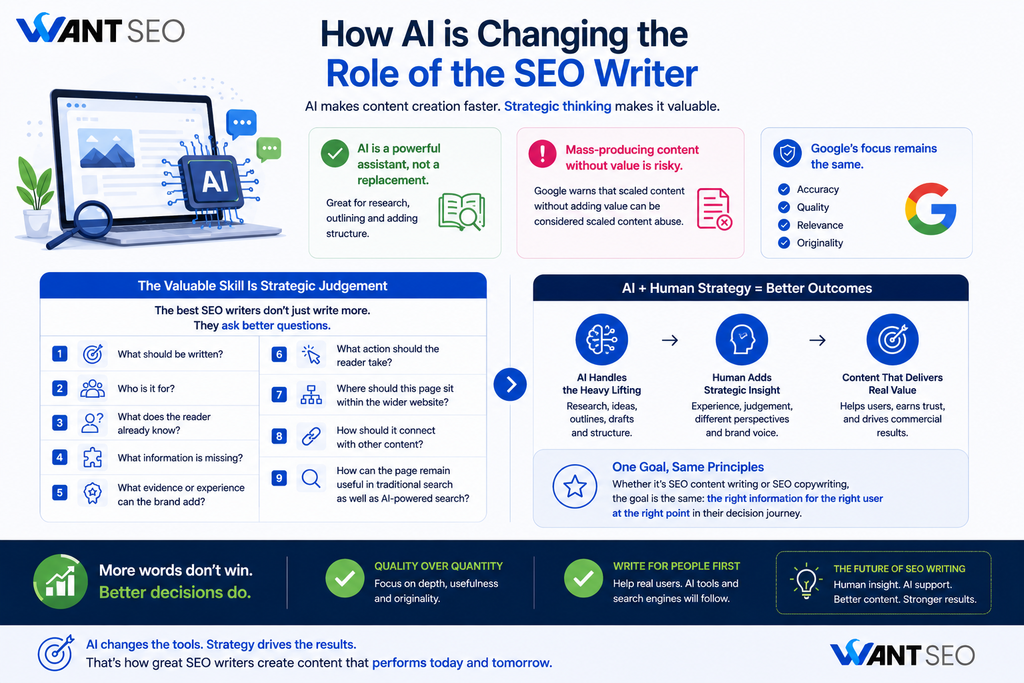
AI has made producing text easier. It has not made strategic judgement less important. In fact, the opposite is increasingly true. Google’s guidance says generative AI can be useful for research and adding structure, but generating large numbers of pages without adding value can fall into scaled content abuse. Google continues to emphasise accuracy, quality, relevance and originality. That means the valuable skill is no longer simply producing more words. It is deciding:
- What should be written?
- Who is it for?
- What does the reader already know?
- What information is missing?
- What evidence or experience can the brand add?
- What action should the reader take?
- Where should this page sit within the wider website?
- How should it connect with other content?
- How can the page remain useful in traditional search as well as AI-powered search?
These questions apply to both SEO content writing and SEO copywriting.
SEO copywriting, AEO and GEO: what changes in practice?
The fundamentals remain relatively simple. Write clearly. Answer the question directly. Use meaningful headings. Make important information available in text. Support claims with credible evidence where appropriate. Use structured data correctly where relevant. Build useful internal links. Make product and business information consistent. Show genuine expertise and experience. Avoid creating pages simply because a keyword variation exists.
Google’s latest generative AI guidance makes this point particularly clearly. It describes generative AI search as being grounded in Google’s existing Search systems and says that SEO best practices remain foundational. It also highlights query fan-out, where AI systems can issue multiple related searches to explore a more complex question.
For content teams, that means a page should cover the subject properly rather than being narrowly written around one exact keyword. For copywriters, it means commercially important pages need enough clear, factual information to stand on their own. For ecommerce brands, it means the quality of the underlying information becomes increasingly important.
How to decide which one you need
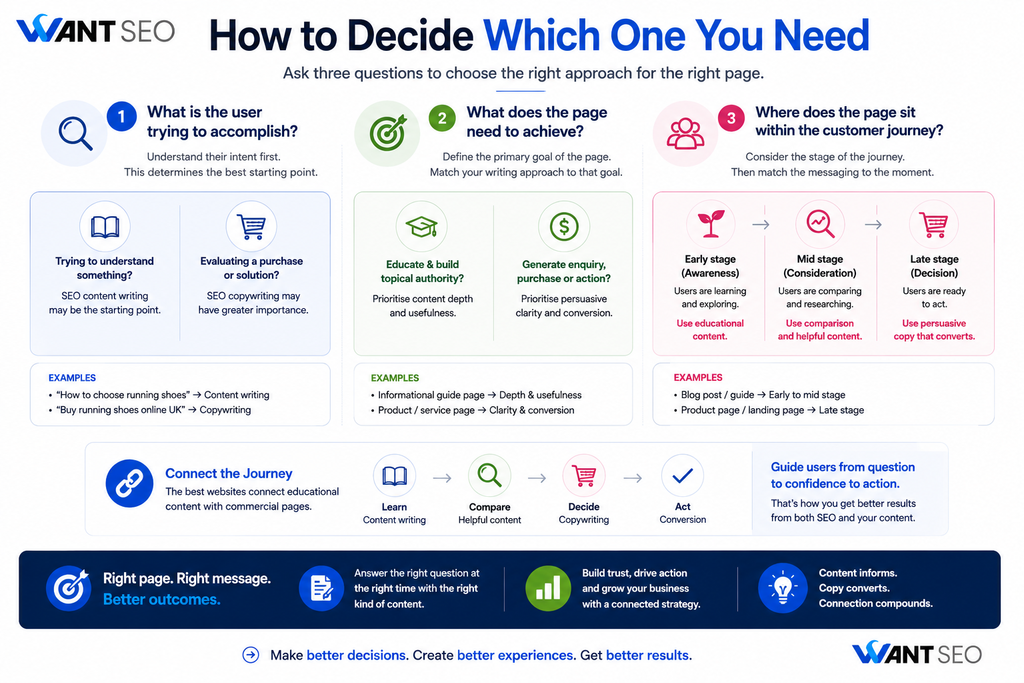
Ask three questions.
First, what is the user trying to accomplish?
If they are trying to understand something, SEO content writing may be the starting point. If they are evaluating a purchase or looking for a solution, SEO copywriting may have greater importance.
Second, what does the page need to achieve?
If the page needs to educate and build topical authority, prioritise content depth and usefulness. If the page needs to generate an enquiry, purchase or other commercial action, prioritise persuasive clarity and conversion.
Third, where does the page sit within the customer journey?
Early-stage pages often benefit from educational content. Later-stage pages need stronger commercial messaging. But the best websites connect the two.
Why the distinction matters more than ever
The traditional SEO model often encouraged businesses to think in terms of rankings, traffic and keywords. That is increasingly incomplete. Search is becoming more conversational. AI systems can summarise information, compare options and answer multi-part questions. Google’s AI Mode can support more complex exploration, while AI Overviews can provide summaries with links to supporting websites.
This does not make traditional SEO irrelevant. It makes useful information and clear commercial communication more important. SEO content writing helps a business demonstrate knowledge and answer questions. SEO copywriting helps turn that knowledge into commercially useful website experiences. A strong strategy understands where each belongs.
Conclusion
The difference between SEO copywriting and SEO content writing is ultimately a difference in purpose. SEO content writing is usually about helping people understand something. SEO copywriting is more closely concerned with helping them decide what to do next. But modern search makes the boundary less rigid. A strong ecommerce SEO strategy needs useful information, persuasive communication, clear search intent and a website structure that connects the different stages of the customer journey. It also needs to account for how people now discover information through AI search, AEO and GEO alongside traditional search.
The answer is therefore not to produce more copy or more content. It is to understand where effort will have the greatest commercial impact. That is the approach we take at Want SEO. We start with intent, prioritise what matters, connect SEO with CRO and AEO, and look at the wider commercial context rather than treating content as an activity to be completed.
If your ecommerce site has plenty of content but you are not confident that the right pages are doing the right job, Want SEO can help you identify what to prioritise, what to improve and what not to spend time on. Because better SEO starts with better decisions.
FAQs
What is the main difference between SEO copywriting and SEO content writing?
SEO copywriting generally combines search optimisation with persuasive messaging and a commercial action. SEO content writing is usually more educational and focused on answering questions, building topical authority and supporting the customer journey.
Is SEO copywriting only for ecommerce websites?
No. SEO copywriting can be used for ecommerce product and category pages, service pages, landing pages and other commercially important website content. The approach is useful wherever search visibility and persuasive communication need to work together.
Does SEO copywriting help with AI search?
It can, particularly when commercial pages provide clear, useful and well-structured information. Google says its AI search experiences continue to rely on foundational SEO and helpful, reliable, people-first content.
Should I use AI to write SEO copy?
AI can assist with research, outlining and drafting, but it should not replace strategic judgement or original value. Google advises focusing on accuracy, quality and relevance and warns against generating large volumes of pages without adding value.
Which is better for SEO, copywriting or content writing?
Neither is universally better. The right approach depends on the page’s purpose and search intent. Most established ecommerce strategies need both: content to build relevance and authority, and SEO copywriting to make commercially important pages clearer and more persuasive.