
SEO Advertising: How SEO and Paid Search Work Together
When people search for a product, service or solution, they do not separate their thinking into “SEO” and “advertising”. They simply see a search results page and decide which result looks most useful and relevant. That makes SEO advertising an increasingly important topic for businesses investing in search. The term can refer to the relationship between organic SEO and paid search advertising, rather than SEO itself being a form of advertising. SEO works to improve organic visibility, while paid search places advertisements in front of people searching for relevant terms. The two approaches can support each other, but they involve different investments, timeframes and decisions.
For an eCommerce business, the important question is therefore not simply whether to “do SEO” or “run ads”. It is where each channel can contribute commercially, where they overlap, and where combining their data can improve the overall search strategy.
Key takeaways
- SEO advertising and paid search solve different problems. SEO builds organic visibility over time, while paid search can create visibility much faster when a business is willing to pay for clicks or other forms of advertising.
- SEO advertising and ads are not a replacement for organic SEO. Paid visibility disappears when advertising spend stops, whereas useful organic assets can continue contributing after the initial investment.
- Paid search data can inform SEO decisions. Search terms, conversion behaviour and landing page performance can reveal which topics and commercial queries deserve greater organic attention. Search Engine Land recently highlighted this two-way relationship, including the opportunity to turn expensive PPC keywords into SEO priorities.
- The goal should be better allocation of effort, not simply more visibility. The strongest approach considers intent, commercial value, competition, conversion potential and the role each channel should play.
What is SEO advertising?
SEO advertising is not technically a standalone advertising channel. SEO, or search engine optimisation, focuses on improving a website’s visibility in unpaid, organic search results. Paid search advertising, by comparison, involves paying for advertisements to appear when people search for relevant terms. Neil Patel describes SEO as organic search optimisation and SEM as the broader search marketing area that can include paid advertising.
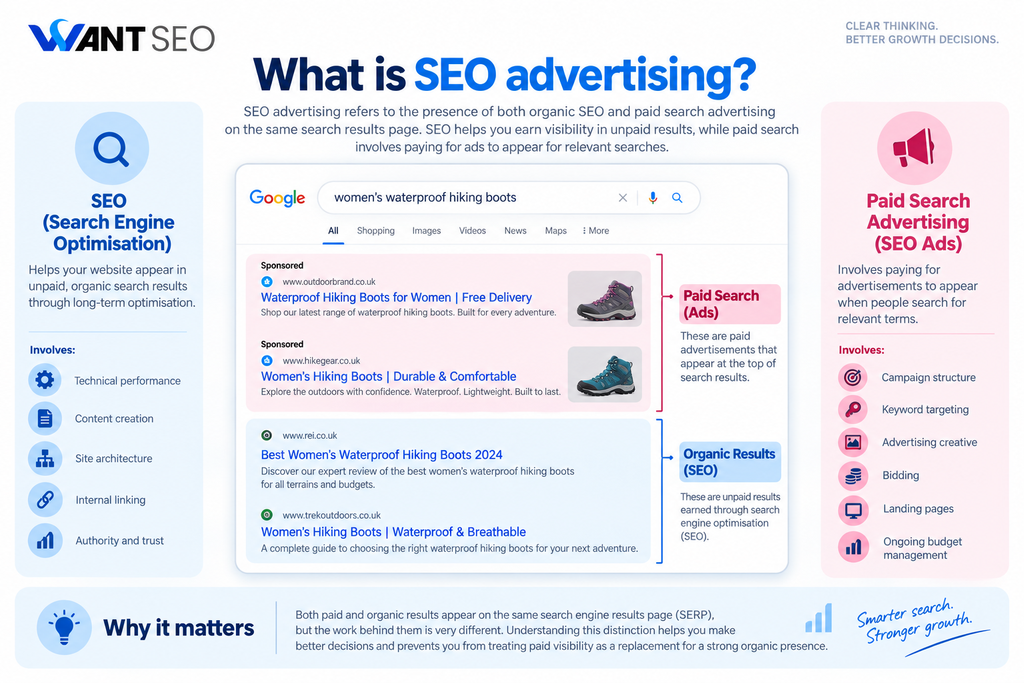
The confusion often comes from the fact that both appear on the same search engine results page, or SERP. A customer searching for “women’s waterproof hiking boots” might see paid shopping or text advertisements, followed by organic results. The customer may interact with either. From the business’s perspective, however, the work behind those appearances is very different.
SEO requires improvements to areas such as technical performance, content, site architecture, internal linking and authority. Paid search requires campaign structure, keyword targeting, advertising creative, bidding, landing pages and ongoing budget management. Understanding this distinction is important because it prevents businesses from treating paid visibility as an alternative to building a stronger organic search presence.
SEO vs paid search: what is the difference?
The simplest distinction is how visibility is earned and how it is funded. With SEO, the business invests in improving the website and its content so that search engines can understand and surface it for relevant searches. Results generally take longer to develop and are influenced by many factors outside the business’s direct control.
With paid search, the business pays to participate in advertising auctions and can gain visibility much faster. However, that visibility depends on continued advertising activity and budget. Google Ads also considers factors such as relevance, expected click-through rate and landing page experience when determining ad placement, so simply having the largest budget does not guarantee the best position.
This creates an important commercial difference. SEO tends to require patience and prioritisation. Paid search tends to provide greater control over when and where a business appears, but it comes with an ongoing cost. Neither should automatically be treated as the “better” channel. The appropriate mix depends on the business, its margins, customer journey, existing organic visibility and commercial priorities.
How SEO ads fit into search engine marketing
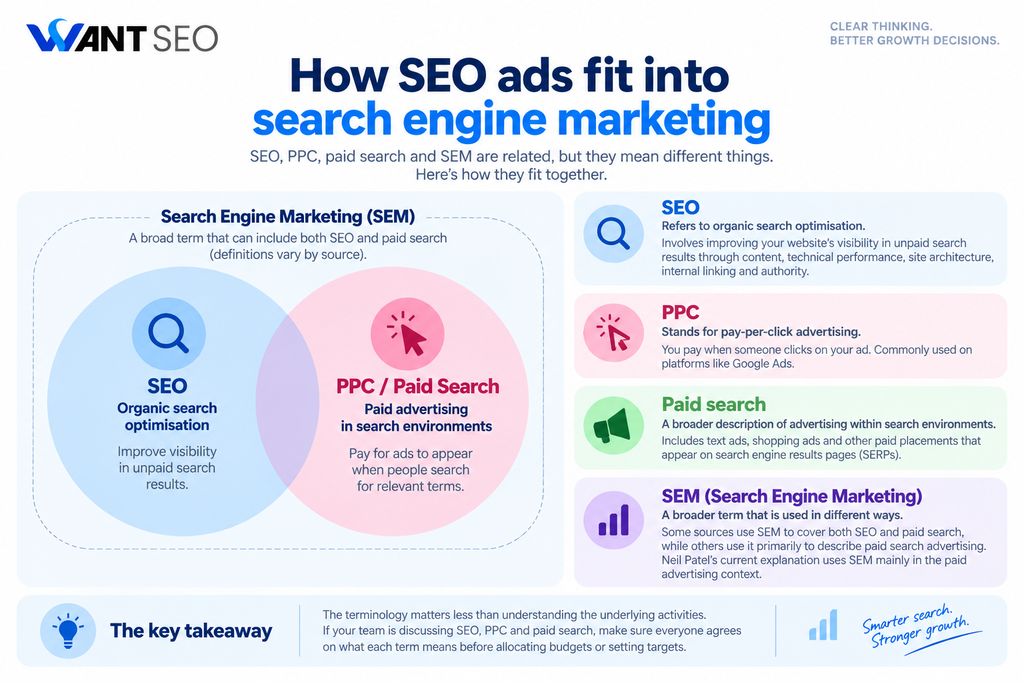
The terminology around search marketing can be confusing.
- SEO generally refers to organic search optimisation.
- PPC refers to pay-per-click advertising, where an advertiser pays when someone clicks an advertisement.
- Paid search is a broader description of advertising within search environments.
- SEM, or search engine marketing, has historically been used in different ways. Some sources use it as an umbrella term covering SEO and paid search, while others use it primarily to describe paid search advertising. Neil Patel’s current explanation uses SEM primarily in the paid advertising context.
For businesses, the terminology matters less than understanding the underlying activities. If your team is discussing SEO, PPC and paid search, make sure everyone agrees on what each term means before allocating budgets or setting targets.
Why SEO advertising and paid search should inform each other
One of the biggest missed opportunities in search marketing is treating organic and paid search as completely separate channels. A paid campaign can generate data relatively quickly. You can see which queries generate clicks, which landing pages receive engagement and which terms contribute to conversions. That information can help identify opportunities for SEO. For example, imagine an eCommerce business discovers through paid search that a particular product category consistently generates profitable sales from a specific long-tail query. That does not automatically mean the company should spend more on that keyword.
The next question could be whether the business should build or improve an organic category page around the same underlying intent. If the opportunity is commercially meaningful and the business can compete organically, SEO may eventually reduce reliance on paid visibility for some searches. Search Engine Land recently made a similar point, highlighting how expensive PPC keywords can become SEO priorities and how strong organic rankings can potentially inform decisions about paid spend. This is where search strategy becomes more useful than channel management.
Can SEO reduce advertising costs?
Potentially, but it should not be treated as a guaranteed outcome. If a website develops strong organic visibility for commercially valuable searches, it may reduce the need to rely entirely on paid advertising for those searches. However, this depends on the competitiveness of the query, the strength of the organic result, the SERP layout, customer behaviour and the role paid advertising plays in the wider customer journey. It is also possible for organic and paid listings to complement each other.
A business might deliberately maintain paid visibility for a highly valuable commercial query while also appearing organically. In other situations, it might find that strong organic visibility provides an opportunity to reduce paid investment. The right decision comes from understanding the economics of each query rather than applying a blanket rule.
How to choose between SEO and paid search
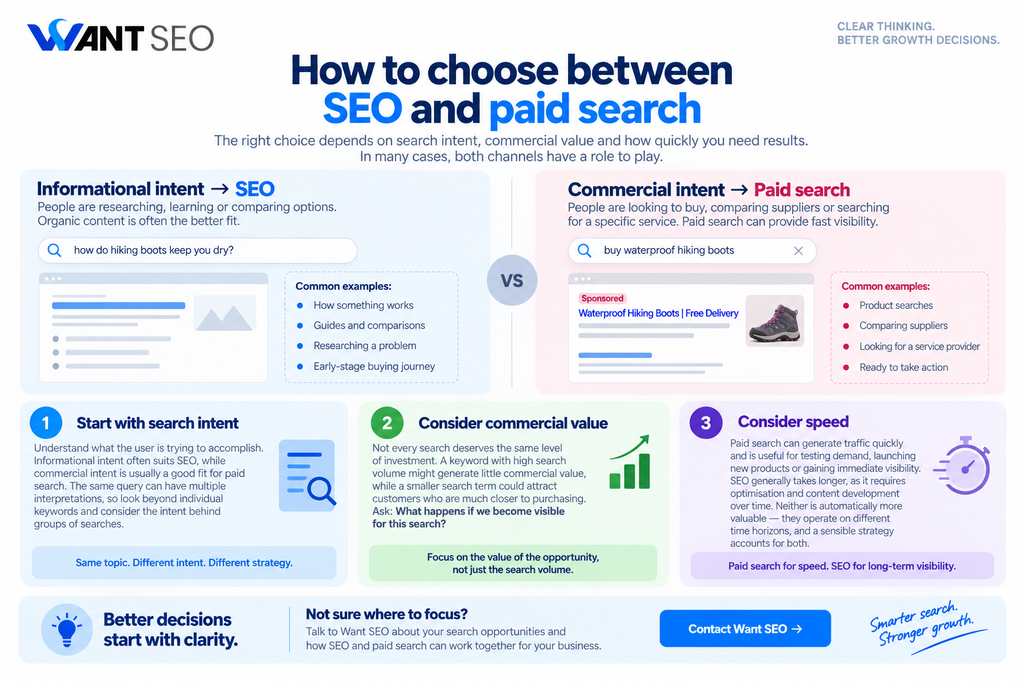
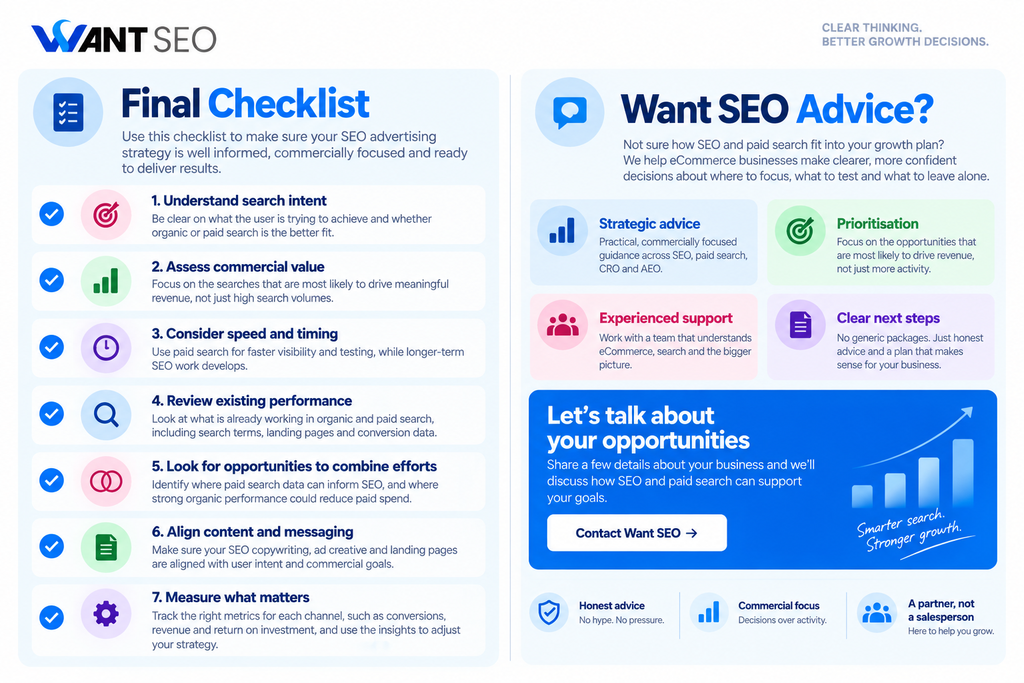
Start with search intent. If someone is searching for a product, comparing suppliers or looking for a service provider, there may be an immediate commercial opportunity. Paid search can provide fast visibility while SEO work develops. If someone is researching a problem, learning how something works or comparing different approaches, organic content may have a more important role.
The distinction is not always clear-cut. The same query can have multiple interpretations, and customer journeys can move through several searches before a purchase. That is why businesses should look beyond individual keywords and understand the intent behind groups of searches.
Consider commercial value
Not every search deserves the same level of investment. A keyword with thousands of monthly searches might generate little commercial value, while a much smaller search term could attract customers who are much closer to purchasing. This is particularly important for eCommerce brands with finite budgets.
Rather than asking, “How many people search for this?”, ask: What happens if we become visible for this search?
That question moves the discussion from volume towards commercial context.
Consider speed
Paid search can be useful when a business needs to test demand, launch a new product or gain immediate visibility while longer-term SEO work is underway. Google Ads can begin generating traffic quickly, whereas SEO normally requires a longer period of optimisation and content development before organic visibility develops. That does not make paid search automatically more valuable. It means the channels operate on different time horizons. A sensible strategy accounts for both.
Where SEO copywriting fits in SEO Advertising
SEO copywriting sits at the intersection of search intent, content quality and commercial communication. The objective is not simply to insert keywords into a page. Good copy should help the user understand the product, service or answer while making the page easier for search engines to interpret. This is particularly important for landing pages supporting paid campaigns.
If an advertisement promises one thing but the landing page provides something different, the customer experience suffers. Relevance between the search query, advertisement and landing page can also influence paid search performance. Google Ads considers landing page experience as part of its advertising systems. The same principle applies to organic SEO. A page should satisfy the intent behind the search rather than simply contain a collection of keywords.
How to choose keywords for your website for SEO Advertising
The phrase keywords for website can make keyword research sound more mechanical than it really is. The better approach is to identify the searches that represent meaningful customer needs and then decide which pages should satisfy them. Start by mapping:
- The products or services you want to grow
- The problems customers are trying to solve
- The questions customers ask before buying
- The comparisons they make
- The commercial terms they use when they are ready to act
Then assess the opportunity around those themes. Paid search can provide useful evidence because advertising campaigns can expose businesses to real search behaviour and conversion data. Keyword match types can also influence how closely search queries need to relate to targeted keywords, helping advertisers manage relevance and budget efficiency.
The important point is not to copy every successful paid keyword into your SEO advertising strategy. Instead, ask why the keyword is performing and whether that underlying search intent deserves an organic asset.
What does SERP SEO mean?
SERP SEO refers broadly to optimising for visibility within search engine results pages. That goes beyond traditional blue organic links. Modern SERPs can contain shopping results, advertisements, featured snippets, images, local results, videos, sitelinks and other search features. Google maintains documentation covering a wide range of search appearances and explains how structured data can help Google understand page content and potentially support eligible search features.
This means the objective should not simply be “rank number one”. The more useful question is:
What type of search result best satisfies this particular intent, and what does our business need to do to compete for it?
For an eCommerce brand, that could mean product visibility, category pages, informational content, shopping results or a combination.
When does paid search make sense?
Paid search can make sense when there is clear commercial intent and the economics support advertising spend. It can also be useful when a business needs faster feedback than SEO can provide. For example, a company launching a new product category may use paid search to test which messaging and search themes generate meaningful engagement. If the data is positive, those insights can inform landing pages, SEO advertising, content, product positioning and CRO.
Paid search can also be useful where organic competition is particularly strong or where a business needs visibility for strategically important terms while its SEO programme develops. The key is to establish the role of paid search before spending. “Run ads” is not a strategy.
When should SEO advertising and strategy be prioritised?
SEO advertising and effective strategy become particularly valuable when a business has search demand that aligns with its products or services and an opportunity to build durable organic visibility. It can also make sense when a brand is repeatedly paying for clicks around searches that have strong organic potential. The decision should consider the economics of the search term, the strength of competitors, the quality of the existing page, the site’s authority, conversion potential and how long the opportunity is likely to remain commercially relevant.
For established eCommerce businesses, SEO advertising and general strategy can also support a broader growth system because the work can improve the usefulness and structure of important pages rather than only targeting search visibility. Neil Patel’s recent SEO advertising guidance similarly emphasises the importance of keyword research, useful content and clear site structure rather than keyword stuffing or producing content simply to generate more pages.
What should you measure?
Measurement should reflect the role of the channel. For paid search, businesses commonly examine metrics such as cost per click, click-through rate, conversions, conversion value, cost per acquisition and return on advertising spend. But these metrics should not be viewed in isolation. A campaign can produce a strong return on advertising spend while still attracting customers who have low lifetime value. Conversely, an SEO page may generate relatively little immediate revenue but contribute to customers who return later through other channels.
This is why paid search analytics should feed into wider commercial analysis rather than sit in a separate reporting dashboard. The question is not simply:
“How many clicks did we buy?”
It is: “Which search behaviour is creating commercially valuable customers, and where should we invest next?”
Should you hire a search engine marketing consultant for SEO Advertising?
A search engine marketing consultant can be useful when search activity has become fragmented across SEO advertising, PPC, content and CRO. The value should not simply come from managing another channel. A consultant should help clarify where investment is justified, which searches deserve attention, what the available data actually tells you and which activities should be deprioritised.
This is especially relevant for growing eCommerce businesses where marketing teams can end up managing separate SEO, PPC and content targets without a clear view of how they interact. The right level of external support depends on the complexity of the business. Some companies need specialist campaign management. Others need a clearer search strategy before additional execution begins.
What about SEO advertising expert services?
The term SEO advertising expert services covers a wide range of activities, from technical SEO and keyword research to content, digital PR, ecommerce SEO and strategic consulting. The important distinction is between activity and decision-making. An SEO advertising expert provider can produce audits, keyword lists and reports without necessarily helping a business decide what deserves investment. For a commercially focused eCommerce brand and SEO expert services, the more useful question is what those activities change.
- Will the work improve an important customer journey?
- Will it strengthen an important commercial page?
- Will it reduce an identified dependency on paid acquisition?
- Will it create an asset that can compound over time?
- If the answer is unclear, more activity may not solve the underlying problem.
Common SEO advertising mistakes
SEO and paid advertising work best as a unified strategy, but companies often silo these channels or track the wrong success metrics. Here are the most frequent pitfalls businesses encounter when managing search visibility and ad campaigns:
- Treating SEO and Paid Search as Competitors: Viewing organic and paid search as opposing departments creates redundant work, inflates costs, and prevents teams from sharing valuable keyword and conversion data.
- Targeting Keyword Volume Over Intent: Chasing high search volume without evaluating user intent leads to wasted ad spend and low-converting traffic that brings little value to the business.
- Directing Traffic to Weak Landing Pages: Sending paid traffic to high-friction pages wastes ad budget, just as creating SEO content without a clear link to commercial opportunities limits ROI.
- Fixating Solely on Rankings and Traffic: Relying on rankings and search volume as primary success metrics creates a false sense of growth, as these diagnostic signals do not automatically translate into revenue.
- Ignoring the Full Conversion Funnel: Failing to connect search visibility to customer behavior, page performance, and business outcomes leaves strategies detached from actual commercial priorities.
How should eCommerce businesses approach SEO advertising?
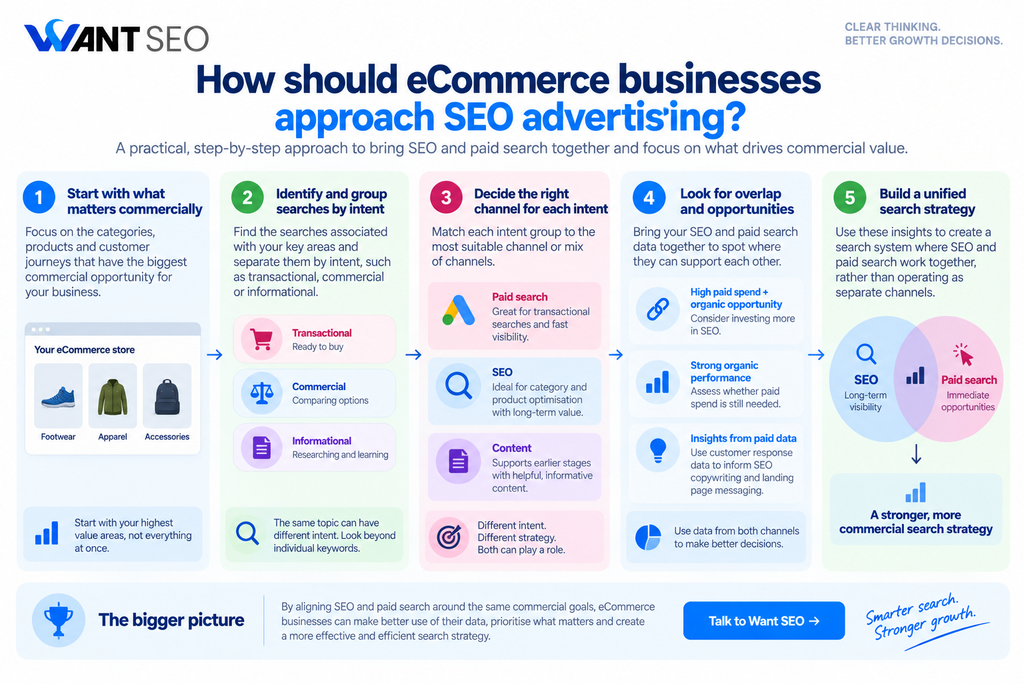
For an eCommerce business, start with the categories, products and customer journeys that matter most commercially. Then identify the searches associated with those areas and separate them by intent. Some searches may be better suited to paid acquisition. Some may justify organic category or product optimisation. Others may require informational content that supports customers earlier in their journey.
The next step is to look for overlap. If paid search is spending heavily on a term that also represents a valuable long-term organic opportunity, SEO may deserve greater attention. If an organic page is already performing strongly, the business can examine whether paid spend on the same search is still justified. If paid search data shows that customers respond strongly to a particular proposition, that insight can influence SEO copywriting and landing page messaging. This creates a search system rather than two disconnected marketing channels.
Want SEO: turning search activity into better decisions
At Want SEO, the starting point is not more activity. It is understanding what the business is trying to achieve and where search can contribute. Our approach is built around clear thinking before execution, strategic prioritisation and SEO advertising as part of a wider growth system. That means looking at SEO, CRO and AEO together rather than treating every channel as a separate project. For eCommerce businesses, that distinction matters.
You may not need more keywords, more pages or another report. You may need to understand which opportunities are commercially meaningful, where effort will compound and what should be left alone. That is consistent with Want SEO’s wider philosophy: good outcomes come from good decisions, not simply more activity. The objective is therefore not to promise rankings or guaranteed results. It is to create enough clarity to make better growth decisions with less risk.
Not sure where your search investment should go? You do not need more activity. You need clarity on what to prioritise, what to test and what to leave alone. Contact our team at Want SEO today and let us look at where SEO, paid search and CRO fit into your wider growth strategy.
Conclusion
SEO advertising is best understood as part of a wider search strategy rather than a standalone tactic. SEO builds organic visibility through improvements to a website, its content and its technical foundations. Paid search provides a way to buy visibility for relevant searches and can generate useful performance data more quickly. Used thoughtfully, the two can inform each other.
For businesses, the opportunity is not simply to appear in more places. It is to understand where visibility has commercial value, which channel is best suited to each opportunity and where investment can compound. That requires looking beyond individual rankings, clicks and campaigns. The better question is: “What search activity helps the business make a better growth decision?”
FAQs
Is SEO advertising the same as Google Ads?
No. SEO advertising focuses on improving organic search visibility, while Google Ads is a paid advertising platform. Paid advertisements can appear alongside organic results, but the two use different approaches and require different types of investment.
Is SEO advertising better than paid search?
There is no universal answer. SEO advertising and paid search have different strengths, costs and timeframes. SEO advertising can build organic visibility over time, while paid search can provide faster visibility when advertising spend is available. The appropriate balance depends on the business and its commercial priorities.
Can paid search help SEO advertising?
Yes. Paid search can provide useful evidence about search queries, messaging, landing pages and conversion behaviour. That information can help identify SEO advertising opportunities, although not every successful paid keyword should automatically become an SEO advertising priority. Search Engine Land has highlighted this two-way relationship between SEO and PPC.
How long does SEO advertising take compared with paid search?
Paid search can create visibility much faster because businesses pay to participate in advertising campaigns. SEO advertising usually requires more time because organic visibility depends on improvements to the website, content, relevance and other search signals.
Should an eCommerce business invest in both organic SEO advertising and paid search?
It can make sense to use both when each has a clearly defined role. Paid search can provide immediate visibility and useful testing data, while SEO advertising can build organic assets and visibility over a longer timeframe. The decision should be based on search intent, commercial value, customer behaviour and the economics of the opportunity rather than the assumption that every channel needs equal investment.