Want SEO
8 Alternative Search Engines You Can Use Instead of Google
Google dominates online search, but it is not the only way to find information on the internet. Several alternative search engines offer different approaches to privacy, search results, AI-powered answers and environmental responsibility. Whether you want more privacy, less personalised advertising or a different perspective on search results, there are several alternative search engines worth considering. The best alternative depends on what you want to change. Some search engines maintain their own web indexes, while others use results from providers such as Google or Microsoft Bing. Understanding this difference can help you choose an option that genuinely meets your needs.
In this guide, we explore the best alternative search engines to Google, their main advantages and the situations in which each one makes sense.
Why Look for Search Engines Other Than Google?
Google remains the leading search engine worldwide. According to Statcounter’s 2026 data, Google accounted for approximately 89.94% of global search engine market share. Its share was around 85.19% in the USA and 91.39% in the UK. These figures demonstrate its dominance, although regional preferences and usage vary. Despite its popularity, Google may not suit every user. Some people prefer search engines that collect less personal information, while others want independent search results or tools that provide direct answers instead of a conventional list of links.
For businesses, exploring alternative search engines can also help develop a broader understanding of how people discover information online. However, choosing a different or alternative search engine should depend on a clear purpose rather than simply moving away from Google.
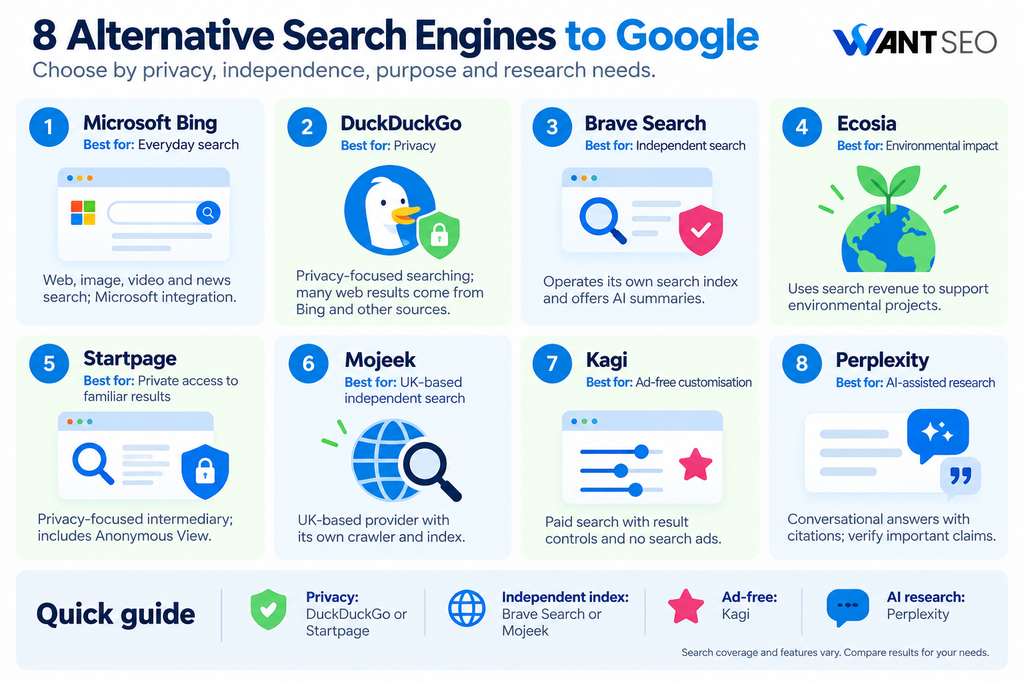
1. Microsoft Bing
Best for: General web searches and Microsoft users.
Microsoft Bing is one of the most established Google alternatives. It provides web search, image search, video results, news and map-based information. Its integration with Microsoft products also makes it a practical choice for people who use Windows and Microsoft Edge. Bing offers a familiar search experience, making it relatively easy to switch from Google without changing how you search for information. It also supports AI-powered search features that can help users explore topics and obtain summarised answers.
For businesses and marketers, Bing is worth considering because it operates its own search index and has a meaningful share of the search market, particularly on desktop devices in the USA.
The trade-off: Bing is still an advertising-supported search platform. If your main priority is reducing dependence on large technology companies or avoiding personalised advertising, it may not address every concern.
2. DuckDuckGo
Best for: Privacy-conscious everyday searching.
DuckDuckGo is a popular alternative search engine known for its privacy-focused approach. It aims to protect users from search tracking and personalised advertising profiles. You can use DuckDuckGo to search for websites, images, news and general information without needing to create an account. Its interface is straightforward, making it a convenient option for everyday searches.
However, privacy and search independence are different things. DuckDuckGo obtains many of its traditional web search results from Microsoft Bing, alongside its own crawler and other sources. Switching to DuckDuckGo may change your privacy experience without necessarily giving you a completely independent set of search results.
The trade-off: DuckDuckGo is a practical choice if privacy is your main concern, but it is not a fully independent alternative to Google’s web index.
3. Brave Search
Best for: Privacy and an independent search index.
Brave Search is an alternative search engine designed around privacy and independent web search. Unlike services that rely primarily on another company’s search index, Brave Search operates its own independent index. This matters because the index influences which websites a search engine can discover and present. Using an independent index can expose you to different sources and rankings, although it does not guarantee that every result will be better than Google’s.
Brave Search also offers AI-powered summaries and supporting links, allowing users to explore a topic without relying exclusively on traditional search results. You do not need to use the Brave browser to access Brave Search. It is available through other browsers, so you can try it without changing your existing browsing setup.
The trade-off: Search results and website coverage can differ from Google, so it is worth comparing both engines for searches where accuracy and completeness matter.
4. Ecosia
Best for: Users who want their searches to support environmental projects.
Ecosia is an alternative search engine that directs profits towards environmental initiatives, including tree-planting projects. Its interface is similar to other mainstream search engines, with results for websites, images and news. This makes it relatively easy to adopt as a daily search engine without learning a different system.
Ecosia’s appeal is its environmental mission. Instead of treating search purely as a way to find information, it connects its business model with funding environmental projects. However, Ecosia’s web search results have historically relied substantially on external providers, including Microsoft Bing and Google in different markets and contexts. It should not automatically be treated as a fully independent search index.
The trade-off: Ecosia suits users who value environmental responsibility, but it may not be the best choice if your main objective is to obtain completely independent search results.
5. Startpage
Best for: Users who prefer Google-style results with a privacy-focused intermediary.
Startpage offers a different approach to alternative search engines. Rather than operating a fully independent general-purpose web index, it provides search results from major providers through a privacy-focused intermediary. This can be useful if you are familiar with Google’s search experience but want to reduce the direct connection between your searches and your identity.
Startpage also offers an Anonymous View feature, which can provide an additional layer between you and certain websites you visit through its service. However, privacy protection has limits. Once you access another website, that website may still collect information about your visit.
The trade-off: Startpage is worth considering if you value familiar search results and privacy, but it is not the right choice if your priority is complete independence from Google’s index.
6. Mojeek
Best for: Users who want an independent search engine.
Mojeek is a UK-based alternative search engine that operates its own web crawler and search index. This makes it a useful alternative for people who want to explore search results beyond those supplied by Google or Bing. An independent index gives Mojeek greater control over how it discovers and organises web pages. It can also produce different results from mainstream search engines, offering another perspective when researching a topic.
For researchers, marketers and curious users, comparing Mojeek with Google can help reveal differences in website discovery and result selection. However, maintaining a large web index requires significant resources. Smaller alternative search engines may not offer the same breadth of results as Google for every query, location or language.
The trade-off: Mojeek is a useful option for independent web search, but its coverage may be less comprehensive for some searches.
7. Kagi
Best for: Ad-free search and greater control over results.
Kagi takes a different approach from most free alternative search engines. It offers a paid search service designed to provide an ad-free experience and greater control over the results users see. Its features include options for adjusting website rankings, allowing users to prioritise or reduce the visibility of particular sources. This can be useful for people who conduct frequent research and want more control over their search experience.
Because Kagi uses a subscription model, it is less dependent on traditional search advertising than advertising-funded services. Its search technology combines its own index with external sources, so it should not be viewed as entirely independent of other search providers.
The trade-off: Kagi may suit frequent searchers who value customisation and an ad-free experience, but its subscription cost makes it less appealing to users who want a free Google alternative.
8. Perplexity
Best for: Research questions and AI-generated answers with sources.
Perplexity approaches search differently from traditional search engines. Rather than presenting only a list of links, it generates conversational answers using information gathered from sources and provides citations that users can follow. This can be helpful when researching complex subjects, comparing options or finding an overview of an unfamiliar topic. Instead of opening multiple pages immediately, you can start with a summary and investigate the cited sources.
However, AI-generated answers can omit context, misinterpret information or make mistakes. Citations should be checked to confirm that the original sources support the claims being made. Perplexity is therefore best viewed as an AI-powered research tool rather than a direct replacement for every traditional search task.
The trade-off: It can save time during initial research, but important decisions should still be based on verified information from reliable sources.
Which Alternative Search Engine Should You Choose?
The right alternative search engine depends on your priorities. There is no single option that is best for every user.
| Your priority | Alternative search engine to consider |
| A general-purpose Google alternative | Microsoft Bing |
| Privacy-focused everyday searching | DuckDuckGo |
| An independent search index with privacy features | Brave Search |
| Environmental responsibility | Ecosia |
| Google-style results through a privacy intermediary | Startpage |
| Independent web search from a UK-based provider | Mojeek |
| Ad-free search and customisation | Kagi |
| AI-powered research with citations | Perplexity |
If you are in the UK, USA or another international market, test your preferred alternative search engines with searches relevant to your location. Local results, language support and website coverage can vary, so an engine that works well for general research may not perform equally well for local businesses or specialist topics.
What Do Alternative Search Engines Mean for SEO?
For businesses, alternative search engines introduce an important consideration: visibility is not limited to Google. Bing has its own search index, while Brave Search and Mojeek also operate independent indexes. Other services, including DuckDuckGo and Ecosia, rely substantially on external search providers. As a result, visibility across these platforms depends partly on how their underlying search systems discover and rank websites. If you manage an eCommerce website, start with the fundamentals. Make sure your important pages are accessible to search engines, use clear page titles, create useful product and category content, and maintain a logical internal linking structure.
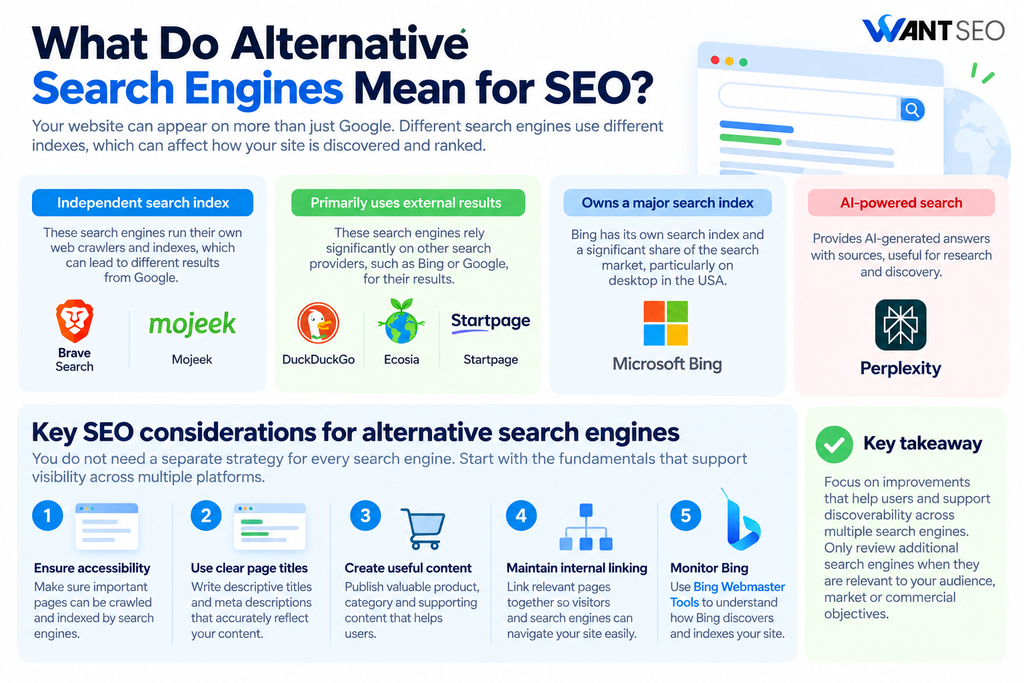
It is also worth monitoring Bing through Bing Webmaster Tools. This can help you understand how Bing discovers and indexes your website. However, do not create a separate SEO strategy for every alternative search engine without a clear reason. Prioritise improvements that help users and support discoverability across multiple platforms. Review additional search engines when they are relevant to your audience, market or commercial objectives.
How Want SEO Can Help You Rank on Google and Alternative Search Engines
Search visibility is no longer limited to Google. Depending on your audience, potential customers may also use Bing, Brave Search and other platforms to discover products, services and information. The challenge is understanding where your business needs to be visible and what will make the biggest difference. At Want SEO, we help eCommerce businesses build a clearer SEO strategy that supports visibility across relevant search platforms. Rather than treating every alternative search engine as a separate project, we focus on the technical foundations, content quality and website structure that help search engines discover, understand and evaluate your pages.
A Strategic Approach to Search Visibility
We focus on the SEO foundations that help your website get discovered across Google and relevant alternative search engines. From technical SEO and content strategy to CRO, we prioritise the improvements most likely to support your business goals.
- Technical SEO: We identify issues that may prevent search engines from crawling and indexing your website properly. This includes reviewing site architecture, internal linking, page accessibility and other technical factors that influence discoverability.
- Content and keyword strategy: We identify the searches that matter to your customers and align your product pages, category pages and supporting content with their intent. The aim is to attract relevant audiences, not simply increase traffic.
- SEO for Google and alternative search engines: We consider how your website can be discovered across Google, Bing and other relevant platforms. Where appropriate, this includes reviewing Bing Webmaster Tools, indexability and the technical requirements that support visibility beyond Google.
- SEO and conversion rate optimisation (CRO): Visibility is only part of the picture. We also consider whether your landing pages help visitors understand your products, evaluate their options and take the next step. This connects search performance with the commercial outcomes that matter to your business.
Focus on What Makes the Biggest Difference
Not every alternative search engine deserves equal attention for every business. The right approach depends on your customers, target markets, current visibility and commercial priorities. We help you understand where to focus, which issues to address first and where additional work is unlikely to make a meaningful difference. This means building a search strategy around your business objectives rather than chasing every new platform or SEO trend.
Want SEO helps you make better growth decisions through SEO, CRO and strategy, with a focus on clarity, prioritisation and sustainable performance.
If you want to understand how your website performs across primary and alternative search engines and what to prioritise next, get in touch with Want SEO to discuss your current position and the opportunities worth exploring.
Conclusion
Alternative search engines offer different benefits, from privacy-focused searching and independent web indexes to environmental initiatives and AI-powered research. Bing is a practical general-purpose alternative, DuckDuckGo is worth considering for privacy, and Brave Search and Mojeek offer independent indexes. Ecosia appeals to environmentally conscious users, Startpage provides a privacy-focused route to familiar results, Kagi offers paid customisation, and Perplexity supports research through AI-generated answers.
The best choice depends on what you want from search. Rather than switching simply because Google dominates the market, identify your priorities and test the alternatives that address them. For businesses, the same principle applies to SEO. Understand where your audience searches, focus on useful content and technical accessibility, and invest in improvements that support meaningful discovery rather than activity for its own sake.
FAQs
1. What is the best alternative search engine to Google?
Bing is a strong general-purpose alternative, while DuckDuckGo suits privacy-conscious users and Brave Search is worth considering for its independent index.
2. Which alternative search engine is best for privacy?
DuckDuckGo, Brave Search and Startpage offer privacy-focused features, but they differ in how they source results and handle information. None makes your entire browsing activity anonymous.
3. Is there an alternative search engine that does not use Google’s results?
Yes. Brave Search and Mojeek operate their own web indexes, giving users an alternative to Google’s index.
4. Is Bing better than Google?
Neither is universally better. Bing offers strong integration with Microsoft products, while Google may provide more useful results for particular queries, locations or topics.
5. Are alternative search engines important for SEO?
They can be, depending on your audience. Bing and independent alternative search engines have their own discovery and ranking systems, so technical accessibility and useful content remain important.
6. Can I use more than one alternative search engine?
Yes. You can use one search engine by default and switch to another for research, privacy or different results. Comparing engines can help you discover information that one platform may not surface.