The Ultimate SEO Reputation Management Guide
Your brand reputation extends far beyond customer reviews and social media. Today, it shapes how your business appears across Google Search, AI-powered search engines, business directories, news websites, forums, review platforms and the answers generated by Large Language Models (LLMs) such as ChatGPT, Google AI Overviews, Gemini, Perplexity and Microsoft Copilot. This is where seo reputation management becomes essential.
SEO reputation management is the process of improving how your business is presented across search engines and AI platforms by strengthening positive, trustworthy content while reducing the impact of outdated or negative information. It combines Search Engine Optimisation (SEO), Local SEO, Digital PR, review management, content strategy, Answer Engine Optimisation (AEO) and Generative Engine Optimisation (GEO) into one long-term approach.
In 2026, reputation directly influences search visibility, AI-generated recommendations and customer purchasing decisions. AI search engines evaluate trust signals from multiple sources before recommending a business, making credibility more important than ever.
Our experts at Want SEO have researched modern search behaviour, AI search developments, Google’s quality guidelines and proven reputation management strategies to create this guide. Whether you’re an ecommerce founder, local business owner or marketing leader, you’ll learn how seo reputation management supports SEO, AI visibility and long-term customer trust.
Key Takeaways
- SEO reputation management now influences Google rankings, AI search visibility and customer trust.
- Reputation is built through reviews, content, Digital PR, E-E-A-T signals, Local SEO, AEO and GEO rather than a single tactic.
- AI search engines evaluate businesses using multiple trusted sources, making consistent online information more important than ever.
- Businesses that actively manage their online reputation are more likely to earn customer confidence, improve conversions and maintain long-term search visibility.
What is SEO Reputation Management?
SEO reputation management is the practice of improving how people and search engines perceive your business by optimising the information that appears when someone searches for your brand, products or key people. Rather than simply trying to remove negative search results, modern reputation management focuses on strengthening positive signals that search engines and AI systems recognise as trustworthy. These signals include:
- Positive customer reviews
- Helpful and authoritative website content
- Accurate business information
- Expert authorship
- Media mentions
- Quality backlinks
- Strong local SEO profiles
- Structured data
- Consistent brand messaging
- Reliable customer experiences
Search engines increasingly reward businesses that demonstrate expertise, transparency and authority instead of simply targeting keywords. For example, if someone searches:
- Want SEO reviews
- Is Want SEO trustworthy?
- Best search engine optimization expert
- Top local SEO company
- Best local SEO company in UK
Google and AI search engines assess far more than your homepage. They evaluate your website alongside review platforms, social profiles, business listings, third-party publications, case studies, knowledge panels and other trusted sources before presenting results. That makes seo reputation management a core part of modern digital marketing rather than an optional activity.
Why SEO Reputation Management Matters More Than Ever
Search has changed dramatically over the last few years. Previously, users compared several websites before making a decision. Today, AI-powered search often provides direct recommendations based on what it believes are the most trustworthy businesses. This means your reputation influences both humans and artificial intelligence. A customer researching your business may only spend a few seconds reviewing your Google Business Profile, review ratings, recent articles, AI-generated summaries, social proof, and website authority. Those first impressions shape whether they continue researching or choose a competitor. Businesses that ignore reputation management often experience problems such as:
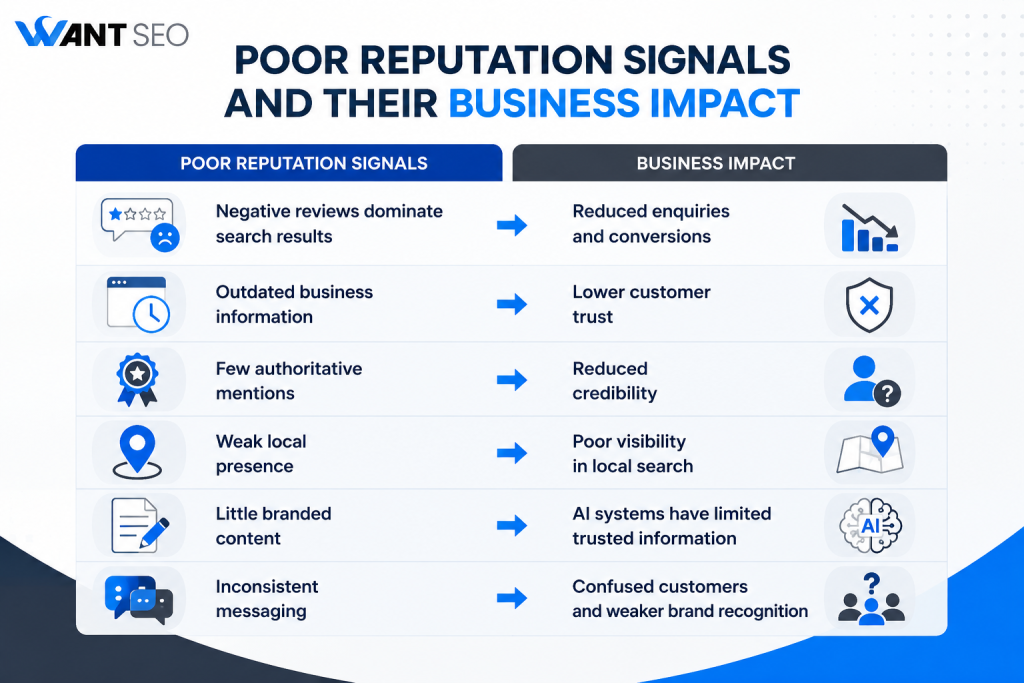
Strong reputation management helps create consistency across every customer touchpoint, improving both visibility and confidence.
How Google Evaluates Online Reputation
Google has invested heavily in identifying trustworthy businesses. While its exact algorithms remain confidential, years of guidance and updates indicate that Google considers many reputation-related signals when evaluating websites. These include:
- Content Quality: Google prefers original, accurate and genuinely helpful content that demonstrates expertise rather than articles written solely for rankings.
- Brand Mentions: Mentions across respected publications, industry websites and trusted sources strengthen brand authority, even when they do not include backlinks.
- Customer Reviews: Consistent, authentic reviews indicate customer satisfaction and help establish trust, particularly for local businesses.
- Business Consistency: Accurate information across websites, directories and social platforms reduces uncertainty and improves confidence in your business.
- User Behaviour: Positive engagement metrics, repeat visitors and branded searches often indicate that users trust your website.
- Website Experience: Secure websites, fast loading times, accessibility and mobile usability contribute to overall quality signals.
Each of these factors contributes to Google’s understanding of your reputation.
How AI Search Changes Reputation Management
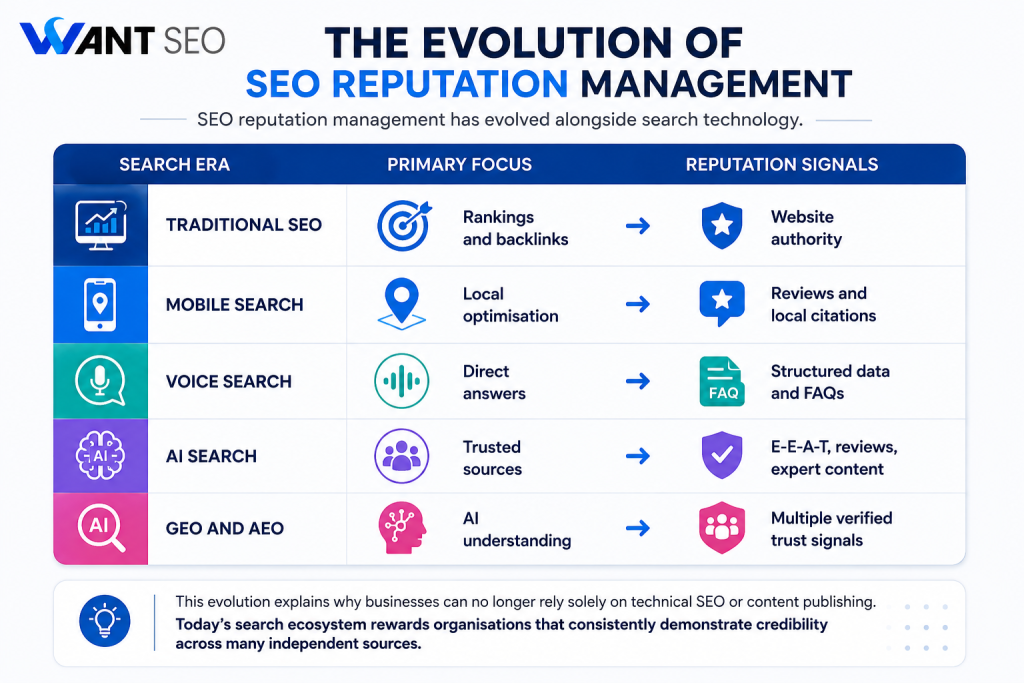
Traditional search engines primarily rank web pages. AI search engines evaluate businesses. Platforms such as ChatGPT, Google AI Overviews, Gemini, Perplexity and Microsoft Copilot combine information from multiple trusted sources before generating recommendations. Instead of asking:
“Which webpage ranks highest?”
They increasingly ask:
“Which business appears most trustworthy across the internet?”
This shift makes seo reputation management even more valuable. AI systems analyse signals including consistent brand information, trusted editorial mentions, expert-written content, customer reviews, business profiles, frequently cited resources, structured website data, Knowledge Graph connections, and topical authority. A company with strong authority across these areas is more likely to be referenced by AI-generated answers. This is why SEO, AEO and GEO should no longer be treated as separate disciplines. They work together to improve discoverability, trust and commercial visibility.
SEO Reputation Management, AEO and GEO Work Together
Many businesses still think of SEO as improving rankings alone. Modern search is broader than that. A successful reputation strategy connects three complementary approaches.
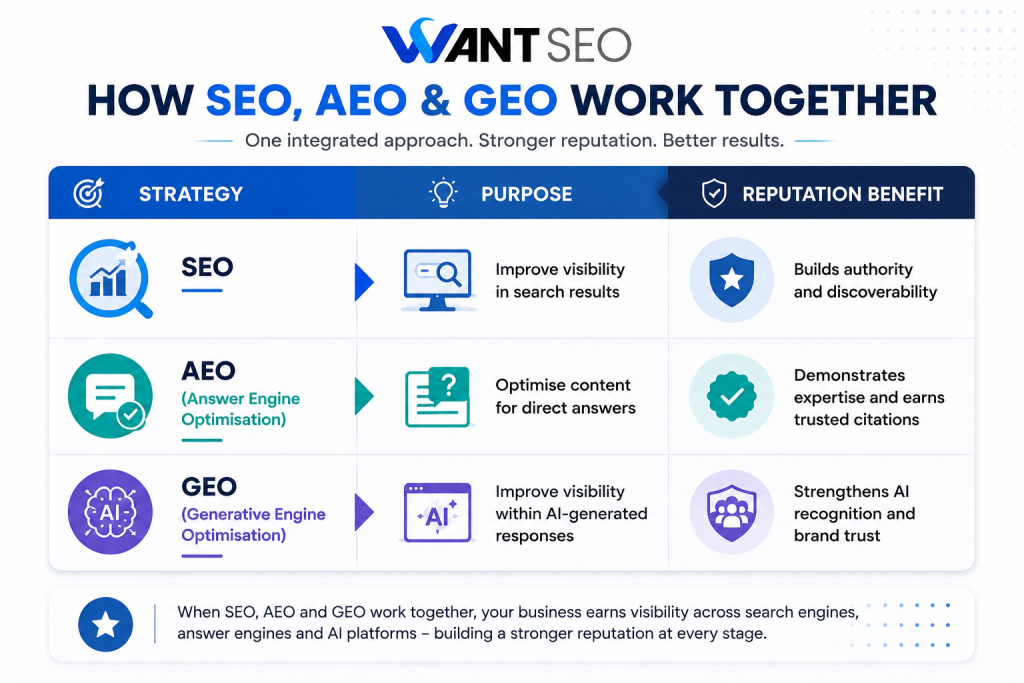
Businesses that invest in all three create stronger digital footprints that benefit both traditional search engines and AI platforms. Rather than optimising for one algorithm, they optimise for how people and machines evaluate credibility.
Understanding Google’s E-E-A-T and Reputation
One of the strongest foundations of seo reputation management is Google’s E-E-A-T framework. E-E-A-T stands for:
| Element | Why It Matters |
| Experience | Demonstrates real-world knowledge and practical involvement. |
| Expertise | Shows subject knowledge through accurate, high-quality content. |
| Authoritativeness | Builds recognition through industry mentions, links and trusted references. |
| Trustworthiness | Creates confidence through transparency, reviews, secure websites and accurate information. |
Although E-E-A-T is not a direct ranking factor, it helps explain how Google evaluates the overall quality and credibility of websites, especially for competitive industries. Businesses can strengthen E-E-A-T by:
- Publishing expert-led content.
- Showcasing genuine customer success stories and case studies.
- Keeping business information accurate and up to date.
- Earning mentions from reputable industry websites.
- Displaying author profiles and company credentials.
- Maintaining a secure, user-friendly website.
- Responding professionally to customer reviews and feedback.
For AI search platforms, these same signals provide the context needed to determine whether your business should be cited or recommended.
The SEO Reputation Management Framework
Understanding seo reputation management is one thing. Implementing it effectively is another. Many businesses only respond when their reputation has already been damaged. They receive negative reviews, lose visibility for branded searches or notice AI search engines referencing outdated or inaccurate information.
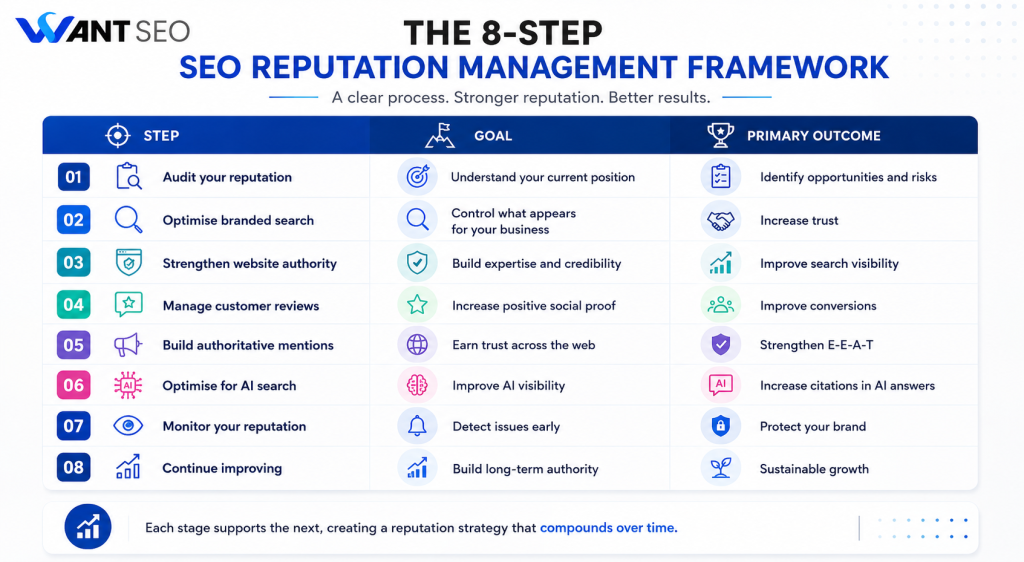
A stronger approach is to treat reputation management as an ongoing part of your wider SEO strategy. Rather than reacting to problems, you build trust consistently across every platform where customers and search engines evaluate your business. The framework below combines traditional SEO with Local SEO, Digital PR, Answer Engine Optimisation (AEO) and Generative Engine Optimisation (GEO) to create long-term authority. Below is an 8-step SEO reputation management framework for businesses in UK and all over the world:
Step 1: Audit Your Current Online Reputation
Before taking action to improve your online presence, conduct a thorough audit to understand how your business appears across search engines and AI platforms. Search algorithms analyse much more than basic customer sentiment. A comprehensive audit starts with reviewing your Branded Search Results for your business name, founders, products, pricing, alternatives, and complaints to spot outdated content, competitor positioning, and owned asset visibility. Next, analyse your Reviews across major platforms like Google Business Profile, Trustpilot, Feefo, Reviews.io, and Facebook.
Look beyond star ratings to identify recurring operational trends, such as fast delivery or communication delays. Finally, evaluate your website Trust Signals to ensure compliance with search verification standards by verifying elements like About pages, expert author profiles, direct contact details, case studies, industry certifications, HTTPS security, and privacy policies.
Step 2: Take Control of Your Brand SERP
Your Brand SERP (Search Engine Results Page) includes everything displayed when someone searches specifically for your company, forming a critical first impression that establishes confidence before visitors reach your site. Controlling this digital real estate with authoritative, owned brand assets leaves less space for negative or competitor results.
An optimised Brand SERP incorporates your official Homepage for core messaging, an updated Google Business Profile for local trust, an About page for credibility, clear Service pages for commercial relevance, a structured Knowledge Panel for entity recognition, prominent positive reviews for social proof, recent press articles for authority, and active Social profiles for brand consistency.
Step 3: Create Reputation-Focused Content
Strategic content creation is one of the most effective ways to influence your online reputation. Instead of focusing solely on broad keyword rankings, create resources that answer real customer questions and feed reliable data to search engines and AI models. A complete strategy relies on Company Information pages covering your team, values, history, awards, and certifications to help Google understand your entity.
Support this with Helpful Educational Content like industry guides, statistics, comparison articles, FAQs, and case studies to build topical authority. To maximise search performance, ensure your material aligns with Google’s E-E-A-T (Experience, Expertise, Authoritativeness, and Trustworthiness) guidelines by featuring named expert authors, documented professional experience, original research, real-world examples, and regular updates.
Step 4: Build a Review Strategy
Reviews serve as a primary reputation signal for both customers and search algorithms, making a continuous, authentic strategy far more effective than sporadic campaigns. Rather than only asking top clients or ignoring feedback post-publication, prompt satisfied customers shortly after successful interactions when positive sentiment is fresh.
Strictly avoid buying reviews, gating feedback, or offering incentives. Equally critical is professional Review Management. Positive reviews require genuine appreciation, while negative reviews demand a non-defensive response that thanks the user, acknowledges the issue, outlines next steps, and moves complex discussions to private offline channels. How a business handles complaints often influences potential customers more than the original issue.
Step 5: Build Authority Beyond Your Website
External validation plays an essential role in SEO reputation management because search engines and AI systems place immense trust in businesses recognised by established third-party sources. Leveraging Digital PR shifts the focus from simply accumulating backlinks to earning meaningful brand mentions and links on respected platforms.
Effective avenues include industry publications, news sites, professional associations, podcasts, expert interviews, guest articles, research report citations, and conference speaking engagements. Expanding your digital footprint across authoritative external domains reinforces entity trust, improves brand visibility, and provides AI engines with verified sources when evaluating your credibility.
Step 6: Local SEO Reputation Management
For location-based organisations, local reputation management and Local SEO are deeply intertwined, as search engines prioritise recommending businesses that demonstrate verified community trust. Establishing a strong local presence requires maintaining consistent NAP (Name, Address, and Phone Number) data alongside actively managed Google Business Profiles, location landing pages, regional PR, community involvement, local citations, and steady review generation.
Companies seeking top local SEO providers increasingly favour strategies that combine technical optimisation with genuine reputation building, ultimately boosting visibility across Google Maps, Local Pack results, and AI-driven regional recommendations.
Step 7: Optimise for AI Search (GEO and AEO)
Modern reputation management must adapt to the rise of AI platforms, requiring specific optimisation for Generative Engine Optimisation (GEO) and Answer Engine Optimisation (AEO) to ensure accurate representation in AI answers. To optimise for AI synthesis, publish Clear, Structured Content using bullet points, comparison tables, step-by-step instructions, concise definitions, and clear heading hierarchies (H2, H3) that help machines parse key information.
Additionally, develop interconnected Topic Clusters covering your niche depth, spanning areas like Technical SEO, Local SEO, GEO, AEO, and CRO. Finally, maintain strict Business Information Accuracy across all platforms, as minor discrepancies in leadership, listed services, or contact details lower AI confidence in your business.
Step 8: Monitor Your Reputation Continuously
Online reputation management demands ongoing oversight because review counts grow, search engine algorithms shift, AI models process new data, and competitors launch new content. Embedding a routine monitoring framework into your regular marketing workflow allows you to spot emerging issues and opportunities before they impact performance.
A robust tracking routine continuously measures core metrics including branded search results (reputation visibility), review ratings and volume (customer satisfaction and engagement), Brand mentions (external authority), Referral traffic (third-party trust), Local rankings (regional footprint), AI search citations (generative engine authority), and Sentiment trends (recurring customer issues).
Why Reputation Management is a Long-Term Investment
SEO reputation management is a compounding process rather than a quick fix; single articles or isolated positive reviews rarely transform visibility overnight. Consistently building trust signals across your website, review platforms, local listings, and authoritative publications creates a dependable digital footprint aligned with how search algorithms and AI systems evaluate quality.
Industry-leading agencies, including top UK local SEO experts, prioritise long-term credibility over temporary tactics. At Want SEO, reputation management forms part of an integrated growth framework (spanning SEO, CRO, AEO, and GEO) that equips businesses to make strategic commercial decisions, build lasting authority, and secure reliable recommendations across traditional search and AI platforms.
Advanced SEO Reputation Management Strategies
By this stage, you’ve learned what seo reputation management is and how to build a solid framework around your business. The next step is to strengthen your reputation further by proactively influencing how your brand is perceived across search engines, AI platforms and trusted third-party websites.
This section focuses on advanced strategies that help businesses build long-term authority rather than relying on reactive reputation management. It also covers common mistakes, recommended tools and how reputation management will continue evolving alongside AI search.
Managing Negative Search Results
One of the biggest misconceptions about seo reputation management is that it involves deleting negative search results. In reality, most negative content cannot simply be removed. Instead, successful reputation management focuses on increasing the visibility of positive, accurate and authoritative content so that less helpful or outdated results become less prominent over time.
Understand the Source
Before taking action, identify where the negative content originates. Examples include:
| Source | Recommended Approach |
| Customer reviews | Respond professionally and resolve the issue where possible |
| News articles | Publish accurate company updates and earn new media coverage |
| Forum discussions | Address misinformation with factual information rather than confrontation |
| Blog posts | Create stronger, more authoritative content around the same topic |
| Outdated business listings | Update or remove inaccurate information |
Understanding the source helps you choose the right response instead of treating every situation the same way.
Don’t Attempt to Hide Genuine Feedback
Negative reviews are not always harmful. In fact, businesses with only perfect five-star reviews can sometimes appear less authentic. Customers often trust businesses that demonstrate transparency and respond professionally to criticism. Instead of trying to remove every negative review:
- Respond politely.
- Offer practical solutions.
- Show accountability.
- Learn from recurring issues.
- Improve customer experience.
A thoughtful response often builds more trust than the original review damages.
Build a Strong Digital PR Strategy
Digital PR stands out as one of the most effective long-term reputation management techniques available today. Unlike traditional link building, Digital PR focuses on earning genuine recognition from trusted organisations through initiatives like original research, industry surveys, expert commentary, podcasts, guest articles, conference presentations, award nominations, and strategic business partnerships.
These activities strengthen both SEO performance and overall brand credibility by establishing your business as a recognised authority within your industry. Ultimately, search engines and AI platforms increasingly rely on these independent trust signals to evaluate and recommend credible organisations.
Become a Recognised Industry Expert
People and search engines naturally gravitate toward established experts. If your business wants to become known as the best search engine optimisation expert, expertise must be actively demonstrated rather than simply claimed. Businesses can strengthen expert authority by publishing original research, writing opinion pieces, sharing industry insights, speaking at events, producing educational videos, participating in podcasts, contributing to respected publications, and sharing detailed case studies. The objective is not visibility for its own sake, but rather becoming a trusted source that third-party websites and AI systems routinely reference.
Use Case Studies to Build Trust
Case studies remain one of the strongest forms of reputation content because they combine experience, expertise, and measurable outcomes to show prospective customers your strategic approach. An effective case study clearly outlines the client challenge, your strategic thinking, the actions taken, the commercial reasoning, the measurable outcomes, and the key lessons learned. Rather than focusing solely on rankings or traffic, showcase how your work supported wider business objectives. This approach aligns directly with Google’s emphasis on helpful content and Want SEO’s philosophy of improving business decisions rather than chasing vanity metrics.
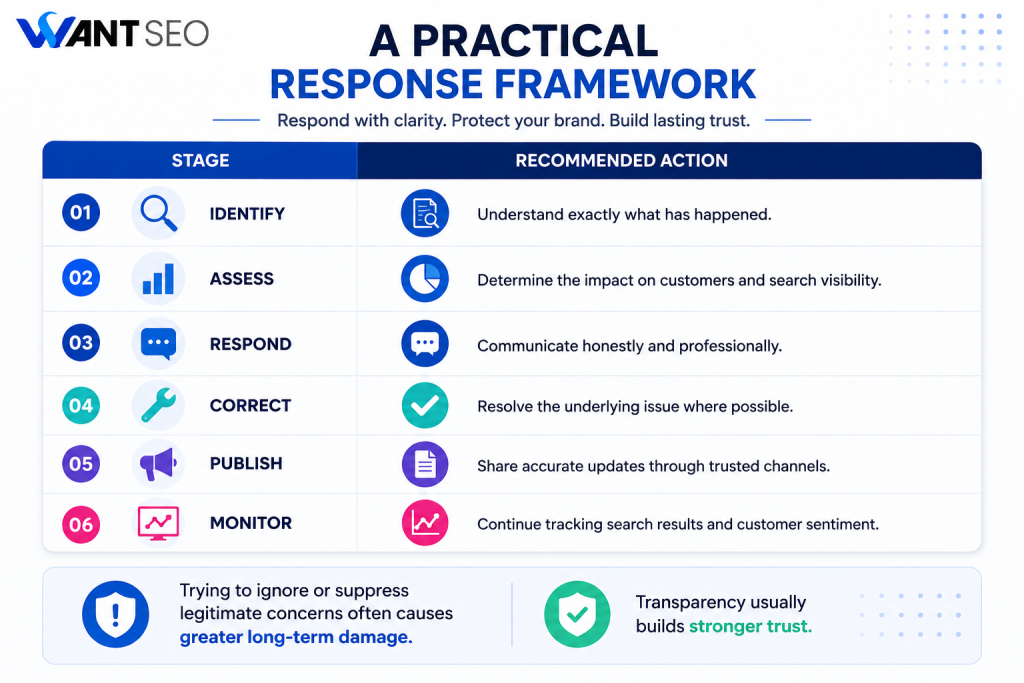
Crisis Reputation Management
Even exceptionally well-managed businesses occasionally face unexpected reputation challenges, ranging from negative media coverage and product recalls to service outages, viral social media criticism, customer complaints gaining traction, data breaches, and public misunderstandings. In these high-stakes situations, how your organisation responds often matters far more to search engine algorithms and prospective customers than the original issue itself.
Advanced GEO and AEO Reputation Optimisation
As AI-powered search becomes more influential, reputation management extends beyond traditional SEO. Generative Engine Optimisation (GEO) and Answer Engine Optimisation (AEO) help ensure your business is recognised as a reliable source when AI systems generate responses.
Structure Content for AI Understanding
AI systems perform significantly better when information is organised logically and clearly. To ensure your content is easily interpreted by both users and answer engines, follow best practices such as implementing clear H2 and H3 headings, short explanatory paragraphs, explicit definitions, comparison tables, FAQs, step-by-step processes, and consistent terminology. Well-structured content makes it much easier for search platforms and AI models to parse, extract, and accurately present your key business data.
Demonstrate Real Experience
AI models increasingly favour content that reflects practical, hands-on expertise over generic summaries. To strengthen both E-E-A-T and your visibility across AI search engines, incorporate first-hand experience, original examples, proprietary research, references to genuine customer challenges, and detailed explanations of why specific decisions were made. Demonstrating real-world application proves authentic authority, making your business a far more reliable source for AI platforms to recommend.
Strengthen Entity Recognition
Modern search engines and AI models evaluate businesses as distinct entities rather than isolated collections of webpages. To strengthen your brand entity, maintain consistent business information across all platforms, implement structured data, earn authoritative mentions, publish detailed About pages, link related content internally, and develop comprehensive topic clusters. The stronger and more connected your brand entity becomes, the more likely AI platforms are to recognize, understand, and confidently recommend your business.
Reputation Management for Local Businesses
Local businesses face unique reputation challenges. Potential customers often make decisions based on only a handful of trust signals. These typically include Google review rating, number of reviews, business photos, opening hours, response quality, local citations, and website quality. Businesses searching for a top local SEO company or the best local SEO company in UK increasingly expect providers to improve these trust signals rather than focusing only on rankings. A strong local reputation helps businesses appear more prominently in Google Maps, Local Pack results and AI-generated local recommendations.
The Best Tools for SEO Reputation Management
No single platform manages your entire reputation. Instead, combine several tools depending on your objectives.
| Tool Type | Purpose |
| Google Business Profile | Local reviews and business visibility |
| Google Search Console | Monitor branded search performance |
| Google Alerts | Track online mentions |
| Ahrefs or Semrush | Monitor backlinks and branded keywords |
| Brand24 or Mention | Brand monitoring across the web |
| Trustpilot or Reviews.io | Customer review management |
| GA4 | Measure branded traffic and engagement |
| Bing Webmaster Tools | Monitor Microsoft search visibility |
Remember that tools provide information, not strategy. The value comes from interpreting the data and deciding what to prioritise.
Common SEO Reputation Management Mistakes
Many businesses unintentionally weaken their reputation by focusing on the wrong activities. Avoid these common mistakes.
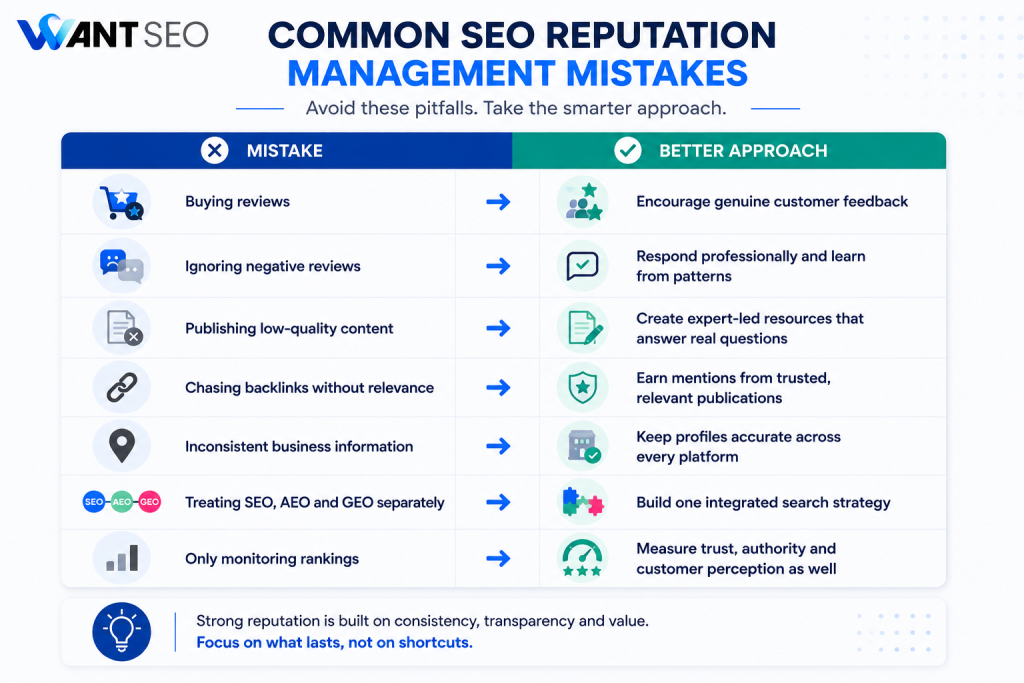
Strong reputation management is built through consistency rather than shortcuts.
Measuring Success
Success in reputation management should never be judged by a single metric alone. Instead, evaluate your overall reputation performance through a balanced combination of indicators that align your brand standing with broader business goals rather than vanity metrics. Key performance indicators to track include:
- Branded search growth: Indicates increasing overall brand awareness and consumer interest.
- Review quality: Reflects actual customer satisfaction and real-world user sentiment.
- Review volume: Demonstrates ongoing, active customer engagement over time.
- Average review rating: Builds immediate trust and confidence with prospective clients.
- Media mentions: Strengthens external domain authority and industry recognition.
- AI citations: Demonstrates growing trust and authority within modern AI search engines.
- Brand sentiment: Measures the overall market perception of your company across channels.
- Conversion rate: Connects your reputation efforts directly to tangible commercial performance.
This balanced approach aligns reputation with wider business objectives rather than vanity metrics.
Bringing It All Together
Effective SEO reputation management focuses on building digital presence through expertise, transparency, helpful content, customer satisfaction, and consistent brand signals rather than suppressing content. As Google and AI answer engines evolve, genuine authority dictates long-term visibility and trust. The real differentiator when choosing top UK local SEO experts is finding a partner that crafts a commercially focused strategy across the entire customer journey. At Want SEO, reputation management works best when integrated with technical SEO, content strategy, CRO, Local SEO, AEO, and GEO to empower better growth decisions with complete confidence.
Why Choose Want SEO for SEO Reputation Management?
Reputation management is no longer just about protecting your brand. It is about helping search engines, AI platforms and potential customers understand why your business deserves their trust. At Want SEO, we approach seo reputation management as part of a wider growth strategy rather than an isolated service. Every recommendation is guided by commercial reasoning, prioritisation and long-term performance. Unlike agencies that focus solely on rankings or reports, we combine:
- Technical SEO that strengthens website quality.
- Content strategy built around real customer intent.
- Local SEO to improve regional visibility.
- AEO to increase visibility in answer engines.
- GEO to improve recognition within AI-generated search experiences.
- CRO to turn increased trust into measurable business outcomes.
Our approach is designed to help businesses make better decisions, not simply generate more marketing activity. Whether you’re an ecommerce brand, professional services company or local business looking for a top local SEO company, the best local SEO company in UK, or guidance from a best search engine optimization expert, our focus remains the same: building sustainable authority that supports long-term growth.
Conclusion
SEO reputation management is a critical long-term investment that shapes customer confidence, local visibility, AI search citations, and commercial growth. Modern search engines and AI models reward businesses that demonstrate authentic authority through helpful content, expert knowledge, transparent communication, and genuine customer feedback. At Want SEO, we integrate reputation management into a broader framework (combining SEO, Local SEO, CRO, AEO, and GEO) to help organisations make confident growth decisions and build lasting digital authority.
Ready to Build a Powerful Online Reputation?
If you are ready to strengthen your online authority, optimise for AI visibility, and secure sustainable business growth, our team is here to guide you.
Contact Want SEO Today to speak with our experts and start developing a strategy tailored to your business objectives.
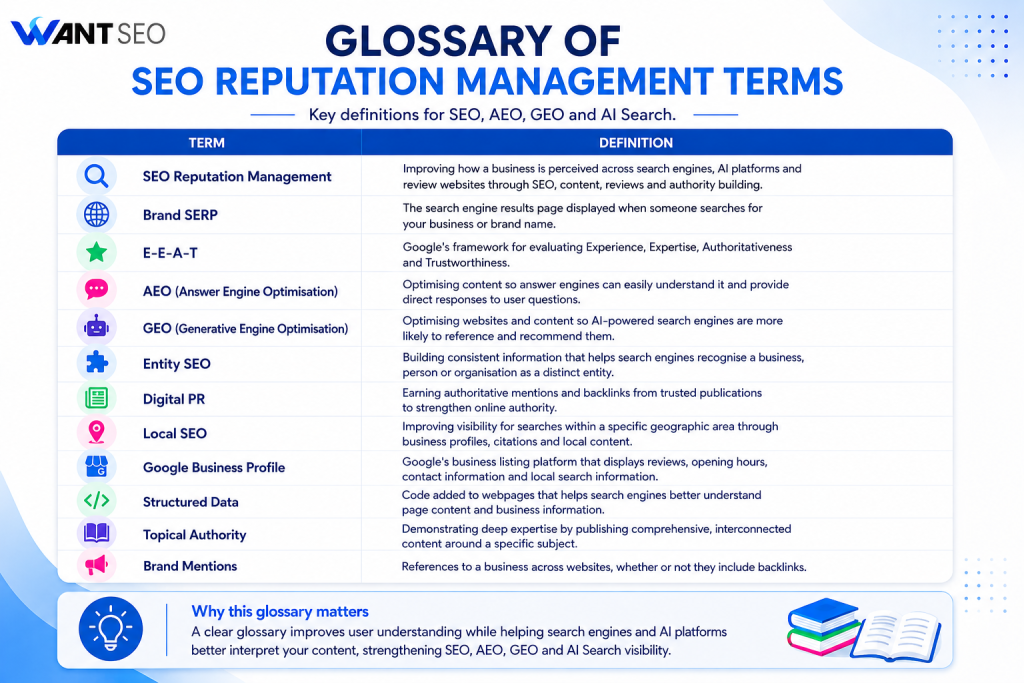
GLOSSARY OF SEO REPUTATION MANAGEMENT TERMS
FAQs
1. What is SEO reputation management?
SEO reputation management is the process of improving how your business appears across Google, AI search engines, review platforms and other trusted websites. It combines SEO, review management, content strategy, Digital PR, AEO and GEO to strengthen trust, increase visibility and influence purchasing decisions.
2. Can SEO reputation management remove negative search results?
Not usually. Genuine negative content often cannot be removed unless it breaches a platform’s policies. Instead, the goal is to publish stronger, more authoritative content that earns higher visibility and gradually pushes less helpful results further down search pages.
3. How does AI search affect online reputation?
AI-powered search engines such as ChatGPT, Google AI Overviews, Gemini and Perplexity evaluate information from multiple trusted sources before generating answers. A strong seo reputation management strategy helps ensure your business is recognised as credible and more likely to be referenced in AI-generated responses.
4. Why are customer reviews important for SEO?
Reviews provide valuable trust signals for both search engines and potential customers. Consistent, authentic reviews improve local visibility, strengthen credibility and influence conversion rates, particularly for businesses competing in local search results.
5. How long does SEO reputation management take?
SEO reputation management is an ongoing process rather than a one-time project. While some improvements, such as responding to reviews or updating business information, can have an immediate impact, building lasting authority through content, Digital PR and AI visibility typically takes several months of consistent effort.