
Want SEO
What Is the 3-3-3 Rule in Digital Marketing?
Digital marketing can quickly become complicated. Businesses often try to reach multiple audiences, communicate too many messages and maintain a presence across every available platform. The result is usually a marketing strategy that spreads time and budget too thinly. The 3-3-3 rule offers a simple way to bring more focus to these decisions. It encourages businesses to concentrate on three audience segments, three core marketing messages and three primary channels.
Rather than trying to do everything at once, the idea is to identify where marketing effort is most likely to make a commercial difference. For eCommerce businesses in particular, this can help create a more consistent approach to reaching customers, communicating product value and supporting purchases.
However, there is an important distinction to understand: the 3-3-3 rule is a practical marketing framework, not a formally established formula. Different marketers use the term to describe slightly different approaches.
What Is the 3-3-3 Rule in Digital Marketing?
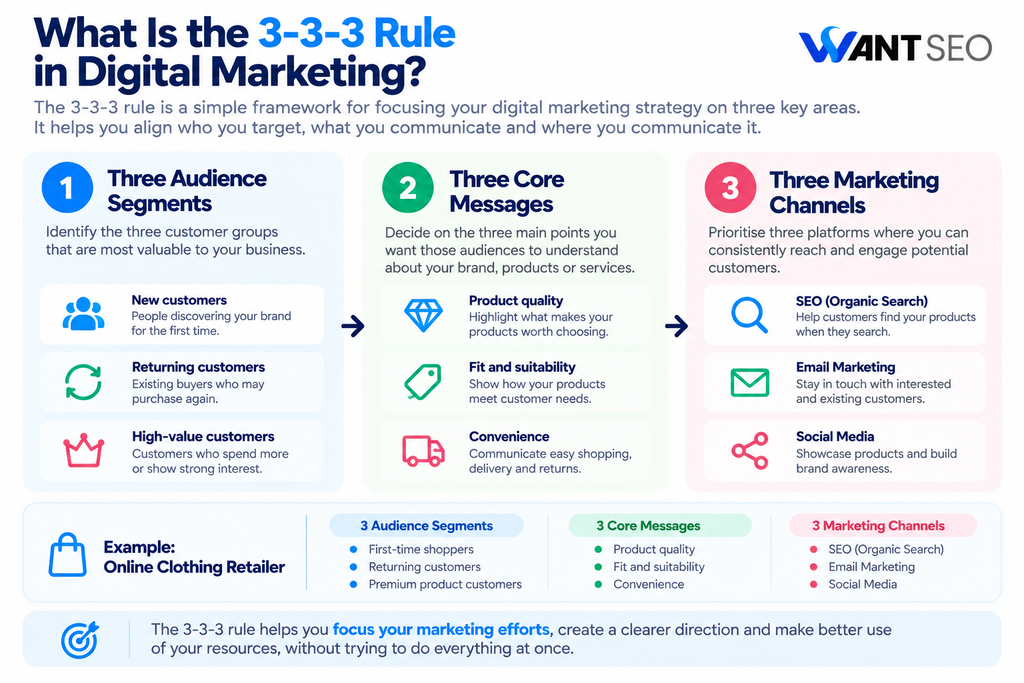
The 3-3-3 rule in digital marketing is commonly used as a framework for simplifying marketing strategy around three key areas:
- Three audience segments: Identify the three customer groups that are most valuable to your business.
- Three core messages: Decide on the three main points you want those audiences to understand about your brand, products or services.
- Three marketing channels: Prioritise three platforms where you can consistently reach and engage potential customers.
The purpose is to create alignment between who you target, what you communicate and where you communicate it.
For example, an online clothing retailer might target first-time shoppers, returning customers and customers interested in premium products. Its core messages could focus on product quality, fit and convenience. It might then prioritise organic search, email marketing and social media as its main channels. This gives the business a clearer direction without requiring it to invest equally in every marketing opportunity.
Breaking Down the Three Parts of the 3-3-3 Rule
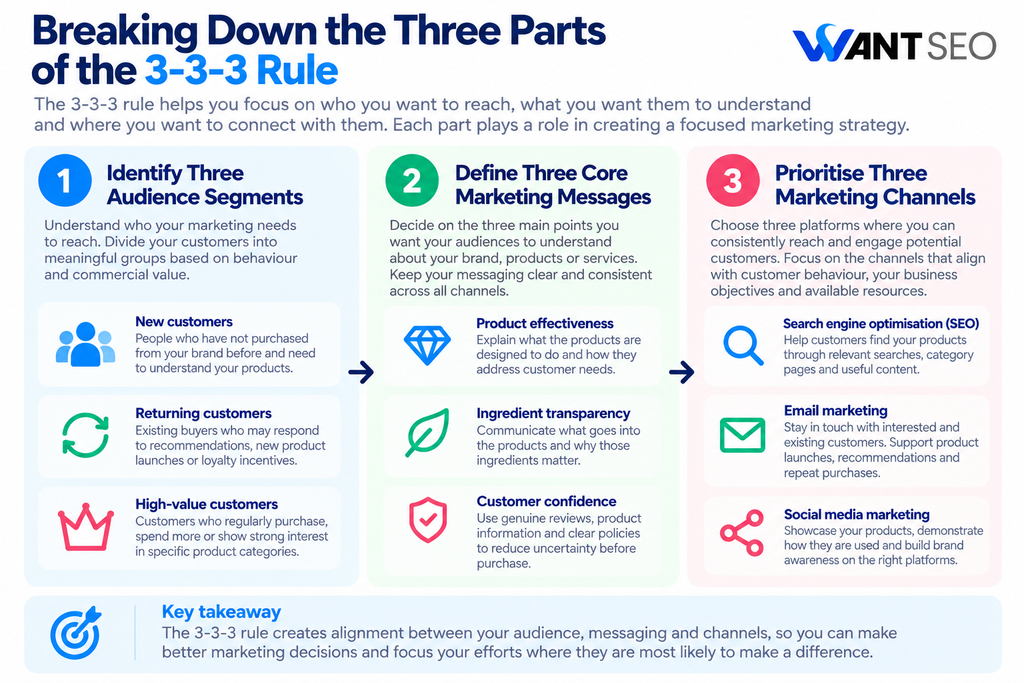
The 3-3-3 rule becomes easier to apply when you look at its three core elements: who you want to reach, what you want them to understand and where you want to connect with them. Each element plays a role in creating a focused marketing strategy that aligns with your business objectives.
1. Identify Three Audience Segments
The first step is understanding who your marketing needs to reach. Not every visitor has the same requirements or buying intentions. Some people are discovering your brand for the first time, while others are comparing products or considering another purchase. Instead of treating everyone as one broad audience, divide your customers into meaningful groups. For an eCommerce business, these could include:
- New customers: People who have not purchased from your brand before and need to understand your products and what makes them worth considering.
- Returning customers: Existing buyers who may respond to relevant recommendations, new product launches or loyalty incentives.
- High-value customers: Customers who regularly purchase, spend more or show a strong interest in particular product categories.
These segments should reflect actual customer behaviour and commercial value, rather than assumptions about who might buy. Review your customer data, purchase history, website behaviour and customer feedback to identify meaningful differences between groups.
As Neil Patel explains in his guide to identifying a target audience, audience segmentation helps businesses develop more relevant messaging and select suitable marketing channels. The important point is to understand what different groups need before deciding how to reach them.
2. Define Three Core Marketing Messages
Once you understand your audiences, the next step is deciding what you want them to remember. A common marketing problem is trying to communicate too many benefits at once. Product quality, price, delivery, customer service, sustainability and promotions may all be important, but presenting everything with equal priority can make your message difficult to understand. The 3-3-3 rule encourages you to narrow your communication down to three central messages. For example, an eCommerce skincare brand might focus on:
- Product effectiveness: Explain what the products are designed to do and how they address customer needs.
- Ingredient transparency: Communicate what goes into the products and why those ingredients matter.
- Customer confidence: Use genuine reviews, product information and clear policies to reduce uncertainty before purchase.
These messages should remain consistent across the website, social media, email campaigns and advertising. That does not mean repeating identical wording everywhere. Each platform has a different format and audience expectation. The underlying message, however, should remain recognisable.
Consistency is also important when customers move between channels. If an advertisement makes a particular promise but the landing page communicates something different, it can create uncertainty and weaken trust.
3. Prioritise Three Marketing Channels
The third part of the framework is deciding where your marketing effort should go. There are many channels available, including SEO, paid search, social media, email marketing, influencer partnerships and affiliate marketing. Trying to manage all of them without sufficient resources can lead to inconsistent execution. Instead, choose three channels based on customer behaviour, business objectives and the resources available. For an eCommerce business, a practical combination might look like this:
- Search engine optimisation (SEO): SEO helps potential customers discover your products when they search for relevant information, categories or solutions. It can support product discovery through category pages, product pages and useful informational content.
- Email marketing: Email allows you to communicate with existing customers and people who have shown interest in your products. It can support product launches, relevant recommendations, abandoned basket journeys and repeat purchases.
- Social media marketing: Social media can help introduce products, demonstrate how they are used and build familiarity with your brand. The most suitable platform depends on where your customers spend time and the type of content your products support.
The right combination will vary between businesses. A brand with a strong visual product range may benefit from prioritising Instagram or Pinterest, while another business may find that organic search and email contribute more directly to its commercial goals. Neil Patel’s guide to multichannel marketing also highlights the importance of selecting platforms based on audience behaviour and available resources, rather than trying to maintain a presence everywhere.
How to Apply the 3-3-3 Rule to an eCommerce Business
Understanding the framework is straightforward. Applying it requires more thought, particularly when different products, customer groups and marketing channels contribute differently to revenue. Consider an online homeware retailer that sells furniture, lighting and decorative accessories. Its 3-3-3 approach could look like this:
| Area | Priority 1 | Priority 2 | Priority 3 |
| Audience | First-time buyers | Returning customers | High-value customers |
| Core message | Product quality | Design and functionality | Reliable delivery and service |
| Marketing channel | SEO | Email marketing | Social media |
The retailer can then connect these priorities. For example, SEO content could help first-time buyers understand product features and compare different options. Email campaigns could introduce complementary products to existing customers. Social media could demonstrate how products look in real homes and encourage further product discovery.
The important part is that each channel has a defined purpose. Marketing activity is no longer based simply on keeping platforms active. It supports a specific audience and business objective.
What Are the Benefits of the 3-3-3 Rule?
The main benefit of the 3-3-3 rule is that it encourages businesses to make clearer marketing decisions. Rather than adding more activity, it creates a structure for deciding what deserves attention.
- Better Marketing Prioritisation: When businesses identify their most valuable audiences, messages and channels, they can allocate resources more deliberately. This makes it easier to decide which campaigns deserve investment and which activities can wait.
- More Consistent Brand Communication: Three core messages provide a common direction for marketing communication. Whether a customer discovers your brand through Google, an email or social media, the main reasons to consider your business should remain consistent.
- More Focused Marketing Spend: Spreading a limited budget across too many channels can make it difficult to understand what is contributing to business performance. Prioritising a smaller number of channels allows teams to give each one sufficient attention, review its contribution and make more informed investment decisions.
- Clearer Performance Measurement: A focused strategy makes it easier to connect marketing activity with meaningful outcomes. Instead of reviewing every available metric, businesses can assess whether their chosen channels are contributing to relevant results, such as qualified product enquiries, purchases, repeat orders and revenue.
Is the 3-3-3 Rule the Same as Other Marketing Rules?
Not necessarily. The term 3-3-3 rule is used in different ways across marketing articles and discussions. The audience, message and channel approach is one common interpretation, but other versions focus on different aspects of marketing. For example:
- Three content types, three channels and three buyer journey stages: This version focuses on planning content and distribution across awareness, consideration and decision-making.
- Three seconds, three messages and three supporting elements: This interpretation focuses on capturing attention and communicating clearly within an advertisement or marketing asset.
- Three seconds, 30 seconds and three minutes: This version focuses on how quickly marketing content should attract attention, communicate value and encourage action.
These interpretations share a similar principle: simplify marketing communication and avoid overwhelming the audience. There is no single official definition that every marketer follows. It is therefore important to understand which version is being discussed before applying it to your strategy.
Common Mistakes to Avoid When Using the 3-3-3 Rule
The 3-3-3 rule is intended to simplify marketing decisions, but it can become another checklist if applied without considering the business context.
- Choosing audiences without customer evidence: Selecting three customer groups simply because they sound commercially attractive will not create a useful strategy. Use purchase data, customer feedback and behaviour to identify segments that genuinely matter.
- Forcing every message into every channel: Consistency does not mean publishing identical content everywhere. A product demonstration may work well on social media, while a detailed comparison may be more useful on a website. Adapt the format while keeping the central message consistent.
- Choosing channels because competitors use them: A platform that works for another business may not be suitable for yours. Consider customer preferences, purchase behaviour, internal resources and the role each channel can play in the customer journey.
- Treating three as a fixed limit: The number three is a useful starting point, not a business requirement. Some brands may need fewer channels, while others may have the resources and evidence to support more. The objective is to prioritise effectively, not follow a number without question.
- Ignoring performance after implementation: A focused strategy still needs regular evaluation. Review the contribution of each channel and adjust your priorities when customer behaviour or business objectives change.
How the 3-3-3 Rule Fits Into a Wider Digital Marketing Strategy
The 3-3-3 rule is best treated as a starting framework rather than a complete digital marketing strategy. It helps establish who you want to reach, what you want to communicate and where you intend to reach them. It does not replace keyword research, customer analysis, conversion optimisation, campaign planning or performance measurement.
For example, selecting SEO as one of your three channels does not automatically tell you which keywords to target, which category pages to improve or what content your customers need before making a purchase. Those decisions require a deeper understanding of search intent, website performance and commercial priorities.
The same applies to CRO. Attracting the right audience is only part of the process. Product information, navigation, pricing, trust signals and the checkout experience all influence whether visitors complete a purchase. This is why digital marketing channels should not operate as disconnected activities. SEO, CRO, content and other marketing efforts need to support the same commercial objectives. For eCommerce businesses, the real value of the 3-3-3 rule is not doing exactly three things. It is using a simple structure to identify where effort is most likely to make a difference.
Conclusion
The 3-3-3 rule in digital marketing provides a practical way to simplify your marketing strategy by focusing on three audience segments, three core messages and three primary channels. It can help businesses improve prioritisation, maintain consistent communication and avoid spreading resources across activities that do not support clear objectives.
However, the framework should not be followed simply because it uses the number three. Your audiences, messages and channels should be selected based on customer behaviour, commercial value and available resources. The better question is not how many marketing activities your business can manage. It is which activities deserve your attention and how they work together to support sustainable growth.
FAQs
1. What is the 3-3-3 rule in digital marketing?
It is a marketing framework that commonly focuses on three audience segments, three core messages and three primary marketing channels to create a more focused strategy.
2. Who should use the 3-3-3 rule?
Small businesses, eCommerce brands and marketing teams can use it to simplify their priorities and avoid spreading resources across too many audiences or channels.
3. Is the 3-3-3 rule a proven marketing formula?
No. It is a practical planning framework rather than a formally validated formula. Its value comes from encouraging clearer decisions about audiences, messaging and channel selection.
4. How do I choose the three best marketing channels?
Start by reviewing where your customers discover products, research options and make purchases. Then consider which channels your team can manage consistently and measure effectively.
5. Can the 3-3-3 rule work for eCommerce businesses?
Yes. eCommerce brands can use it to prioritise customer segments, communicate key product benefits and focus on channels such as SEO, email marketing and social media.
6. Should businesses always stick to three marketing channels?
No. Three is a useful starting point, not a fixed requirement. Businesses should expand or reduce their channel mix based on performance, customer behaviour and available resources.