Want SEO
Is AEO Different from SEO? 8 Key Differences and How to Use Both
Search is changing, but that does not mean traditional SEO is becoming irrelevant. Businesses are now competing for visibility across conventional search results, AI-generated answers, conversational search platforms and other discovery experiences. This has introduced a new term into digital marketing: Answer Engine Optimisation (AEO). While SEO focuses on improving a website’s visibility in search engine results, AEO focuses on helping content become a useful source for direct answers generated by search engines and AI-powered platforms.
The distinction sounds straightforward, but the two approaches share many of the same foundations. Both depend on useful content, technical accessibility, relevance, authority and a clear understanding of what users are trying to achieve.
So, is AEO genuinely different from SEO, or is it simply an extension of traditional search optimisation? Understanding where they overlap, where they differ and how they work together can help businesses make better decisions about their search strategy.
What Is SEO?
Search Engine Optimisation (SEO) is the process of improving a website so that search engines can discover, understand and rank its content for relevant searches. The aim is to make a website more visible when potential customers search for information, products, services or solutions related to a business. SEO involves several interconnected areas, including technical optimisation, content development, keyword research, internal linking, website structure, user experience and authority building. Each contributes to helping search engines understand the relevance and usefulness of a website.
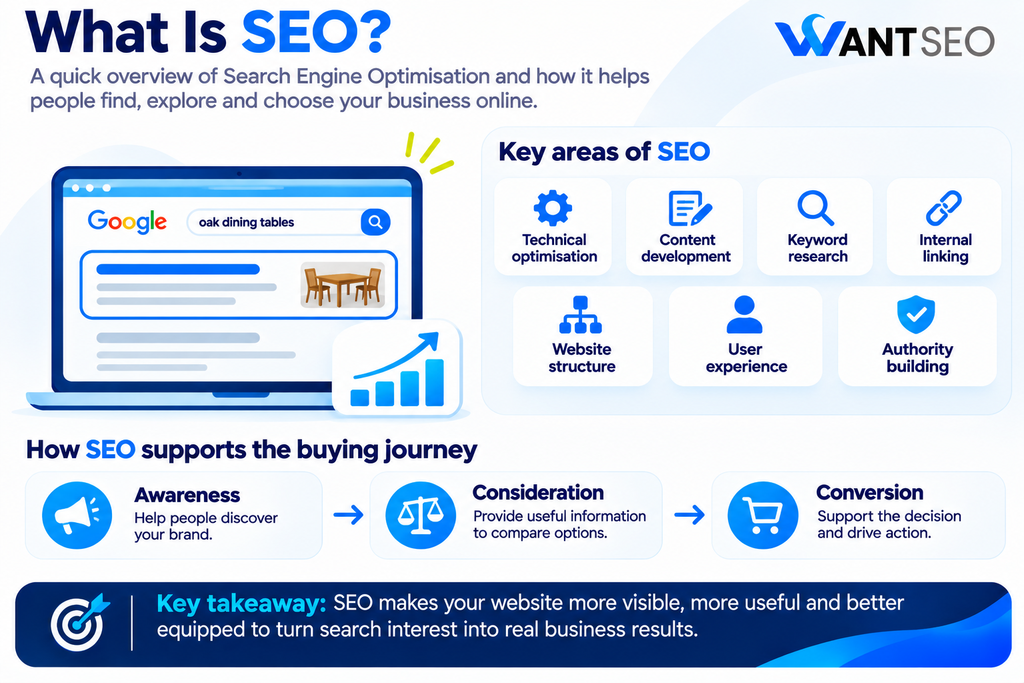
For example, an online furniture retailer might optimise its category pages for searches such as “oak dining tables” or “small dining tables for apartments”. It may also publish buying guides to answer questions about table sizes, materials and maintenance. The objective is not simply to appear for more keywords. It is to reach people at relevant stages of their buying journey and provide information that helps them make a decision.
SEO can support awareness, consideration and conversion by connecting a business with users who are actively searching for something it offers. Its commercial value therefore depends on more than rankings or organic traffic. The quality of the visitors, the pages they land on and whether those pages support the next step are equally important.
What Is AEO?
Answer Engine Optimisation (AEO) is the process of improving content so that search engines and AI-powered answer platforms can understand, retrieve and use it when responding to user questions. Traditional search often presents users with a list of webpages to explore. Answer engines can interpret a question, combine information from multiple sources and provide a summarised response directly to the user.
This changes how businesses think about visibility. Instead of competing only for a position in search results, they also need to consider whether their content is clear, reliable and relevant enough to be referenced within an AI-generated answer. For example, someone researching skincare products might ask an AI platform:
“What is a good skincare routine for someone with sensitive skin?”
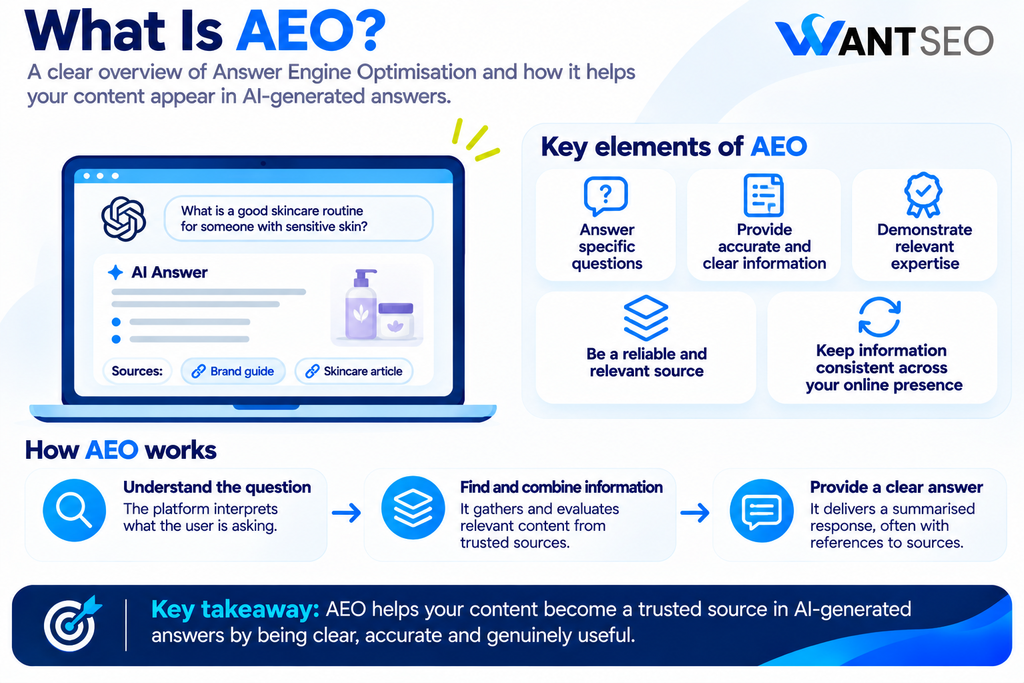
Rather than clicking through several websites, the platform may provide a summary of recommended products, ingredients to consider and skincare practices. It may reference particular brands, articles or sources that support its response. AEO aims to make your content a useful source within these answers. This involves providing accurate information, answering specific questions, explaining concepts clearly, demonstrating relevant expertise and maintaining consistency across your website and wider online presence.
AEO is not about creating content specifically for AI at the expense of people. Content that is genuinely useful, clear and trustworthy remains the central requirement.
Is AEO Different from SEO?
Yes, AEO and SEO have different visibility objectives, but they are closely connected. SEO primarily focuses on helping webpages rank in traditional search results, while AEO focuses on making information suitable for retrieval, use and citation within direct answers. The distinction becomes clearer when you compare what each approach is trying to achieve.
| Area | SEO | AEO |
| Primary objective | Improve organic search visibility and rankings | Increase visibility within direct answers and AI-generated responses |
| Search experience | Traditional search results and relevant search features | AI answers, conversational search and answer-based experiences |
| Content focus | Pages that satisfy search intent and cover topics effectively | Clear, specific information that can be understood and used to answer questions |
| Keyword approach | Keywords, topics, search intent and semantic relevance | Questions, conversational queries, context and specific information needs |
| Content structure | Well-organised pages with useful headings and supporting content | Clearly defined answers, descriptive headings and easily understood information |
| Authority | Relevant links, expertise, reputation and content quality | Trustworthiness, consistent information, credible references and brand recognition |
| Technical requirements | Crawlability, indexability, website performance and architecture | The same foundations, alongside content that can be accessed and interpreted by relevant systems |
| Measurement | Organic clicks, impressions, rankings, conversions and revenue | AI mentions, citations, source visibility and referral activity where measurable |
The biggest difference is how visibility is earned and presented. SEO helps a page compete for a place in search results. AEO helps information become part of an answer that may be generated from several sources. However, this does not mean the two strategies require completely separate content or technical work.
Where SEO and AEO Overlap
AEO builds on many of the same principles that have always mattered in SEO. Search engines and AI-powered platforms need to discover information, understand what it means and assess whether it is useful enough to surface. This is why many SEO activities continue to support AEO.
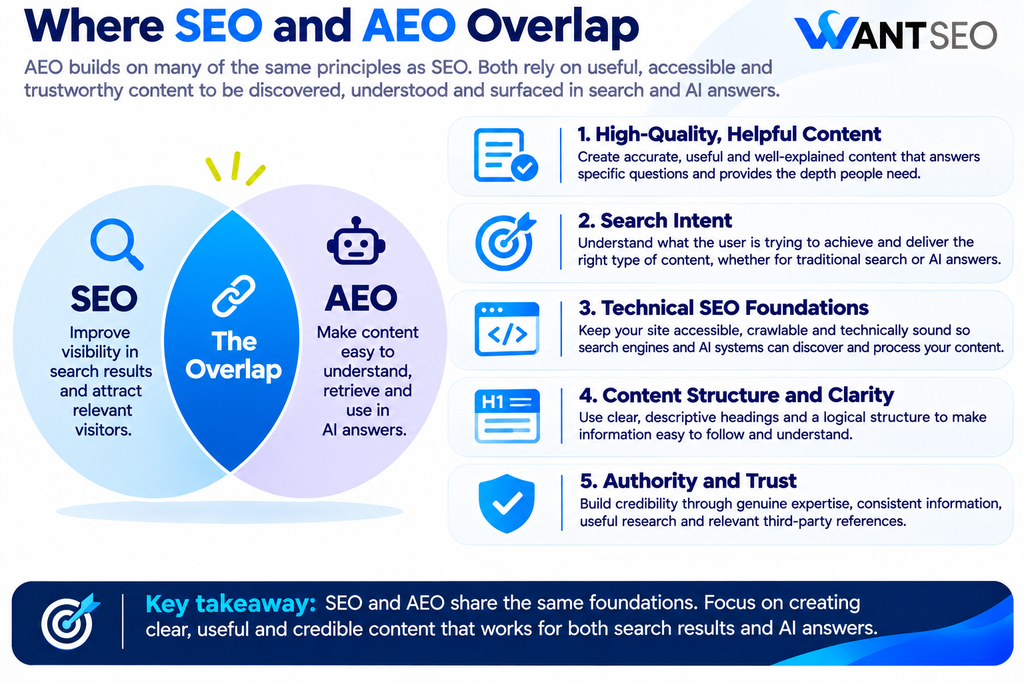
1. High-Quality, Helpful Content
Both SEO and AEO depend on content that genuinely addresses the needs of the audience. A webpage that provides accurate, useful and well-explained information is more valuable than one created simply to target a keyword or increase publishing volume. For SEO, helpful content can support relevance and organic rankings. For AEO, it can provide information that AI systems may be able to interpret and use when answering questions.
The difference is not that AEO requires a completely new type of content. It requires you to consider whether the information is clear enough to answer a specific question, while still providing the depth needed to satisfy the wider topic. For example, a guide about choosing a washing machine should explain the differences between capacity, energy efficiency, programmes, dimensions and price. It should not simply mention these terms without helping the reader understand how they affect the buying decision.
2. Search Intent
Understanding search intent is equally important for both approaches. SEO uses search intent to determine what type of page is most likely to satisfy a query. A person searching for “best running shoes” may want recommendations, comparisons and buying advice, while someone searching “how to clean running shoes” wants practical instructions.
AEO requires a similar understanding. AI platforms need to interpret what the user is asking, which information is relevant and what context is required to produce a useful answer. If your content addresses the wrong intent, it is unlikely to perform well simply because it is optimised for a particular keyword. This is why understanding your audience’s questions, concerns and decision-making process should come before deciding how a page needs to be optimised.
3. Technical SEO Foundations
A website still needs to be accessible, crawlable and technically sound. Important pages should not be blocked unnecessarily, content should be accessible to relevant crawlers, and the website should have a logical structure. Technical SEO helps search engines discover and process your content. It also supports the wider accessibility and reliability of your website.
These foundations matter for AEO because content that cannot be accessed or understood by relevant systems has fewer opportunities to be retrieved and referenced. There is little value in investing heavily in answer-focused content if important pages have indexing problems, poor architecture or technical barriers preventing discovery.
4. Content Structure and Clarity
Well-structured content benefits both search engines and readers. Descriptive headings, logical sections, concise explanations and relevant supporting details help users navigate a page. They also make it easier to identify what each section covers. For example, a page about eCommerce conversion rate optimisation might use headings such as:
- What is eCommerce conversion rate optimisation?
- Why do eCommerce websites have low conversion rates?
- How can product pages improve conversions?
- Which conversion rate metrics should you monitor?
Each heading establishes a clear topic, while the content underneath provides the relevant explanation. AEO adds greater emphasis to making individual sections understandable in their own context. This does not mean every paragraph should be reduced to a short answer. It means the page should communicate information clearly, without requiring readers to navigate through unnecessary wording before reaching the main point.
5. Authority and Trust
Search visibility is not built through content alone. A business’s reputation, expertise, credibility and wider presence can influence how users and search systems understand it. For SEO, relevant links, brand reputation, expertise and useful content contribute to the broader picture of website quality and authority. For AEO, trust is also important because AI systems need to draw on information that is sufficiently credible and relevant to a user’s question. Consistent business information, genuine expertise, useful research, accurate claims and credible third-party references can help establish a stronger online presence.
Neither approach benefits from artificial authority-building activities that have little genuine value. Publishing useful information and building a credible reputation is a more sustainable priority.
What Does AEO Require That Traditional SEO May Not Focus On as Much?
Although SEO and AEO share many foundations, AEO introduces additional considerations around how information is selected, interpreted and presented within AI-generated responses.
1. Answering Specific Questions Directly
AEO places greater emphasis on answering individual questions clearly. Traditional SEO content may cover a broad topic to satisfy several related search intents. This remains valuable, but answer-focused visibility also requires content to address specific questions without ambiguity. For example, an article about email marketing might include a section answering:
How often should an eCommerce business send marketing emails?
A useful answer would explain that frequency depends on the audience, type of email, customer expectations and engagement. It could then distinguish promotional campaigns from transactional messages and automated customer journeys. The answer provides a clear starting point, while the rest of the section adds context and practical considerations. This approach helps readers quickly understand the answer and allows the content to address the wider topic in meaningful depth.
2. Making Information Easy to Extract and Understand
AI-generated answers often combine information from several sources. Content should therefore communicate important facts in a way that is clear, specific and easy to interpret. This means avoiding vague claims, unnecessarily complicated sentences and explanations that depend on missing context.
For example, instead of writing: “Our advanced solutions provide exceptional outcomes through a comprehensive approach to improving digital performance.”
A clearer explanation would be: “We improve website performance by identifying technical problems, reducing friction and prioritising changes that support more conversions.”
The second statement explains what the business does and how it approaches the work. Clear information is useful for readers, search engines and AI systems. It also makes your content more credible because it replaces generic statements with explanations that can be understood and evaluated.
3. Covering Related Questions and Context
Users rarely ask only one question before making a decision. They often follow up with additional questions, constraints or comparisons. For example, someone researching an SEO agency may ask:
- What does an SEO agency do?
- How much does SEO cost?
- How long does SEO take to work?
- How do I know whether an SEO agency is suitable for my business?
- What should I expect from an SEO strategy?
A useful content strategy considers these related questions and develops information around the wider decision-making process. This does not mean creating a separate page for every variation of a question. In many cases, several closely related questions can be answered within one well-structured guide. The objective is to provide sufficient context without creating unnecessary content or repeating the same information across multiple pages.
4. Strengthening Brand Visibility Beyond Your Website
SEO traditionally places significant emphasis on improving the visibility of your own website. AEO also encourages businesses to consider how their brand is represented across other relevant sources. AI platforms may use information from websites, publications, discussions, reviews and other sources when developing responses. Your own website is important, but it is not the only place where potential customers may encounter information about your brand.
For businesses, this makes reputation and brand consistency increasingly relevant. Genuine customer reviews, useful industry contributions, credible mentions, partnerships and accurate business information can help strengthen the wider context surrounding your brand. This is not a reason to chase mentions across every platform. Prioritise the sources and communities that are genuinely relevant to your industry and audience.
Does AEO Replace SEO?
No. AEO does not replace SEO, and businesses should not abandon their existing search strategy to focus exclusively on AI visibility. Traditional search remains an important discovery channel for people researching products, comparing businesses, looking for services and accessing detailed information. SEO also provides foundations that can support visibility across newer search experiences.
AEO expands the areas businesses need to consider. It introduces additional opportunities to appear within AI-generated answers, but it does not remove the need for accessible websites, useful content, relevant pages, technical optimisation and a credible online presence. The more practical approach is to treat AEO as an extension of your wider organic visibility strategy.
Rather than creating separate SEO and AEO programmes that compete for resources, identify the work that supports both. Improving content quality, answering customer questions, strengthening technical accessibility and making your website easier to understand can benefit several search experiences at once.
Businesses should also avoid assuming that AI visibility will automatically produce website traffic or revenue. Some users may discover your brand through an AI answer without visiting your website. Others may use an AI platform to research a product before eventually completing their purchase through another channel.
The commercial impact should therefore be assessed alongside other marketing activity, not in isolation.
How to Optimise for Both SEO and AEO
The most effective approach is to prioritise the fundamentals while making content more useful for answer-based search experiences.
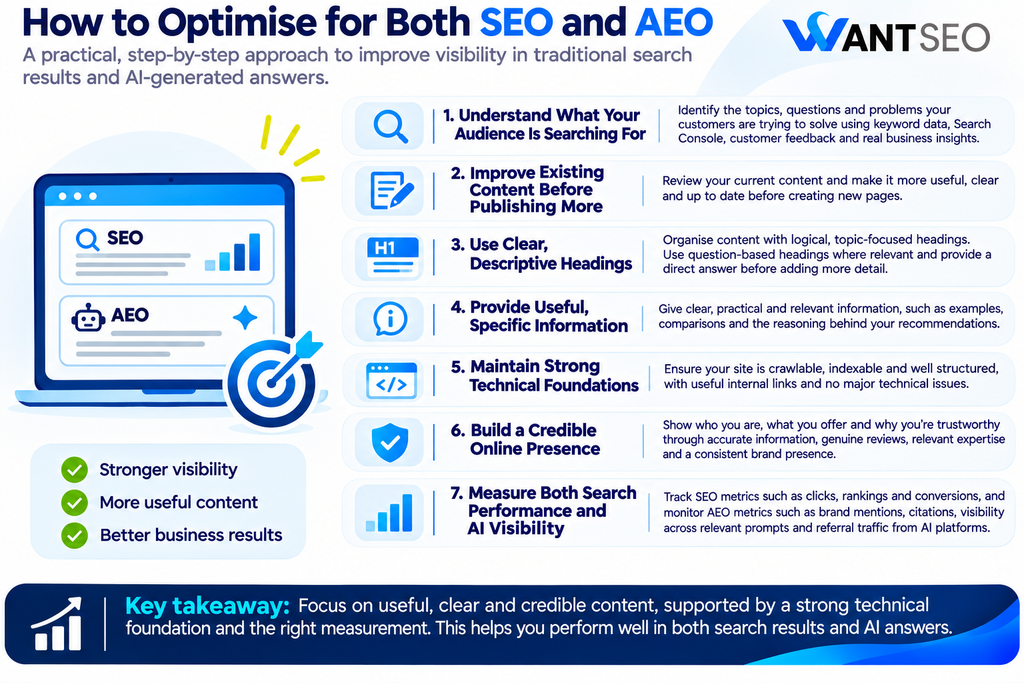
1. Understand What Your Audience Is Searching For
Start by researching the topics, questions and problems your customers are trying to solve. Use keyword research, Search Console data, customer feedback, product reviews, support enquiries and sales conversations to identify relevant information needs. Look beyond search volume. A question with lower demand may be more commercially valuable if it comes from someone who is closer to making a purchase or choosing a service.
2. Improve Existing Content Before Publishing More
Review your existing website content to identify pages that could be more useful. Look for articles that lack clear explanations, product pages with missing information, category pages that do not support buying decisions and content that has become outdated. Improving a page that already attracts relevant visitors may provide more value than publishing another article targeting a similar keyword.
3. Use Clear, Descriptive Headings
Organise content around logical topics and questions. Headings should help readers understand what each section covers, rather than simply include keywords. Where relevant, use question-based headings and provide a direct answer before expanding on the subject. This creates a clearer reading experience and helps your content communicate its purpose.
4. Provide Useful, Specific Information
Avoid generic explanations that could apply to almost any business. Where appropriate, include practical examples, comparisons, original observations, relevant data and explanations of why a recommendation matters. The more useful your content is for someone making a decision, the more meaningful its contribution to your wider search strategy.
5. Maintain Strong Technical Foundations
Make sure important pages can be crawled and indexed, your website has a logical structure, internal links are useful and your content is accessible. Technical problems can limit the visibility of content regardless of how well it is written. Prioritise issues based on the pages affected and their commercial importance, rather than attempting to fix every reported issue without understanding its impact.
6. Build a Credible Online Presence
Your website should communicate who you are, what you offer and why customers should trust your business. Support this through accurate information, clear product and service details, genuine reviews, relevant expertise and a consistent brand presence across appropriate channels. Avoid manufacturing authority through artificial mentions or low-value content. A credible reputation takes time to build and is more difficult to replace with shortcuts.
7. Measure Both Search Performance and AI Visibility
SEO and AEO do not have identical measurement requirements.
For SEO, monitor metrics such as:
- Organic clicks and impressions.
- Relevant keyword rankings.
- Organic landing page performance.
- Conversion rates.
- Revenue and leads generated through organic search.
For AEO, where reliable measurement is available, review:
- Brand mentions in AI-generated answers.
- Citations and linked sources.
- Visibility across relevant prompts and questions.
- How accurately AI platforms describe your business.
- Referral traffic from AI platforms.
- Commercial outcomes associated with AI-referred visitors.
Measurement should help you understand whether your work is improving visibility and contributing to business outcomes. Avoid treating every new metric as something that needs to become a target.
SEO vs AEO: Which Should Your Business Prioritise?
The answer depends on your audience, current performance, resources and how customers discover your products or services. For most businesses, SEO should remain a core priority because it provides the foundations for organic discoverability. If your website has technical issues, weak content, poor category structures or limited visibility for commercially relevant searches, addressing those problems is likely to be more valuable than investing heavily in AEO-specific activity.
AEO becomes more important when your audience increasingly uses AI platforms to research products, compare services, understand problems or identify potential suppliers. However, this does not mean every business needs a completely separate AEO strategy. If your existing content is already useful, technically accessible, well-structured, and supported by credible information, you may have a strong starting point. The next step is to identify where your content could answer customer questions more clearly and where your brand is missing from relevant discovery experiences.
For an eCommerce business, this might mean improving product specifications, clarifying delivery and returns information, strengthening buying guides, adding meaningful comparisons or making category pages more informative. For a service business, it might involve explaining processes, pricing considerations, service differences, limitations and the factors customers should evaluate before choosing a provider.
The priority is not to do more SEO or more AEO. It is to identify where your business is currently difficult to discover, understand or choose, and address that gap.
Final Thoughts
AEO is different from SEO in its primary visibility objective, but the two are closely connected. SEO helps businesses improve their presence in traditional search results, while AEO focuses on making their information useful and visible within direct answers generated by AI-powered platforms. The distinction matters, but it should not create unnecessary complexity.
Businesses do not need to abandon established SEO principles or create a separate strategy for every new search acronym. They need useful content, strong technical foundations, clear information, relevant authority and a better understanding of how customers discover and evaluate products or services.
A well-planned SEO strategy can support AEO, while AEO can highlight opportunities to improve the clarity, usefulness and wider visibility of your existing content. The best approach is to treat both as part of the same organic growth system, prioritising the work that helps potential customers find your business and make better decisions.
FAQs
1. What is the main difference between AEO and SEO?
SEO focuses on improving a website’s visibility in traditional search results, while AEO focuses on helping content appear within direct answers generated by search engines and AI-powered platforms.
2. Is AEO more important than SEO?
Not necessarily. SEO remains an important foundation for organic visibility, while AEO supports discovery through AI-generated answers. The priority depends on your audience, business objectives and existing search performance.
3. Does SEO help with AEO?
Yes. Technical accessibility, useful content, clear structure, relevant authority and accurate information can support both SEO and AEO. These shared foundations make the two strategies closely connected.
4. Can a website rank in Google but not appear in AI answers?
Yes. Ranking well in traditional search does not guarantee that your content will be selected, referenced or cited in AI-generated answers. The two visibility outcomes are related but not identical.
5. Do I need separate SEO and AEO content?
Usually not. Most businesses can improve both through a unified content strategy. Existing pages can often be improved by answering questions more clearly, providing useful context and making information easier to understand.
6. How can I measure AEO performance?
You can monitor brand mentions, citations, linked sources, visibility across relevant AI prompts and referral traffic from AI platforms. These measurements should be considered alongside organic traffic, conversions and other commercial outcomes.