What Is Search Engine Marketing (SEM)? A Practical Guide for Modern Search
Search has changed significantly. People still use Google and Bing to find products, services and information, but the search journey now includes paid ads, organic results, AI Overviews, AI Mode and other generative search experiences. That makes search engine marketing more important, but also more nuanced than simply paying for clicks.
At its core, search engine marketing (SEM) is the process of using search engines to make a business more visible to people who are actively looking for something relevant to its products, services or expertise. In current industry usage, SEM is often used to describe paid search and PPC advertising, although the term has historically been used more broadly to include both SEO and paid search. For businesses, the distinction matters less than the underlying objective: show up where demand exists, understand the intent behind that demand, and turn visibility into commercially useful action.
This guide, researched and worked out by our expert Want SEO team, explains what search engine marketing means today, how SEM works, how it differs from SEO, where PPC fits, what businesses should measure, and how SEM connects with AI search, GEO and AEO.
Key takeaways
- SEM is best understood through intent and commercial value, not simply clicks or impressions.
- Paid search gives businesses immediate opportunities to capture existing demand, but performance depends on relevance, ad quality, landing pages, bidding and conversion economics.
- SEO and SEM should inform each other. Paid search can reveal valuable commercial queries, while SEO can build longer-term visibility around proven demand.
- AI search changes the wider search journey, not the need for search strategy. GEO and AEO should complement strong SEO and SEM foundations rather than become disconnected activities.
What is search engine marketing?
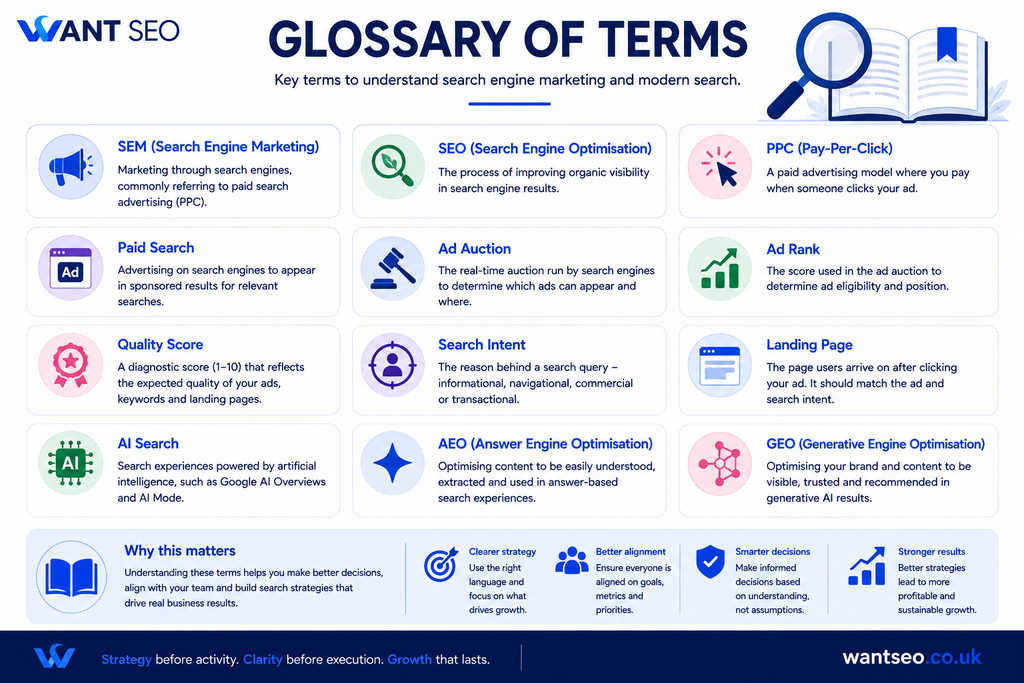
Search engine marketing is marketing designed to reach people through search engines when they are actively searching for information, products or services. In practical terms, the phrase is commonly used today to describe paid search advertising, particularly PPC campaigns on platforms such as Google Ads and Microsoft Advertising. Advertisers bid for opportunities to show ads against relevant searches, with the search engine determining which ads are eligible to appear and where they appear.
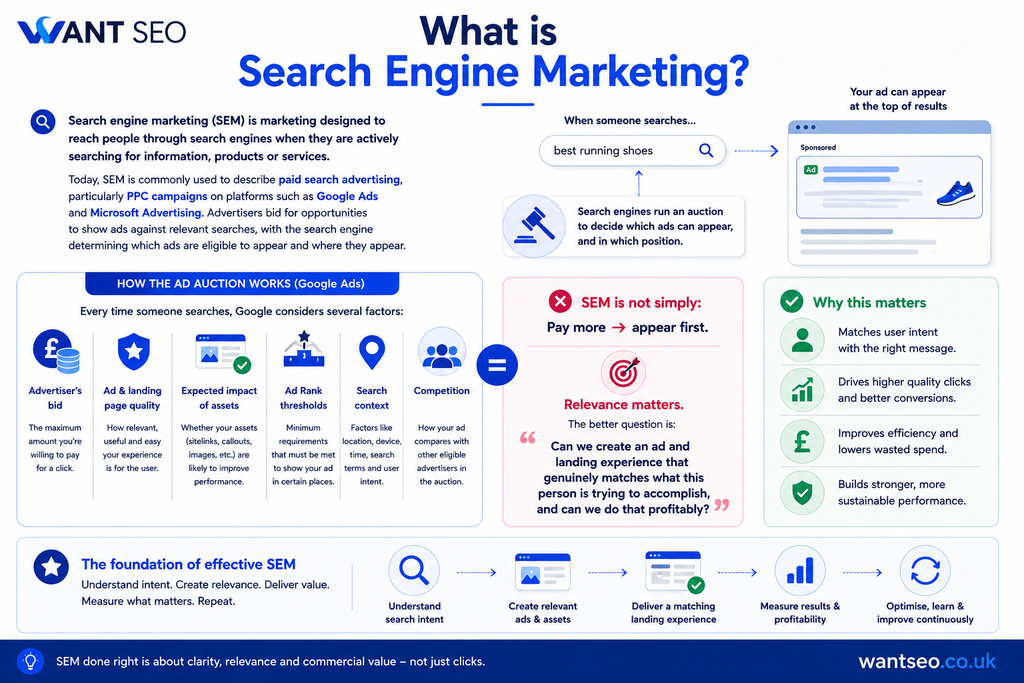
Google explains that its Ads system runs an auction every time someone searches, considering factors including the advertiser’s bid, ad and landing page quality, expected impact of assets, Ad Rank thresholds, search context and competition. That means search engine marketing is not simply:
Pay more → appear first.
However, relevance matters. Therefore, the better question is:
“Can we create an ad and landing experience that genuinely matches what this person is trying to accomplish, and can we do that profitably?”
That is the foundation of effective SEM.
Why is search engine marketing important?
Search engine marketing is valuable because it puts businesses in front of people at a point when they have already expressed an interest through a search. Someone searching for “running shoes” is different from someone searching for “best running shoes for flat feet” or “buy men’s running shoes size 10 UK”. The searches reveal different levels of intent.
This makes search engine marketing particularly useful for businesses that can connect a relevant search with a clear commercial proposition. For example, an eCommerce business could use paid search to capture demand for:
- Product-specific searches
- Brand searches
- High-intent category searches
- Location-specific searches
- Promotional searches
- Competitor or alternative searches, where appropriate
But visibility alone is not the objective. A campaign can generate thousands of clicks and still be commercially weak if the traffic does not convert, margins are too low or acquisition costs are unsustainable. This is why Want SEO’s approach to search engine marketing starts with commercial context rather than activity. Before increasing spend, ask:
“What demand are we trying to capture, and what is a commercially acceptable cost for doing so?”
How does SEM work?
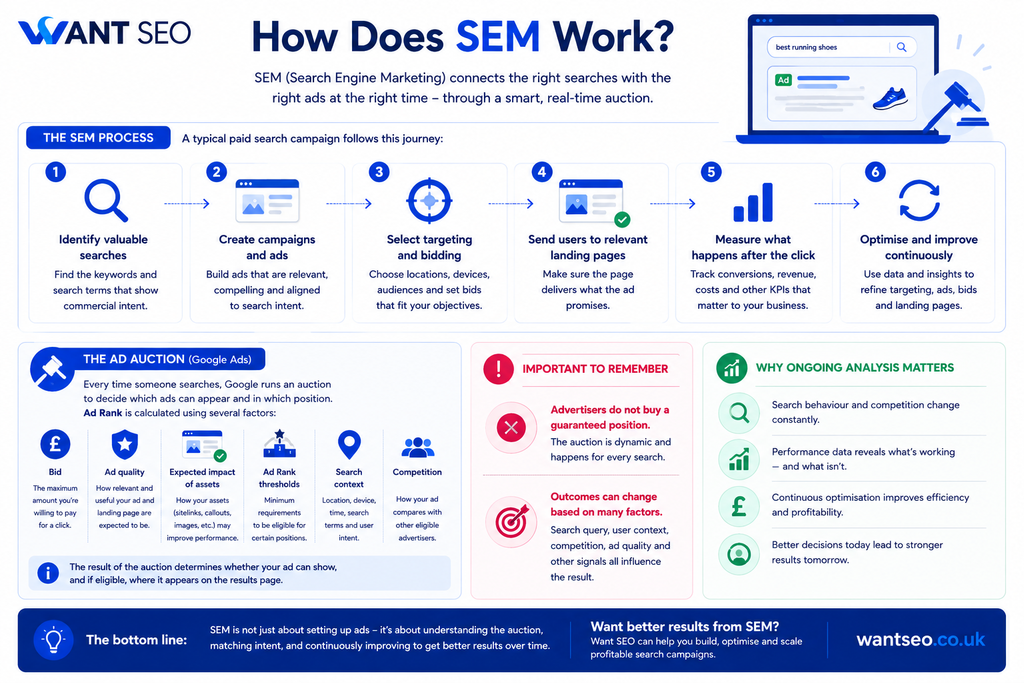
The mechanics of search engine marketing are relatively straightforward, but the decisions behind them are not. A typical paid search campaign involves identifying valuable searches, creating campaigns and ads, selecting targeting and bidding settings, directing users to relevant landing pages, and then measuring what happens after the click. When a search takes place, the advertising platform evaluates eligible ads through an auction.
Google states that Ad Rank is calculated using several factors, including bid, auction-time ad quality, thresholds, competition, search context and the expected impact of ad assets and formats. The result determines whether an ad can show and, if eligible, where it can appear.
Importantly, advertisers do not simply buy a guaranteed position. The auction is dynamic, and the outcome can change according to the search, user context, competition and other factors. This is one reason why successful SEM requires ongoing analysis rather than simply setting a budget and leaving campaigns running.
What are the main components of search engine marketing?
A strong search engine marketing strategy usually brings together several connected elements.
Keyword and search-term research
Keywords provide one way of understanding what people are searching for, but the more useful question is what those searches reveal about intent. A keyword with high volume is not automatically valuable. A lower-volume search can be commercially stronger if the person searching is much closer to making a decision. For example, compare “sofa” with “3 seater grey sofa delivery UK”
The second search communicates considerably more about the user’s needs and potential buying stage. Modern SEM therefore needs to move beyond volume and consider relevance, intent, competition, cost and commercial value.
Campaign structure
Campaigns need enough structure to allow businesses to control budgets, targeting and messaging without creating unnecessary complexity. The right structure depends on the business, product range, locations and objectives. There is no benefit in creating dozens of campaigns simply to make an account look sophisticated. The structure should make it easier to answer useful questions such as:
- Which products are generating profitable demand?
- Which markets are most efficient?
- Which searches are wasting budget?
- Which landing pages convert?
- Where should budget increase or decrease?
Ad copy and assets
Your ad is the bridge between a search and a website visit. It needs to communicate why the user should choose your business while remaining relevant to the search. Google recommends matching ad language to the customer’s search and using ad assets to provide additional useful information or links. This is where generic advertising often falls short. If several competitors are all saying “high quality”, “great service” and “shop now”, the ad gives the searcher little reason to choose one business over another. A stronger ad communicates something specific that matters to the intended customer.
Landing pages
The click is not the outcome. The landing page is where the business either validates the decision to click or creates friction. Google specifically recommends ensuring that landing pages closely match the ad and keywords, and that users can quickly find what the ad promised. For an eCommerce business, that might mean sending a searcher directly to the relevant product or category rather than a generic homepage.
For a B2B service, it could mean creating a page that directly addresses the service and intent reflected in the search. The stronger the connection between search → ad → landing page → action, the more coherent the experience becomes.
Search engine marketing vs SEO
One of the most common questions is the difference between SEM and SEO. The answer depends partly on how the term SEM is being used. In current paid-search usage, SEM generally refers to paid search advertising, while SEO refers to improving organic search visibility.
Search Engine Land takes a broader historical view, treating SEO and paid search as disciplines within search engine marketing. Neil Patel’s current guide, however, uses SEM primarily for paid advertising such as PPC. For practical business conversations, it is often clearer to use:
SEO = organic search visibility
SEM/PPC = paid search visibility
The two should not be treated as competitors. They solve different problems.
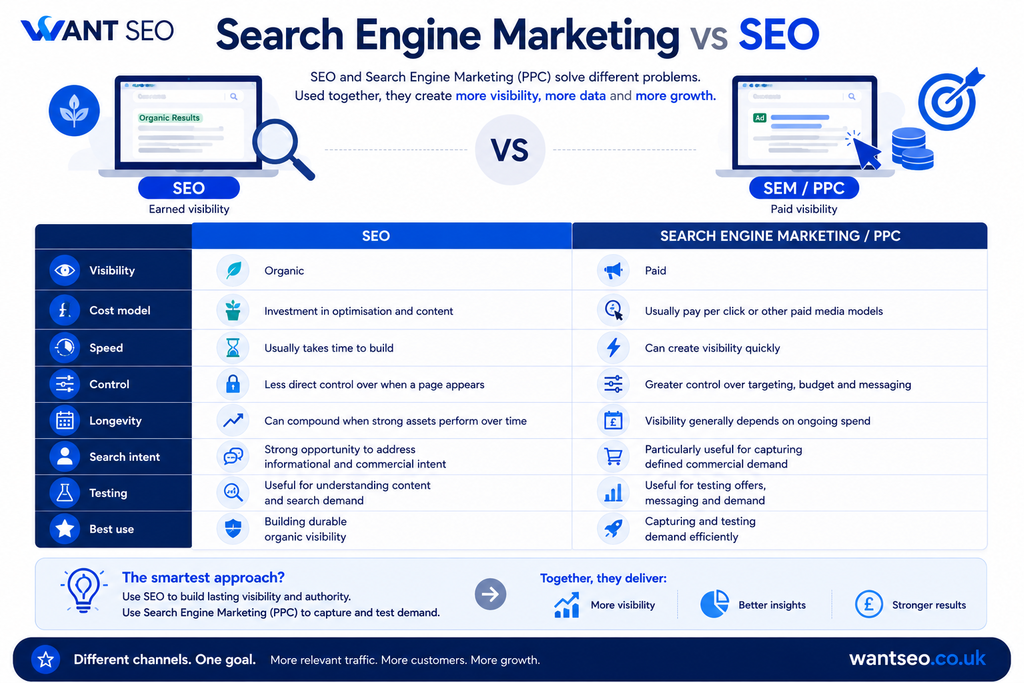
The best approach is rarely to choose one channel simply because it sounds better. Instead, look at where each channel creates the most value.
SEO and SEM should work together
SEO and search engine marketing often produce more useful insights when treated as connected parts of the same search strategy. Paid search can reveal:
- Which search terms generate conversions
- Which propositions attract clicks
- Which products generate commercial demand
- Which locations perform well
- Which messages resonate with customers
Those insights can inform SEO. At the same time, SEO can help identify topics, products and categories that deserve greater paid-search investment. For example, if an eCommerce category performs strongly through organic search and has healthy margins, there may be a commercial case for testing paid search around high-value terms.
Conversely, if paid search repeatedly demonstrates that a particular query produces poor-quality leads, that evidence may influence whether SEO resources should be invested in the same topic. The goal is not to make both channels target everything. It is to understand where effort compounds and where paid spend is genuinely incremental.
What is PPC and how does it relate to SEM?
PPC, or pay-per-click advertising, is a payment model in which an advertiser typically pays when someone clicks an ad. Paid search is one of the most common forms of PPC. This is why the terms SEM, PPC, paid search and search advertising are often used interchangeably in marketing conversations, even though they are not technically identical.
- SEM describes the broader search marketing activity.
- PPC describes a payment model.
- Paid search describes advertising through search results.
Google Ads is one of the major platforms used for search advertising, while Microsoft Advertising provides another route to paid search audiences. The distinction becomes useful when building a strategy because it stops terminology from becoming confused with objectives. A business does not need “more PPC”. It needs the right level of paid search investment against commercially valuable demand.
What determines where a paid search ad appears?
Google’s current explanation of the ad auction is useful because it shows why simply increasing bids is not a complete strategy. Ad Rank considers several factors.
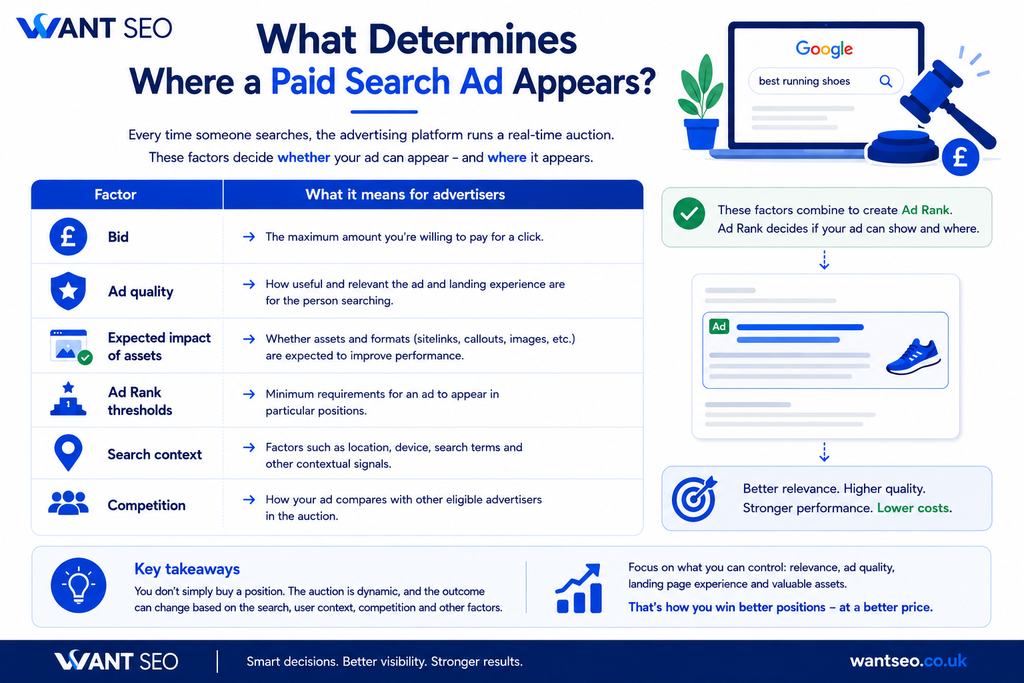
Google states that higher-quality ads can achieve stronger positions and may pay less per click than lower-quality ads. This is an important distinction for commercial decision-making. The goal is not to win every auction. The goal is to win the auctions that matter at an acceptable economics.
What is Quality Score in SEM?
Quality Score is often misunderstood. Google describes Quality Score as a diagnostic tool, measured from 1 to 10, that helps advertisers understand how their ad quality compares with other advertisers. It is based on factors including expected click-through rate, ad relevance and landing page experience.
However, Google explicitly says Quality Score itself is not an input into the ad auction and should not be treated as a KPI to maximise. That distinction matters. Do not chase a “10/10” score for its own sake. Instead, use the diagnostic information to ask:
- Is the ad relevant to the search?
- Is the expected CTR weak?
- Does the landing page satisfy the search?
- Is the message consistent from ad to page?
- Are we targeting the right searches?
This is much more aligned with the way Google evaluates ad quality.
How to build a search engine marketing strategy
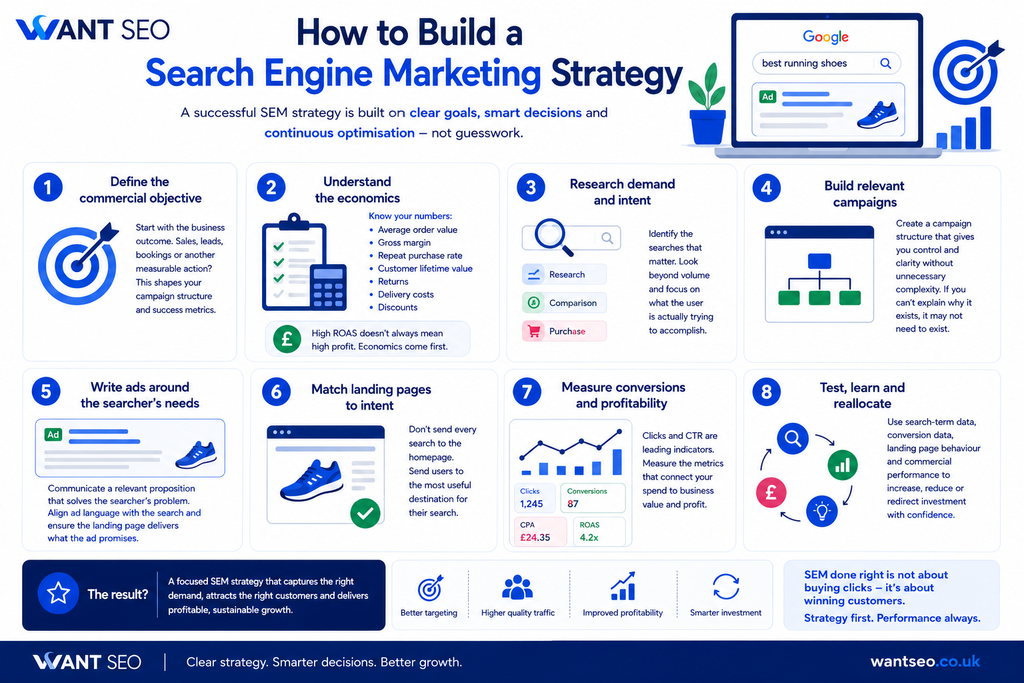
A strong search engine marketing strategy starts before the first campaign is created.
1. Define the commercial objective
Start with the business outcome. Are you trying to generate profitable eCommerce sales, qualified leads, bookings, applications or another measurable action? This determines how campaigns should be structured and how success should be judged.
2. Understand the economics
Know your acceptable acquisition cost. For eCommerce, consider factors such as:
- Average order value
- Gross margin
- Repeat purchase rate
- Customer lifetime value
- Returns
- Delivery costs
- Discounts
A campaign can have an impressive ROAS and still be commercially weak if the underlying margin is poor.
3. Research demand and intent
Identify the searches that matter. Look beyond search volume and consider whether a search indicates research, comparison or purchase intent. Search engine marketing works best when the targeting reflects what the user is actually trying to accomplish.
4. Build relevant campaigns
Create a campaign structure that gives you useful control without unnecessary complexity. The objective should be clarity. If you cannot explain why a campaign exists, it may not need to exist.
5. Write ads around the searcher’s needs
Your ads should communicate a relevant proposition rather than simply repeat the keyword. Google’s guidance recommends aligning ad language closely with the user’s search and ensuring the landing page delivers what the ad promises.
6. Match landing pages to intent
Do not automatically send every search to the homepage. The landing page should be the most useful destination for the specific search.
7. Measure conversions and profitability
Clicks and CTR tell you what happened before the commercial outcome. They do not tell you whether the campaign was worthwhile. Measure the metrics that connect spend with business value.
8. Test, learn and reallocate
Search engine marketing is an iterative process. Use search-term data, conversion data, landing-page behaviour and commercial performance to decide where to increase, reduce or redirect investment.
What should you measure in SEM?
The right metrics depend on the business model. A useful measurement framework might include:
- Visibility: impressions, impression share and top-of-page visibility.
- Engagement: clicks and CTR.
- Efficiency: CPC and cost per acquisition.
- Commercial performance: conversion rate, revenue, profit contribution, ROAS or qualified leads.
The important point is not to report everything. Report the metrics that help answer a decision. For example, if CPC is increasing but conversion quality is also improving, higher CPC may not be a problem. If traffic is increasing while profitable sales are falling, more clicks are not necessarily a positive outcome. This is the difference between reporting activity and understanding performance.
How should eCommerce businesses approach SEM?
eCommerce search engine marketing needs to connect search demand with product economics. A campaign should not be judged purely on the number of transactions it generates. Consider the full picture. A product with a £100 selling price and £70 contribution margin has a very different acquisition ceiling from a product with a £20 margin. Likewise, a customer who makes repeat purchases may justify a different acquisition cost from a one-off purchaser.
This is why product-level data, search terms, margins and conversion behaviour should influence SEM decisions. Google Shopping and product-led search experiences can also form part of a broader paid search strategy, depending on the business and market.
For UK retailers, factors such as delivery expectations, promotions, pricing, product availability and regional demand should be reflected in the campaign and landing experience. For international businesses, the same principle applies across markets. Do not assume that a campaign that works in the UK should simply be copied into the US, Europe or another market. Search behaviour and economics can differ considerably.
What are the most common SEM mistakes?
The biggest SEM mistakes are rarely caused by a lack of tools. They are usually caused by poor prioritisation.
- Targeting keywords because they have high volume: High volume does not necessarily mean high commercial value.
- Sending every click to the homepage: The landing page should reflect the searcher’s intent.
- Optimising for clicks rather than customers: A cheap click is not necessarily a valuable click.
- Ignoring search-term data: Actual searches reveal whether your targeting matches real-world demand.
- Treating Quality Score as the objective: Google explicitly describes Quality Score as a diagnostic tool rather than an auction input or primary KPI.
- Running paid search in isolation: SEM becomes more useful when insights are shared with SEO, CRO, merchandising and wider marketing activity.
- Scaling before the economics work: Increasing spend on an inefficient campaign usually scales the problem rather than solving it.
How SEM fits into AI search, GEO and AEO
This is where search engine marketing is becoming more interesting. The search journey is no longer limited to a traditional results page. Google’s search experience increasingly incorporates AI-generated answers and AI-powered features, while users are also turning to generative AI systems to research products, compare options and form opinions before visiting a website.
Search Engine Land recently described this shift as a change in the relationship between SEO and PPC. AI answers can influence the journey before a user reaches the traditional results, while paid and organic listings continue to compete for attention. That creates a wider search system:
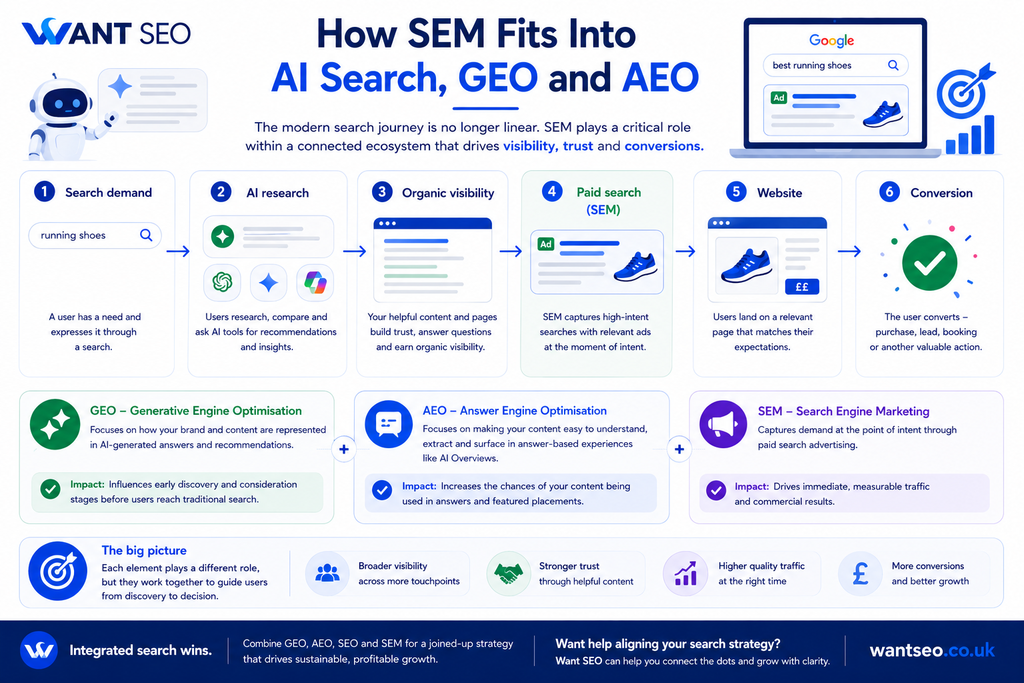
The exact journey will vary, but the principle is important.
SEM and GEO
GEO, or Generative Engine Optimisation, focuses on improving how brands and their information are represented in generative AI search experiences. GEO is not simply another form of paid search. In fact, treating GEO as a collection of tricks can distract from the more important work of building useful, credible information that AI systems can understand and reference.
Search Engine Land’s current GEO coverage highlights the growing importance of brand authority, topical focus and genuine visibility across AI search. SEM therefore has a different but complementary role. Paid search captures explicit demand at the point of search. GEO helps influence how a brand may be understood during earlier research and recommendation stages.
SEM and AEO
AEO, or Answer Engine Optimisation, is generally concerned with making information useful and accessible for answer-based search experiences. Again, the objective is not to replace SEM. It is to recognise that customers can now encounter answers, comparisons and recommendations before they click an advertisement. This makes the relationship between paid visibility and organic or AI visibility increasingly important.
Search Engine Land’s recent analysis suggests that AI visibility can add context to PPC performance by helping marketers understand influences that may happen before the click. For businesses, this means SEM reporting should not exist in a silo. If a customer sees your brand in an AI answer, later searches for your product and finally clicks a paid ad, the paid click is only one part of the journey.
Does AI replace search engine marketing?
No. AI is changing the search journey, but it has not removed the need to capture existing commercial demand. Paid search remains valuable because it allows businesses to participate directly in search auctions and control elements such as targeting, budget, creative and landing-page destinations. At the same time, AI can influence what happens before the paid click.
Search Engine Land recently reported that LLM referral traffic can convert differently from paid search, reinforcing the point that different search surfaces can contribute differently to the customer journey. The strategic response should not be to abandon SEM. It should be to understand how paid search fits into a wider SEO, CRO, AEO and GEO system.
How AI is changing paid search
Paid search platforms themselves are also becoming more automated. Microsoft Advertising, for example, has begun rolling out AI Max globally for Search campaigns, combining broader search-term matching, automated creative generation and dynamic landing-page selection. Google is also expanding AI-powered capabilities across its advertising products. This changes the role of the marketer.
The work is moving further away from manually controlling every individual variable and towards providing strong inputs, setting appropriate constraints, understanding commercial objectives and evaluating whether automation is producing useful outcomes. That makes strategy more important, not less. If an automated system is given a weak proposition, poor landing pages or unclear commercial objectives, automation can simply execute the wrong strategy faster.
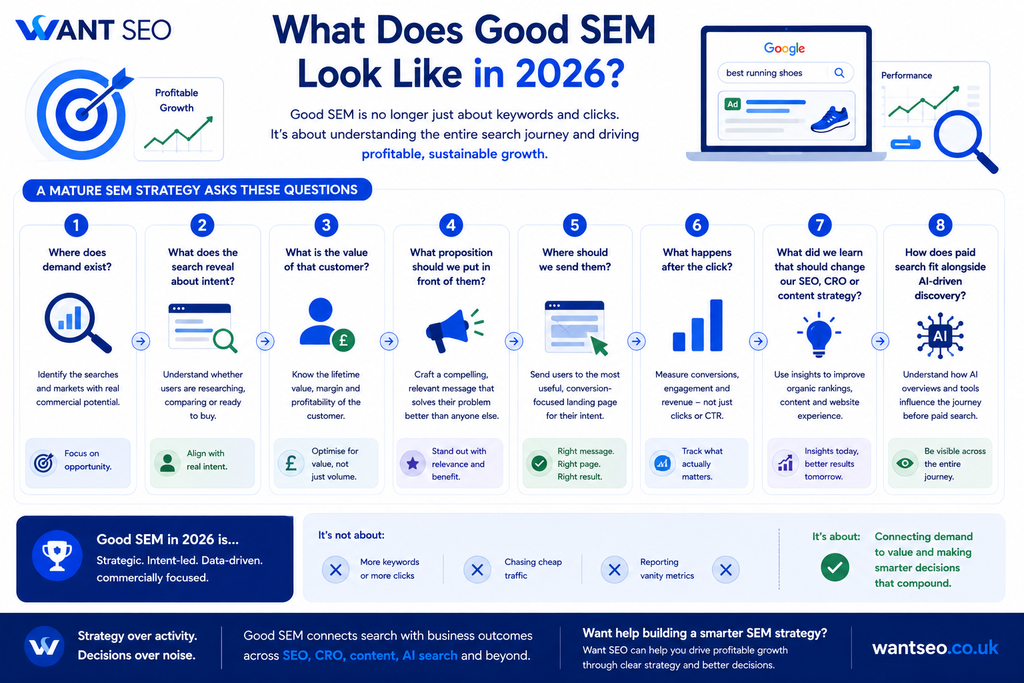
Should every business invest in SEM?
No. Paid search is not automatically the right answer for every business. SEM can make sense when there is sufficient search demand, a commercially viable offer, measurable conversion actions and enough margin to support acquisition. It may be less appropriate when search demand is extremely limited, the economics do not support paid acquisition, or the business has not yet established a proposition that converts.
In those situations, SEO, content, partnerships, social channels, CRO or other forms of demand creation may deserve greater priority. This is where restraint matters.
The question is not “Should we run SEM?”
It is: “Is paid search currently one of the best ways for this business to capture valuable demand?”
How to create a more effective SEM strategy
If you are reviewing an existing search engine marketing programme, start with the areas closest to commercial value.
- First, understand which campaigns and search terms actually generate valuable customers.
- Then look at where spend is being allocated and whether that allocation reflects business priorities. Review the connection between search term, ad and landing page.
- Next, examine whether the website experience supports conversion.
- Finally, connect the learning back to SEO, CRO, content and AI search visibility.
This prevents SEM from becoming a standalone advertising activity. It becomes part of a wider growth system.
Conclusion
Search engine marketing is ultimately about making better use of search demand. In its current practical usage, SEM is largely associated with paid search and PPC advertising, although the term has historically been used more broadly to describe marketing through search engines. The important distinction is not the terminology. It is how the channel is managed. Effective search engine marketing does not mean buying as many clicks as possible. It means identifying commercially valuable demand, matching ads to intent, creating relevant landing experiences and measuring whether the resulting customers justify the investment.
The search environment is also becoming more complex. AI Overviews, generative search, GEO and AEO are changing how people research and make decisions before they reach a website. That makes coordination between paid search, SEO, CRO and AI visibility increasingly important. At Want SEO, we believe the best search strategies start with clarity before activity. Our approach is to understand where effort can compound, what should be prioritised and what should not be done simply because a platform or competitor is doing it.
If your search engine marketing activity is generating clicks but you are unsure whether it is generating enough commercial value, Want SEO can help you assess the wider search opportunity and decide where your investment should go next.
FAQs
1. What is search engine marketing?
Search engine marketing is the practice of marketing through search engines. Today, SEM is commonly used to describe paid search advertising such as PPC, although the term has historically included SEO more broadly.
2. What is the difference between SEM and SEO?
SEO focuses on improving organic search visibility, while SEM is commonly used to describe paid search advertising. They can work together by sharing insights about search demand, intent and customer behaviour.
3. Is SEM the same as PPC?
Not exactly. PPC describes a payment model, while SEM refers to search engine marketing. Paid search is a common form of PPC and is what many marketers mean when they use SEM today.
4. Is search engine marketing still effective with AI search?
Yes. AI is changing how people discover and evaluate information, but paid search remains a way to capture active search demand. SEM should increasingly work alongside SEO, CRO, GEO and AEO rather than operate separately.
5. How much does search engine marketing cost?
There is no fixed cost. Spend depends on factors such as search demand, competition, bids, location, industry and conversion economics. The more useful question is what acquisition cost the business can support profitably.