
How Fragmented Content & Bad Product Data Destroy Your AI Search Visibility
AI search is changing how people discover and evaluate products. Instead of simply returning a list of blue links, AI-powered search experiences can interpret a question, combine information from multiple sources and present a more direct answer. For ecommerce brands, that creates a different kind of visibility challenge. It is no longer enough for a product page to exist, rank for a keyword or contain a basic product description. The information about your products needs to be clear, consistent and trustworthy enough for AI search systems to understand what you sell, who it is for, what makes it different and whether the information can be relied upon.
This is where two problems become particularly damaging: fragmented content and poor product data.
A product might have one description on the website, another name in Google Merchant Centre, different specifications in a marketplace feed and contradictory information in supporting content. At the same time, useful information may be spread across product pages, category pages, buying guides, FAQs and blog posts without a clear relationship between them. For a human shopper, this can be frustrating.
For AI search systems trying to establish what is true, it can make your brand and products harder to understand. Google’s current guidance makes an important point: the same fundamental SEO practices remain relevant for AI Overviews and AI Mode. Pages still need to be crawlable, indexable and useful, while important content should be available in text and structured data should accurately reflect visible content.
So the goal is not to create a separate set of “AI SEO tricks”. The better approach is to make your existing ecommerce information more coherent.
Key takeaways
- AI search visibility depends on how clearly search systems can understand your products and content.
- Fragmented information creates uncertainty around what your brand actually offers.
- Inconsistent product names, specifications, pricing or availability can undermine trust in your product data.
- Product structured data and Merchant Centre feeds can help Google understand and verify ecommerce information, but they do not compensate for poor underlying data.
- Content should work as a connected information system rather than a collection of isolated pages.
- Improving AI Search Visibility often starts with fixing information architecture and product data before producing more content.
What is AI Search Visibility?
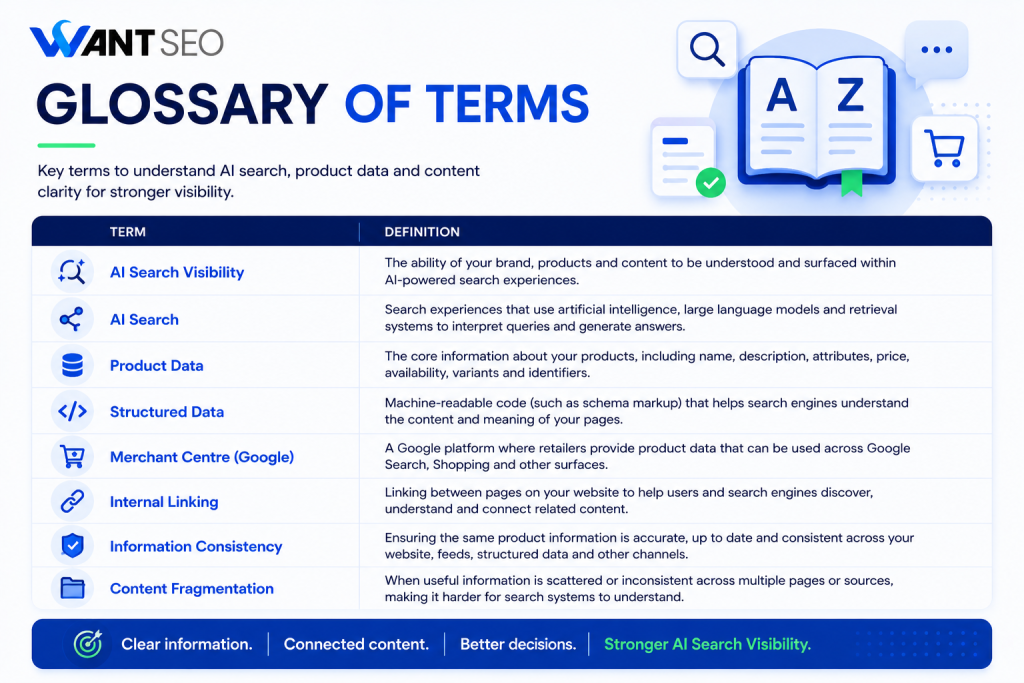
AI Search Visibility is the ability of your brand, products and content to be understood and surfaced within AI-powered search experiences. This includes experiences such as Google’s AI Overviews and AI Mode, as well as other search environments that use large language models and retrieval systems to answer user questions. The important distinction is that visibility is not simply about whether your website appears somewhere in an AI-generated response. The underlying issue is whether your business has information that can be reliably interpreted, connected and used when someone asks a relevant question.
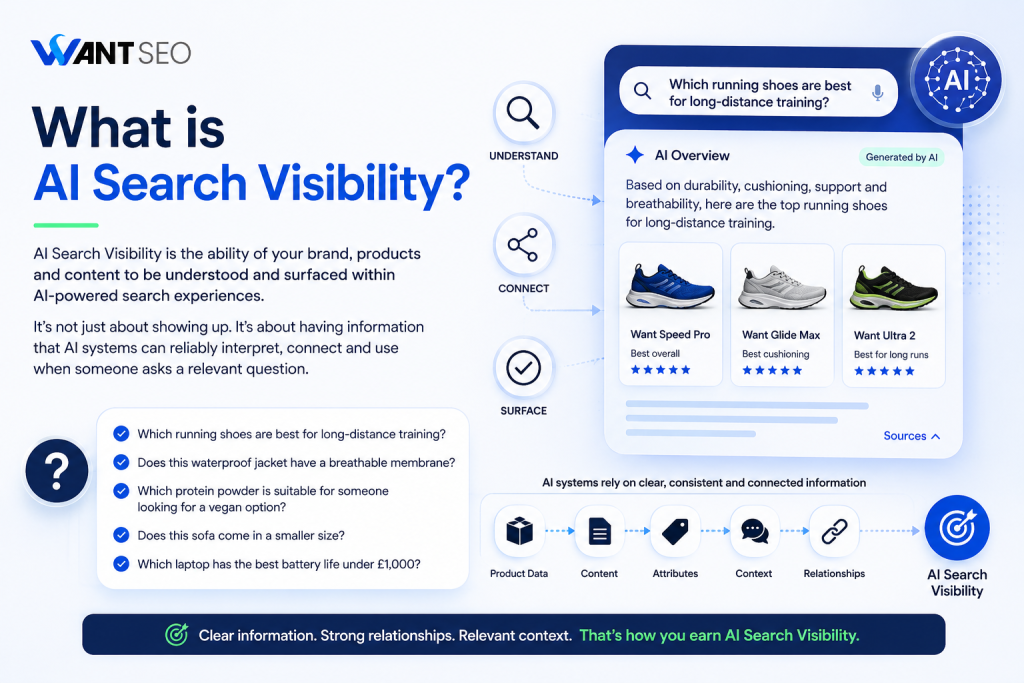
For an ecommerce brand, that could involve questions such as:
- “Which running shoes are best for long-distance training?”
- “Does this waterproof jacket have a breathable membrane?”
- “Which protein powder is suitable for someone looking for a vegan option?”
- “Does this sofa come in a smaller size?”
- “Which laptop has the best battery life under £1,000?”
These are not necessarily traditional keyword searches. They involve attributes, comparisons, preferences, constraints and product relationships. That means your product information needs to communicate more than a keyword. It needs to provide enough reliable context for regular and AI search systems to understand the product properly.
Why fragmented content creates an AI visibility problem
Fragmented content is not simply a case of having lots of pages. The problem occurs when useful information is distributed across your website without a clear, consistent relationship between those pieces of information. Imagine an ecommerce brand selling outdoor clothing. The product page says a jacket is waterproof. A buying guide calls it water-resistant. A category page describes the range as suitable for heavy rain. An FAQ says the jacket is designed for light showers.
None of these statements may have been deliberately misleading. They may have been created by different teams at different times. But collectively, they create ambiguity. A human might recognise that the descriptions are broadly related. An automated system has to interpret the available evidence and determine which information is reliable. This becomes even more important when AI search is answering a specific question rather than simply retrieving a page.
If the supporting information is inconsistent, the system has less confidence in how the product should be represented.
Content silos make important information harder to connect
Ecommerce websites often develop content in silos. The SEO team creates category copy. The ecommerce team manages product pages. The merchandising team maintains product specifications. The content team publishes buying guides. The paid media team manages product feeds. The development team controls structured data. Each function may be doing its job correctly, but the customer sees one brand.
Both regular and AI search systems increasingly need to interpret that same brand as a connected information environment. Google recommends making important content available in textual form, ensuring internal links help regular and AI search engines find content and keeping structured data consistent with visible page content. This is why internal linking and content architecture matter beyond traditional crawling.
A buying guide about “how to choose a waterproof hiking jacket” should naturally connect to relevant categories and products. The product pages should clearly explain the attributes discussed in the guide. The category should establish the broader product relationship. The structured data should reinforce the product information rather than introduce conflicting details. The result is a clearer system of information.
More content does not necessarily mean more visibility
One of the easiest mistakes to make is responding to AI search by publishing more content. A brand notices that competitors are appearing for questions around its products and decides to create dozens of articles, FAQs and comparison pages. That can increase the amount of information available without improving the quality of the information.
If the new content repeats existing points, contradicts product data or creates pages with little original value, the website becomes more fragmented rather than clearer. Google’s guidance on AI-generated content reinforces the importance of accuracy, quality and relevance, including for metadata and structured data.
The better question is not: “How much content are we missing?”
It is: “What information does a customer need to make a decision, and where should that information live?”
That shift matters. A smaller number of well-connected, useful pages can provide a stronger information system than hundreds of loosely related articles.
Bad product data can undermine everything around it
Content fragmentation is only part of the problem. For ecommerce businesses, product data is often the foundation on which AI search systems build their understanding of what is being sold. Product data can include:
- Product name
- Brand
- Description
- Product type
- SKU
- GTIN or other identifiers
- Colour
- Size
- Material
- Price
- Availability
- Reviews
- Shipping information
- Returns information
- Product variants
Google specifically recommends sharing ecommerce product information through product structured data and, where appropriate, Google Merchant Centre feeds. It notes that combining structured data with Merchant Centre data can help Google understand and verify product information. This means product data is not simply an operational concern for merchandising teams. It has a direct relationship with how regular and AI search systems understand your products.
Inconsistent product names create ambiguity
Suppose a product is called “Nike Air Zoom Pegasus 41 Men’s Running Shoes” on your website. Your feed calls it “Pegasus 41 Men’s”. A comparison article calls it “Nike Pegasus Running Trainer” and structured data uses a shortened or outdated product name.
A human can usually connect these references. But consistency makes entity understanding easier. The same principle applies to brands, product models, variants and identifiers. The more consistently a product is represented across your digital ecosystem, the easier it is to establish that different references relate to the same underlying product.
Inaccurate specifications can damage trust
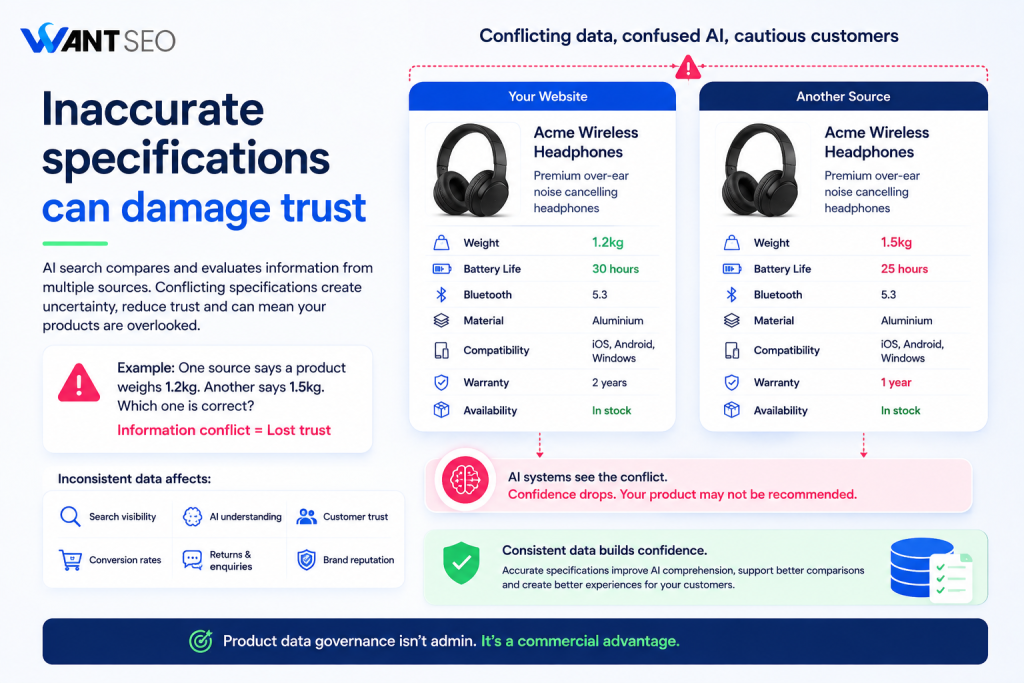
Product specifications are particularly important when consumers use AI search for comparison. A shopper might ask which product is lighter, which has more storage or which is suitable for a particular use case. If your website says a product weighs 1.2kg but another source says 1.5kg, you have created an information conflict. The same applies to:
- Dimensions
- Battery life
- Materials
- Capacity
- Compatibility
- Ingredients
- Sizes
- Technical specifications
- Warranty periods
- Delivery times
- Availability
This is why product data governance should not be treated as an administrative task. It is part of AI search visibility and customer experience.
Pricing and availability need particular attention
Price and availability are among the most commercially important pieces of product information. They are also highly changeable. Google’s product guidance specifically includes price and availability among the information that can be represented through product data and merchant listings. If your website says a product is available, but your feed says it is out of stock, or if a price differs between your page and your Merchant Centre data, the problem is bigger than a technical warning.
You are creating conflicting signals about a commercially important fact. For ecommerce businesses, this is where product data management, feed management, structured data and website content need to work together. The objective is simple: the same product should tell the same story wherever it appears.
Product structured data is useful, but it is not a shortcut
Structured data can help regular and AI search engines understand the content and meaning of a page. For product pages, Google supports structured data that can communicate information such as product details, price, availability, ratings and other attributes. But structured data should not be treated as a hidden layer where you can place information that the page itself does not support.
Google explicitly recommends that structured data matches the visible content on the page. That distinction matters. Adding schema that says a product is available when the visible page says it is out of stock does not solve the underlying problem. Neither does adding attributes simply because you want AI search systems to associate your product with them. Structured data should describe the product accurately, not manufacture a better version of the product.
The relationship between product pages and supporting content
A strong ecommerce content system does not treat product pages and editorial content as separate worlds. They should reinforce one another. A product page should answer product-specific questions. A category page should explain the broader product set and help users navigate choices. A buying guide should help customers understand how to make a decision. Comparison content should explain meaningful differences. FAQs should address genuine uncertainties. Internal links should connect these resources where the relationship is useful.
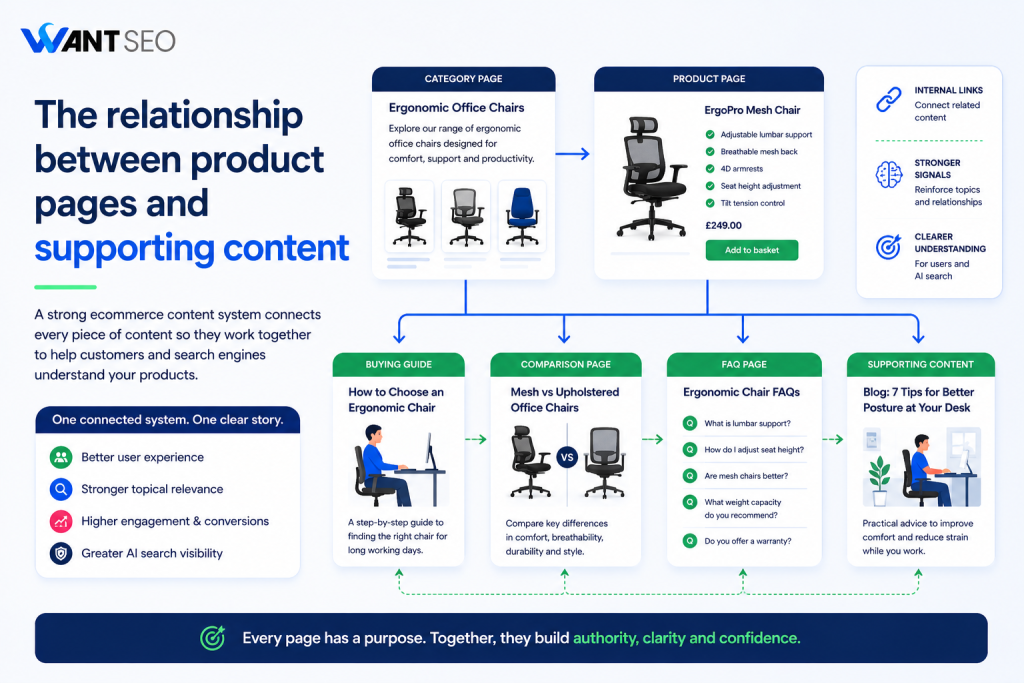
For example, a furniture retailer selling office chairs could build a connected content system around ergonomics. The category page establishes the range of ergonomic office chairs. Individual product pages explain the features of each chair. A guide explains how to choose an ergonomic chair for long working days. Another page compares mesh and upholstered office chairs. An FAQ addresses common questions about lumbar support, adjustability and seat height.
Each page has a different purpose, but they all reinforce the same product and topic relationships. That is much stronger than publishing ten unrelated blog posts about office chairs.
Fragmentation often starts with organisational problems
It is tempting to see content fragmentation as an SEO problem. In many ecommerce businesses, it is actually a data and governance problem. Different teams may control different parts of the customer journey. The merchandising team owns product attributes. Marketing owns editorial content. SEO owns optimisation. Developers own structured data. Operations owns stock information. Customer service owns many of the questions shoppers ask.
Without shared definitions and processes, inconsistencies naturally appear. This is why improving AI Search Visibility often requires decisions outside the SEO team. You may need to establish a single source of truth for product attributes. You may need consistent naming conventions. You may need to define which team owns specific data points. You may need to review how product information is distributed to your website, feeds and other channels.
The strategic question becomes: Where does the truth about each product live, and how consistently is that truth distributed?
What ecommerce brands should prioritise?
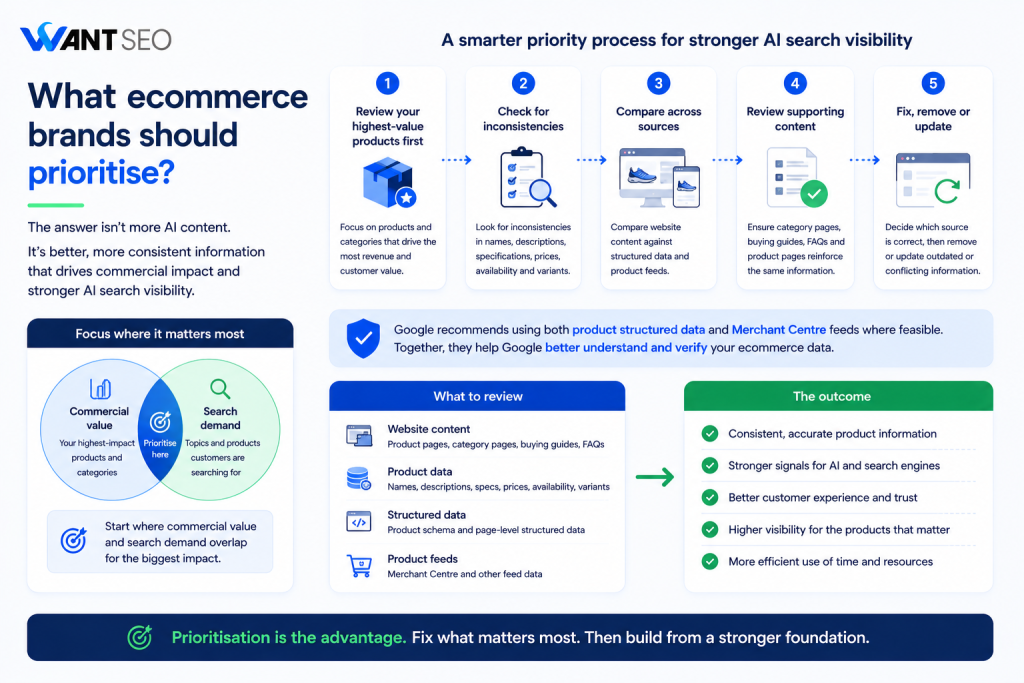
The answer is rarely “create more AI content”. Start with the information that has the greatest commercial impact. Review your highest-value products first. Look for inconsistencies in product names, descriptions, specifications, prices, availability and variants. Then compare what appears on the website against structured data and product feeds. Google recommends using both product structured data and Merchant Centre feeds where feasible, as the combination can help improve Google’s understanding and verification of ecommerce data.
Next, review the supporting content around those products. Ask whether the category pages, buying guides, FAQs and product pages reinforce the same information; where they do not, decide which source is correct. Then remove or update outdated information. This is where prioritisation matters. You do not need to audit every page on a large ecommerce website at once. Start where the commercial value and search demand overlap.
Build content around decisions, not keywords
A useful way to reduce fragmentation is to organise content around the decisions customers actually make. For example, a customer buying a mattress may need to understand:
- Which firmness is right for them?
- Which size should they choose?
- What is the difference between memory foam and pocket springs?
- Is the mattress suitable for their sleeping position?
- What happens if they do not like it?
These questions can inform the content architecture. The product pages provide the facts. The guides provide decision support. The category pages provide product relationships. The FAQs resolve uncertainty. The result is a content ecosystem that reflects how people actually evaluate products. That is more useful than creating a separate page for every variation of a keyword.
How to diagnose fragmented content and product data
Evaluating and resolving fragmented product information is essential for maintaining accurate data signals, protecting conversion rates, and ensuring regular / AI search engines reliably present your catalogue.
- Audit Product Data Across Touchpoints: Sample key commercial items across product pages, category pages, structured data, Merchant Centre, product feeds, buying guides, FAQs, and marketplace listings to catch conflicting details.
- Prioritise Contradictions Over Missing Fields: Address conflicting product attributes immediately, as data contradictions generate far more uncertainty for shoppers and search engines than simple omissions.
- Evaluate Content Connectivity: Review internal links between products, categories, and supporting content to ensure relationships are obvious, informative, and aligned with search guidelines for discovery.
- Avoid Links for Volume Alone: Structure internal linking purposefully to explain why two pieces of information belong together rather than adding links indiscriminately.
- Align Structured Data with Visible Content: Validate core schema attributes like product name, price, availability, brand, and reviews directly against what customers can see on the page.
- Focus Schema on Quality Over Quantity: Use Search Console reports to maintain accurate, high-utility structured data rather than attempting to maximise total schema property counts.
- Prevent Conversion Drops: Clear up conflicting specifications so prospective buyers can quickly confirm a product meets their needs without abandoning the purchase.
- Reduce Support Costs and Protect Trust: Eliminate inconsistent specs and inaccurate availability data to minimise customer service inquiries and retain brand credibility.
- Optimise for AI Search Engines: Provide clear, reliable information architecture so conversational search systems can confidently represent your products during consumer research.
Fixing these fragmented data points strengthens your search footprint while removing friction across the entire customer buying journey.
AI search makes clarity more valuable, not complexity
There is a temptation to respond to AI search with another layer of optimisation.
- New content formats.
- New schema.
- New tools.
- New prompts.
- New dashboards.
But the fundamentals remain important. Google’s guidance states that there are no additional technical requirements or special schema types required specifically for AI Overviews or AI Mode. Instead, existing SEO fundamentals such as crawlability, indexability, helpful content, internal linking and accurate structured data continue to matter.
That is useful because it brings the conversation back to something more practical. Before asking what else you should create, ask whether what you already have makes sense.
- Can someone understand your products quickly?
- Can your teams agree on what the product information actually is?
- Does your website tell a consistent story?
- Do your feeds reflect the website?
- Does your structured data match the visible page?
- Are your supporting content assets connected to genuine customer decisions?
If the answer is no, producing more content is unlikely to be the best first move.
Conclusion
AI search visibility starts with information that can be understood and trusted. For ecommerce businesses, that means treating content and product data as part of the same system rather than separate SEO activities. Fragmented content makes relationships harder to understand. Poor product data creates uncertainty around the products themselves. Inconsistent structured data can reinforce the problem rather than solve it. The answer is not to chase every new AI optimisation tactic.
Start with clarity. Establish consistent product information. Connect supporting content to real customer decisions. Make important information accessible and easy to interpret. Keep structured data aligned with visible content, and make sure your product feeds reflect the same underlying truth. Most importantly, prioritise the areas where better information can influence commercially important products and decisions.
Better AI Search Visibility is often the result of better decisions about what information matters, where it belongs and how consistently it is communicated.
FAQs
1. What is AI Search Visibility?
AI Search Visibility refers to how effectively a brand, product or piece of content can be understood and surfaced within AI-powered search experiences. It depends heavily on clear, useful and trustworthy information rather than simply targeting more keywords.
2. Can fragmented content reduce AI Search Visibility?
Yes. When important information is spread across disconnected pages or different pages contain conflicting claims, it can become harder for search systems to establish clear relationships and determine which information accurately represents the business or product.
3. Why is product data important for AI search?
Product data provides fundamental information about what an e-commerce business sells, including names, descriptions, attributes, pricing and availability. Accurate and consistent product data makes it easier for search systems to understand products and their characteristics.
4. Does product schema improve AI Search Visibility?
Structured data can help Google understand page content and make products eligible for certain search features, but it is not a shortcut to AI visibility. The structured data should accurately reflect the visible content on the page.
5. Should ecommerce brands create more content for AI search?
Not necessarily. More content is only useful when it addresses a genuine customer need and adds information that is missing from the existing content system. Fixing fragmented content and inconsistent product data may be a higher priority than publishing more pages.
6. How can I improve AI Search Visibility for an ecommerce website?
Start by auditing your most commercially important products. Compare product information across your website, structured data, Merchant Centre and supporting content. Fix contradictions, improve internal relationships between pages and make sure important product information is accurate, consistent and accessible.