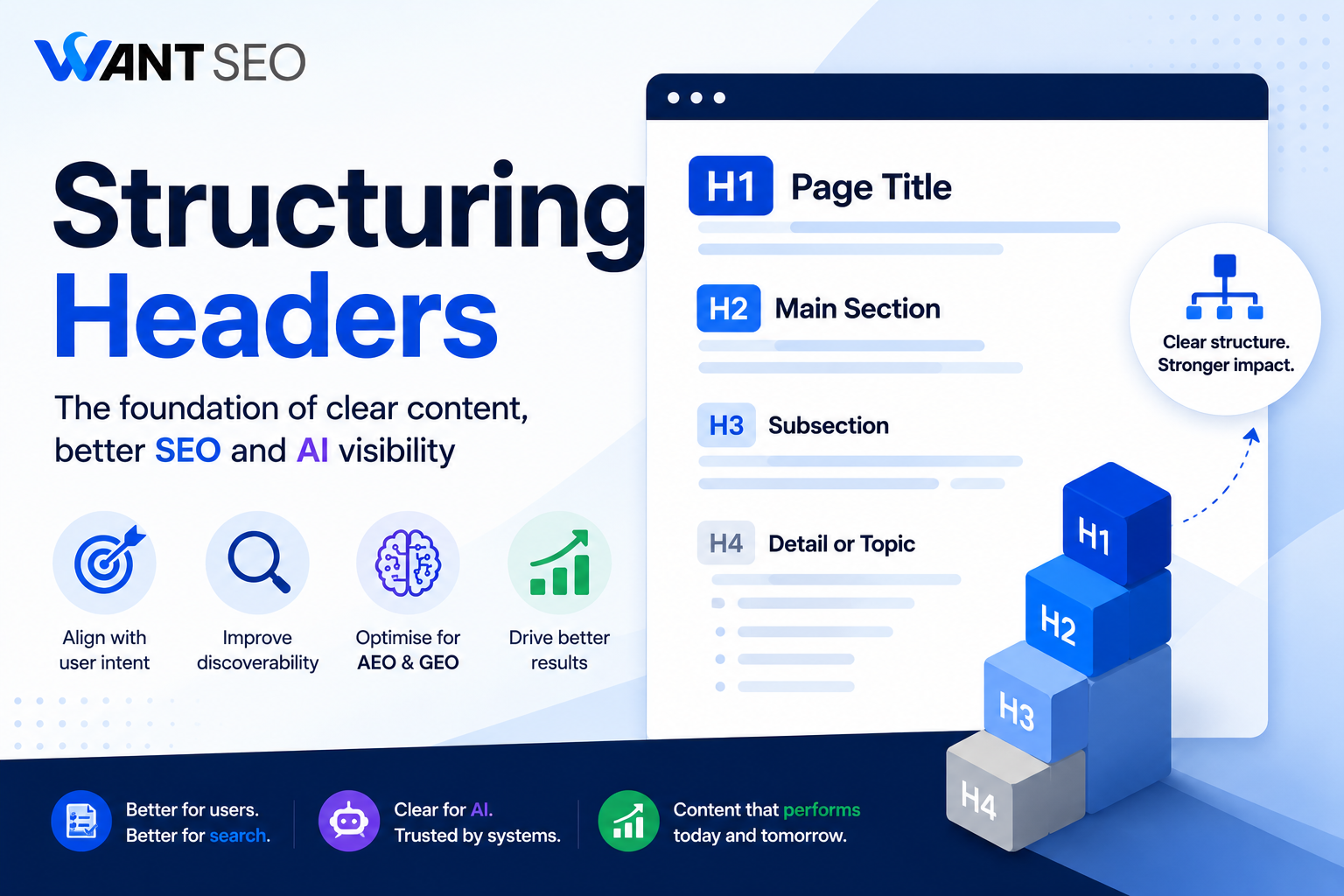
Structuring Headers as Explicit Natural-Language Prompts to Align With User Intent
Search has moved beyond short, keyword-focused queries. People now ask longer, more conversational questions, compare options, describe problems in detail and increasingly use AI tools to explore what they need. This makes structuring headers around natural-language prompts an important part of creating content that is clear to both users and modern search systems. A heading such as “Benefits of SEO” tells a reader very little about what the section will actually answer. A heading such as “How does SEO help an ecommerce business grow?” creates a much clearer expectation. It identifies the subject, reflects a likely user question and gives the content underneath a specific job to perform.
For businesses investing in SEO, AEO and GEO, this distinction matters. Search engines and AI systems need to understand what individual sections are about, while users need to know quickly whether a page addresses their question. Structuring headers effectively therefore sits at the intersection of information architecture, search intent, content quality and AI visibility.
At Want SEO, we have researched and worked through this approach as part of a broader principle: content should not exist simply because a keyword has search volume. Every section should have a purpose, answer a meaningful question or help the reader make a better decision.
Key takeaways
- Structuring headers as natural-language questions makes the purpose of each section clearer to users and search systems.
- Strong headers should reflect real search intent rather than forcing exact-match keywords into every section.
- Natural-language headers work particularly well with AEO and GEO because they create clearer relationships between questions, answers and supporting context.
- The best approach is not to turn every heading into a question, but to use explicit prompts where they genuinely clarify the user’s intent.
What is structuring headers around natural-language prompts?
Structuring headers around natural-language prompts means writing H2s and H3s in the way a real person might phrase a question, need or decision.
Instead of writing: “SEO Benefits“
You might write: “How can SEO support ecommerce growth?“
Instead of: “Local SEO Strategy“
You might write: “What should a local business prioritise in its SEO strategy?“
The second versions provide more context. They tell the reader what the section intends to answer and create a stronger semantic relationship between the heading and the paragraphs that follow. This does not mean every H2 needs to contain a question mark. A descriptive heading can be perfectly effective when it communicates a clear concept. The point of structuring headers is not to make content look conversational for its own sake. It is to make the information architecture reflect the questions, problems and decisions that sit behind a search.
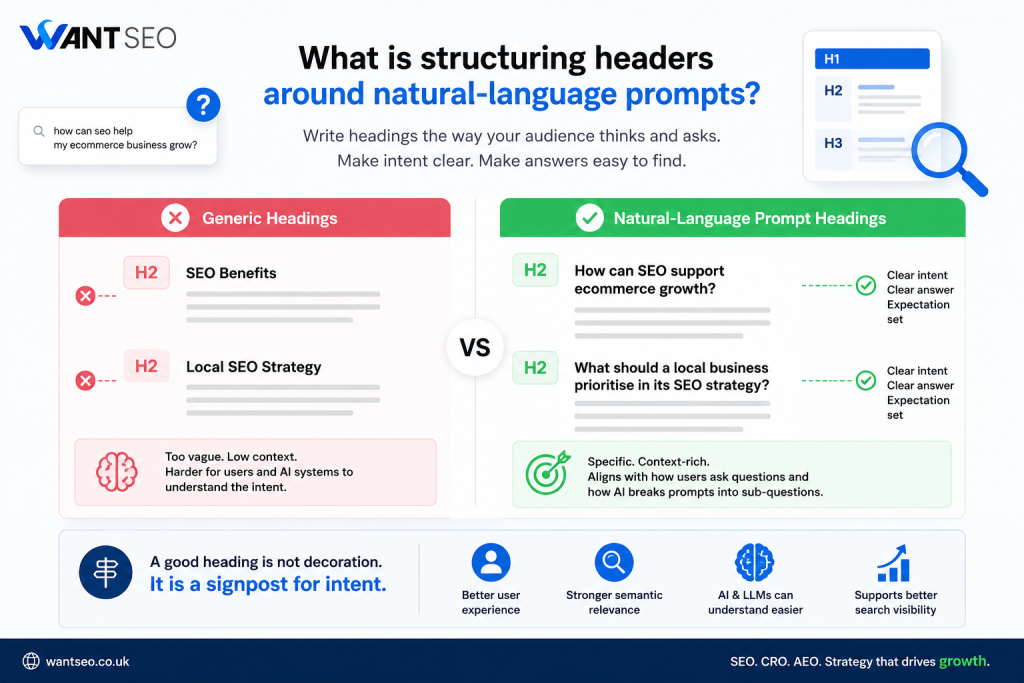
Search Engine Land’s current guidance on AI and LLM optimisation makes a similar distinction. It notes that question-based headings can help align content with the way AI systems break broader prompts into smaller sub-questions. A generic heading such as “Benefits” carries little contextual information, while a heading such as “What are the benefits of…” makes the intended answer much more explicit.
That is a useful way to think about modern content structure: a good heading is not decoration. It is a signpost for intent.
Why does header structure matter for search intent?
Search intent is the underlying reason behind a query. Someone searching “what is technical SEO?” has a different need from someone searching “best technical SEO agency for ecommerce” or “how much does technical SEO cost?”
The wording may overlap, but the decision stage is different. Search Engine Land describes user intent as the “why” behind the search, while Neil Patel’s current search intent guidance separates queries into informational, navigational, commercial and transactional intent. That distinction should influence how a page is structured.
If the main intent is informational, headers might include:
- What is technical SEO?
- Why does technical SEO matter?
- Which technical SEO issues should you fix first?
If the intent is commercial:
- What should you look for in a technical SEO agency?
- How much does technical SEO typically cost?
- Which technical SEO services does an ecommerce business actually need?
The underlying keyword might be similar, but the content architecture is not. This is where structuring headers becomes more strategic than simply inserting keywords into H2s. The goal is to map the page to the user’s actual journey.
How should you turn user intent into natural-language headers?
To turn user intent into natural-language headers, you should start with the query and work backwards. Instead of asking what keywords you can insert into your H2s, focus on what the reader actually wants to know, compare, solve, or decide. For instance, if your target topic is e-commerce SEO, a weak outline might rely on generic labels like “Ecommerce SEO,” “Benefits,” “Strategies,” “Tools,” “Mistakes,” and “Conclusion.” While there is nothing technically wrong with these headings, their broad nature forces both the reader and search systems to infer what each section contains.
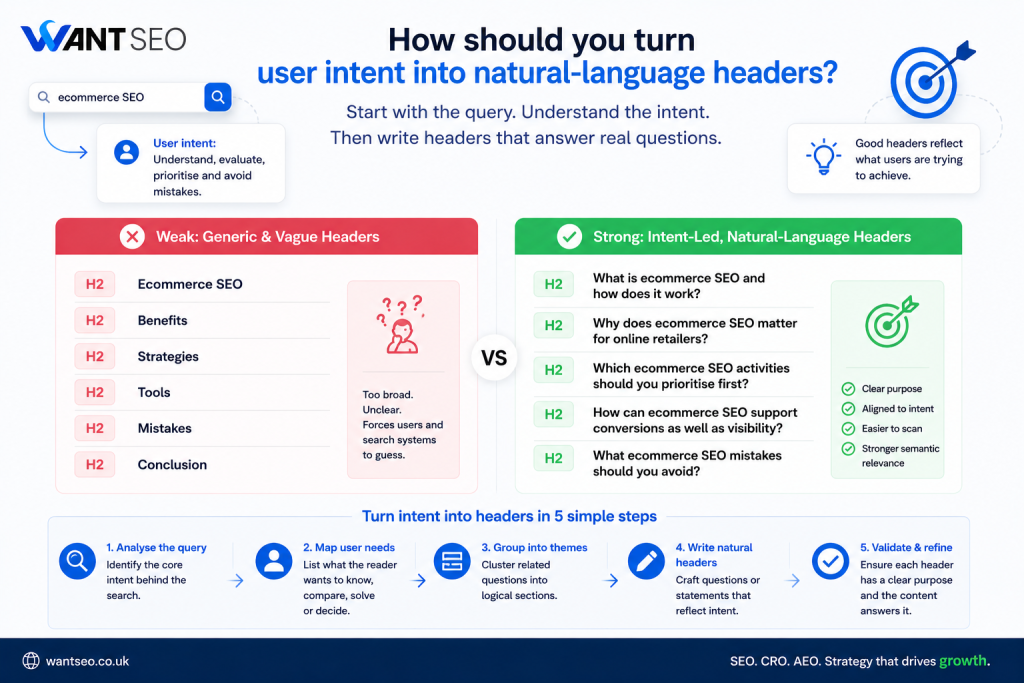
A significantly stronger structure replaces those broad labels with explicit questions: “What is ecommerce SEO and how does it work?”, “Why does ecommerce SEO matter for online retailers?”, “Which ecommerce SEO activities should you prioritise first?”, “How can ecommerce SEO support conversions as well as visibility?”, and “What ecommerce SEO mistakes should you avoid?”
By reframing headers this way, every section gains a clear, dedicated purpose. This approach also introduces a valuable discipline for the writer: if you cannot convert a heading into a meaningful question or concise statement, there is a good chance the section itself has not been properly defined.
Structuring headers should follow the question hierarchy
A useful page usually has a hierarchy of questions. The H1 establishes the primary subject. H2s then cover the major questions or decisions around that subject. H3s can address narrower questions that sit underneath those larger sections. For example:
How to Improve Ecommerce SEO
What is ecommerce SEO?
How does ecommerce SEO differ from traditional SEO?
Which ecommerce SEO issues should you prioritise?
Should you fix technical SEO or content gaps first?
When should category pages be prioritised?
How can ecommerce SEO improve commercial performance?
How does organic visibility influence product discovery?
How should SEO and CRO work together?
This is effective structuring headers because the hierarchy mirrors the way a user might explore the subject. It also gives AI systems clearer contextual units. Google’s current documentation explains that AI Overviews and AI Mode can use query fan-out, where related searches are performed across subtopics to build a response.
That means a page covering a broad topic should not only answer the headline query. It should consider the important related questions that naturally arise from it.
What is query fan-out and why does it change header strategy?
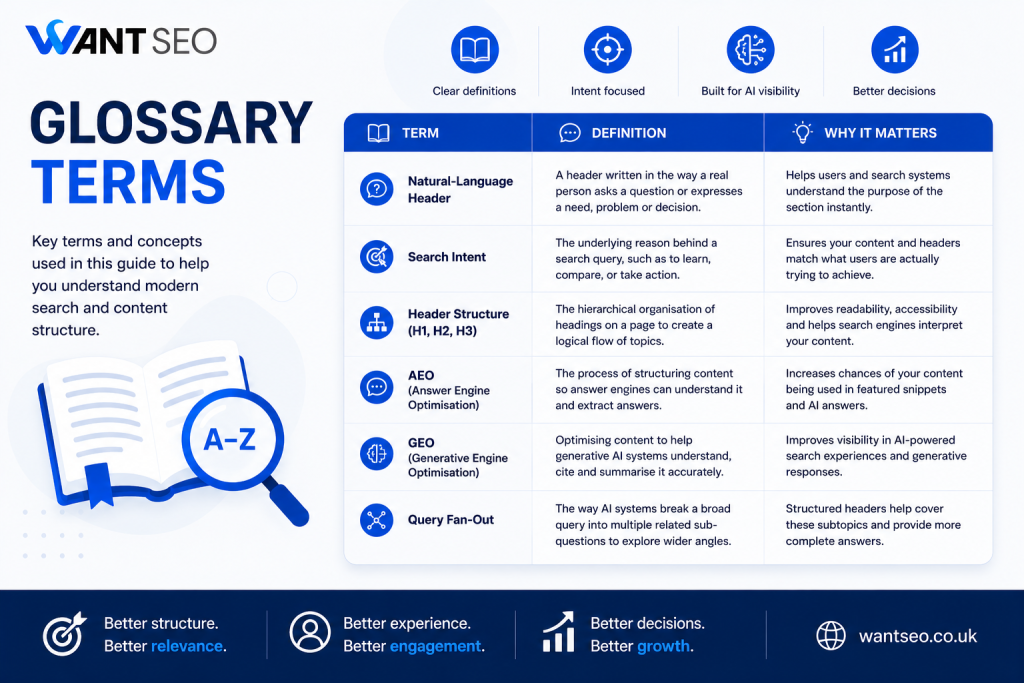
Query fan-out is increasingly important to understand when creating content for AI search. A traditional search might begin with one query. An AI-powered search experience can break that request into multiple related questions, retrieve information from different sources and combine the findings into a broader response. Search Engine Land describes this as a shift away from optimising for one narrow keyword or intent and towards addressing the wider question set around a topic. Consider a user asking:
“What is the best SEO strategy for an ecommerce business that has stopped growing?”
That single question could lead to several underlying questions:
- Why has ecommerce growth stalled?
- Is the problem technical SEO?
- Are category pages underperforming?
- Is the site targeting the wrong search intent?
- Is there enough non-brand demand?
- Are organic visitors converting?
- Should SEO or CRO be prioritised first?
A page that only targets “ecommerce SEO strategy” may miss much of this decision context. A page with well-designed, natural-language H2s and H3s can make those relationships explicit. This is one of the strongest reasons for structuring headers around user questions rather than building a page around a list of keywords.
Does every header need to be a question?
Not every header needs to be framed as a question. In fact, overusing question-based headings can quickly make your content feel repetitive, unnatural, and visibly written for a search engine rather than a person. For example, asking “What are the benefits of internal linking for SEO?” works well when the section provides a direct answer, but forcing a label like “What is the conclusion of this SEO guide?” adds no real value.
Similarly, a statement like “A practical framework for prioritising SEO opportunities” is often much clearer than twisting it into “How can you use a practical framework for prioritising SEO opportunities?”.
Ultimately, the core principle is not to make every heading a question, but to use the clearest natural-language structure that matches the user’s intent. Even Google’s own documentation recommends using descriptive headings that help readers navigate content and maintain a clear hierarchy, rather than adhering to a rigid requirement to frame every heading as a question.
What makes a strong intent-led header?
A strong header normally does three things. First, it identifies the subject. Second, it communicates the user’s likely need. Third, it creates a clear expectation for the content that follows. Compare these examples:
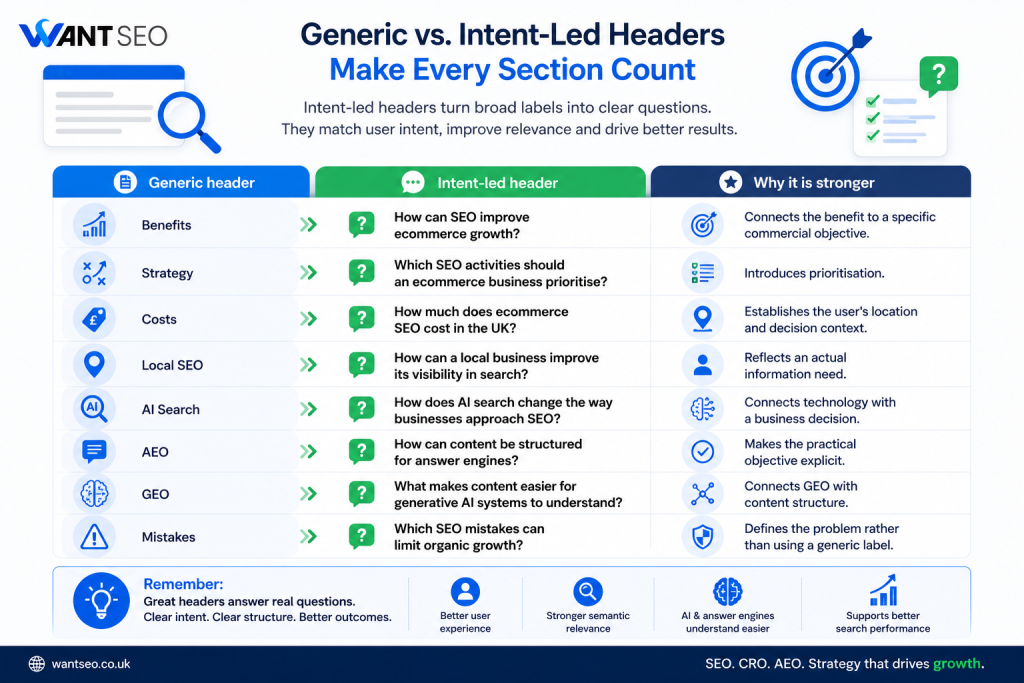
The stronger version is not automatically better because it contains more words. It is better because it carries more meaning.
How does structuring headers support AEO?
Answer Engine Optimisation, or AEO, is concerned with making information easier for answer engines and AI-powered search experiences to understand, retrieve and present. A natural-language heading can establish a clear relationship between a question and its answer. For example:
How does AEO work?
The paragraph immediately below can begin:
AEO is the process of structuring content, so answer engines can identify, understand and reuse useful information when responding to user questions.
The heading establishes the question. The opening sentence establishes the answer. The rest of the section provides supporting context. This creates a clean information unit. It also improves usability because readers can scan the page and identify the sections most relevant to their needs.
Neil Patel’s guidance on H1s similarly emphasises that headings should describe the page topic, provide a good user experience and address user intent. His more recent SEO guidance also connects clear site structure and authoritative content with both traditional search and AI visibility. The important point is that structuring headers is not a separate trick for AEO. It is a logical extension of good information architecture.
How does structuring headers support GEO?
Structuring headers effectively is essential for Generative Engine Optimisation, where AI systems synthesise information rather than simply returning a list of links. This shifts the focus from asking whether a page can rank for a keyword to asking whether an AI system can understand what a section answers and accurately use it in a broader response.
Clear headings establish critical context. A generic header like “Pricing” could refer to anything, whereas a descriptive header like “How much does ecommerce SEO typically cost?” gives both AI systems and readers immediate clarity. The paragraph following that specific heading can then logically cover pricing models, cost factors, and key criteria for evaluating SEO providers.
This aligns directly with Google’s guidance on generative AI search, which emphasises that success relies on existing SEO fundamentals rather than secret tactics. By focusing on valuable, people-first content that is well-organised, you make the information genuinely useful for human readers while ensuring its structure is clear enough for AI machines to parse.
How should you map headers to different types of search intent?
The structure should change according to the purpose of the page.
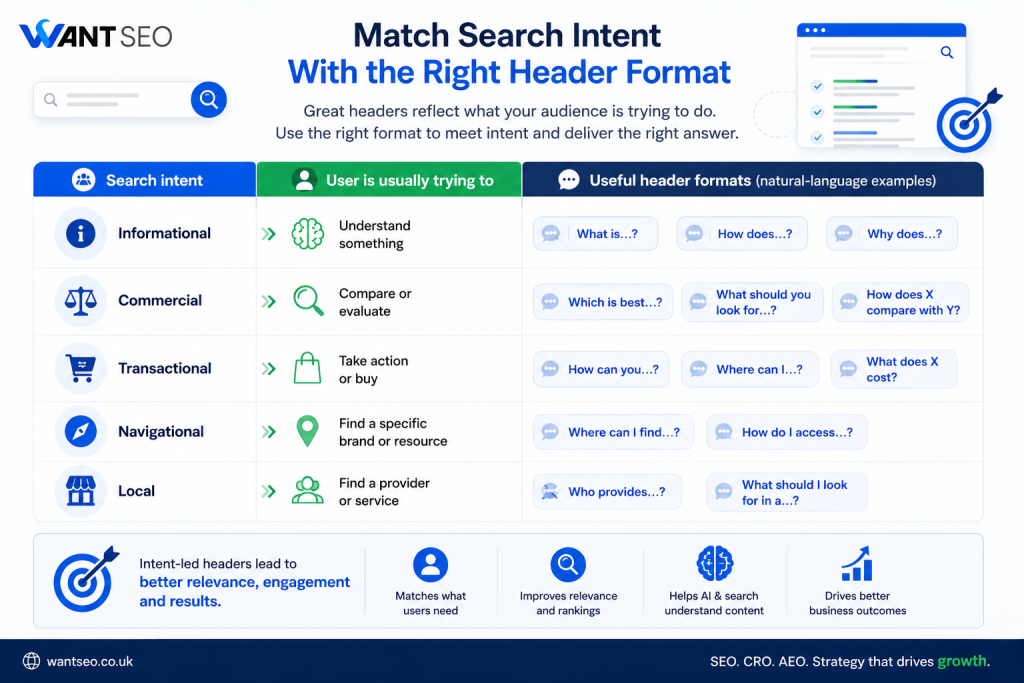
This matters particularly for service-led searches. Someone searching for a top local SEO company is not necessarily asking for an explanation of local SEO. They are evaluating providers. Someone searching for the best local SEO company in the UK is even more clearly in a comparison or commercial research phase.
Likewise, someone searching for the best search engine optimisation expert is likely evaluating expertise, experience, services and credibility rather than simply learning what SEO means. A useful content strategy therefore needs to understand the commercial intent behind the wording rather than treating each phrase as an isolated keyword.
How can headers support commercial decision-making?
This is where many SEO articles become too generic. A page can answer a question correctly and still fail commercially if it does not help the reader understand what to do next. For example, consider the query: “How much does SEO cost?”
A generic article may explain different pricing models. A more commercially useful structure might be:
How much does SEO cost in the UK?
What affects the cost of an SEO campaign?
When is a monthly SEO retainer justified?
Should an ecommerce business invest in technical SEO first?
How can you judge whether SEO is commercially worthwhile?
The final questions help move the reader from information towards decision-making. That is particularly important for founder-led ecommerce businesses. They rarely need another list of SEO activities. They need to understand where effort is likely to compound, what can wait and what should not be done at all.
This is consistent with Want SEO’s positioning: starting with intent, prioritising what matters and treating SEO, CRO and AEO as part of one wider growth system.
What mistakes should you avoid when structuring headers?
One common mistake when structuring headers is forcing the exact target keyword into every heading. If your primary keyword is “structuring headers,” repeatedly using variations like “Structuring Headers Benefits,” “Structuring Headers Strategy,” and “Structuring Headers SEO” produces repetitive copy and weakens the natural flow of the article. Instead, you should rely on semantic variations and natural questions such as “Why does header structure matter for search intent?”, “How should headers reflect user questions?”, or “How can headings support AEO and GEO?”. While the primary keyword can still appear naturally throughout the text, the surrounding headings should expand the topic rather than constantly restate the same phrase.
Another frequent error is writing headings that promise an answer the body copy fails to deliver. If a heading asks “How much does ecommerce SEO cost in the UK?”, the following section must directly address UK pricing considerations rather than speaking in vague generalities. Maintaining strict alignment between your headers and content matters for both human readers and search systems. Google emphasises accuracy, quality, and relevance, specifically warning against creating misaligned or deceptive content primarily designed to manipulate search engines or AI visibility.
How should you use H1, H2 and H3 tags?
The hierarchy should reflect the information architecture of the page.
- The H1 establishes the main topic.
- H2s represent the major sections.
- H3s sit beneath relevant H2s and address narrower questions or supporting concepts.
For example:
H1: Structuring Headers for SEO, AEO and GEO
H2: Why does header structure matter for user intent?
H2: How should you turn search intent into headers?
H3: What does informational intent look like?
H3: What does commercial intent look like?
H2: How can headers support AI search?
H3: How does query fan-out affect content structure?
H3: How can AEO benefit from question-led sections?
H2: How should you audit existing headers?
This is not about creating a complicated hierarchy. It is about making the page logical. Google’s documentation recommends hierarchical heading structures and descriptive headings that help users navigate a page. Google also notes that headings can be among the sources it considers when generating title links, reinforcing the importance of having a clear main heading and page structure.
How can you audit your existing headers?
You do not always need to rewrite an entire article. Start by reviewing the existing H1, H2 and H3 structure. Ask what each heading is actually doing. Does it identify a meaningful topic? Does it reflect a user question? Does the content beneath it answer that question? Does the hierarchy make sense? Is there unnecessary repetition? A practical audit can then group headers into four categories:
- Keep when the heading is clear and aligned with intent.
- Rewrite when the section is useful, but the heading is vague.
- Merge when two sections cover almost the same question.
- Remove when a section adds little value or exists only to target another keyword variation.
This is where structuring headers becomes a prioritisation exercise rather than a formatting exercise. The goal is not to have more headings. The goal is to have better-defined sections.
How can AI help with structuring headers without replacing strategy?
AI can be useful for identifying potential questions, clustering related queries and suggesting alternative heading structures. For example, an SEO team could provide a primary topic and ask an AI system to identify:
- common informational questions
- commercial comparison questions
- implementation questions
- objections and risks
- related subtopics
- questions that naturally follow the primary query
However, the output should not automatically become the page structure. AI can generate possibilities. It cannot decide which questions matter commercially to a specific business without context. That distinction is important. Google’s guidance allows generative AI to assist with research and structure, but emphasises that content must still provide accuracy, quality, relevance and genuine value. Generating large quantities of low-value pages without adding value can create problems under Google’s scaled content abuse policies.
The best workflow is therefore:
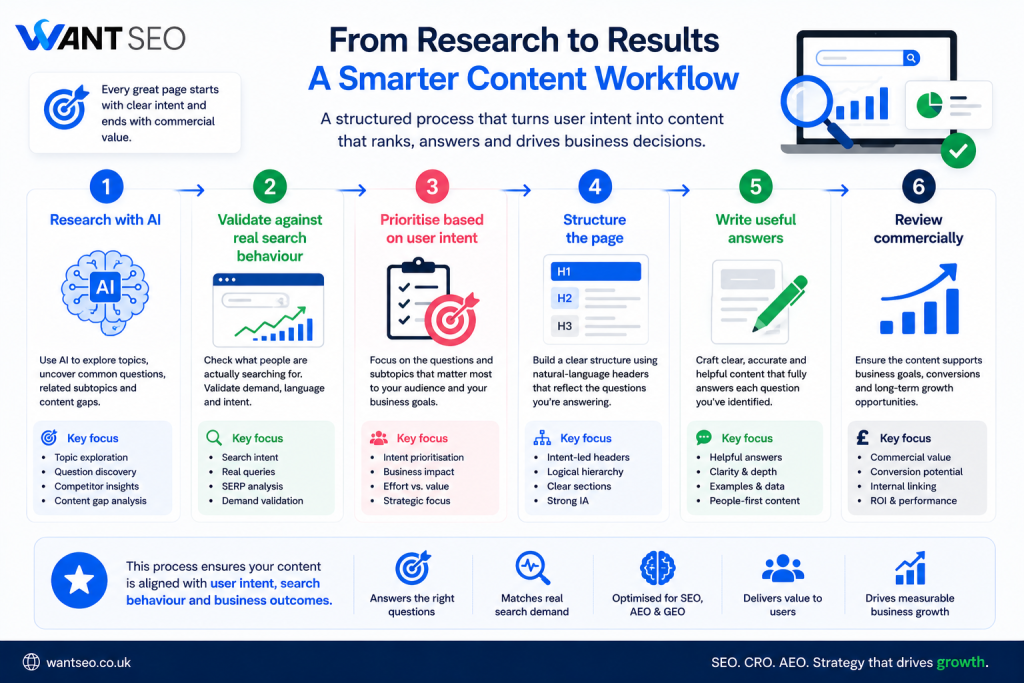
That is a much stronger process than asking AI to produce dozens of keyword-led H2s.
A practical framework for structuring headers
When creating or refreshing a page, use this sequence.
Start with the primary search intent. Identify what the user is actually trying to accomplish rather than simply recording the keyword. Then identify the supporting questions. Think about what the user would naturally ask immediately after receiving the first answer. Next, group related questions. Avoid creating a separate section for every tiny variation. Combine closely related questions where one useful section can answer them properly.
Then write the headings in natural language. Use questions where they genuinely clarify intent and descriptive statements where they provide a cleaner structure. After that, write the answer directly beneath each important question. Do not make the reader search through several paragraphs before reaching the point. Finally, review the page commercially. Ask whether the content helps the reader understand what matters, what to prioritise and what decision comes next.
This is the part that often gets missed in conventional content optimisation.
What does good structuring headers look like in practice?
To see what good header structure looks like in practice, consider a business creating a page around “ecommerce SEO agency.” A keyword-first approach often results in a rigid, repetitive list like “Ecommerce SEO Agency Services,” “Ecommerce SEO Agency Benefits,” “Ecommerce SEO Agency Costs,” and “Ecommerce SEO Agency Strategy.”
A stronger, intent-led approach transforms those generic topics into a logical progression that reflects a buyer’s actual decision-making process:
- How to Choose an Ecommerce SEO Agency
- What should an ecommerce SEO agency actually help you achieve?
- Which SEO problems should an ecommerce agency identify first?
- Should an ecommerce SEO agency focus on traffic or commercial performance?
- How much does ecommerce SEO cost in the UK?
- What questions should you ask before choosing an SEO agency?
- When does an ecommerce business actually need ongoing SEO support?
This structure is far more useful because it addresses real questions, creates natural opportunities to explain trade-offs, and builds trust instead of simply listing services. Ultimately, it demonstrates the critical difference between content that merely targets a keyword and content that truly serves search intent.
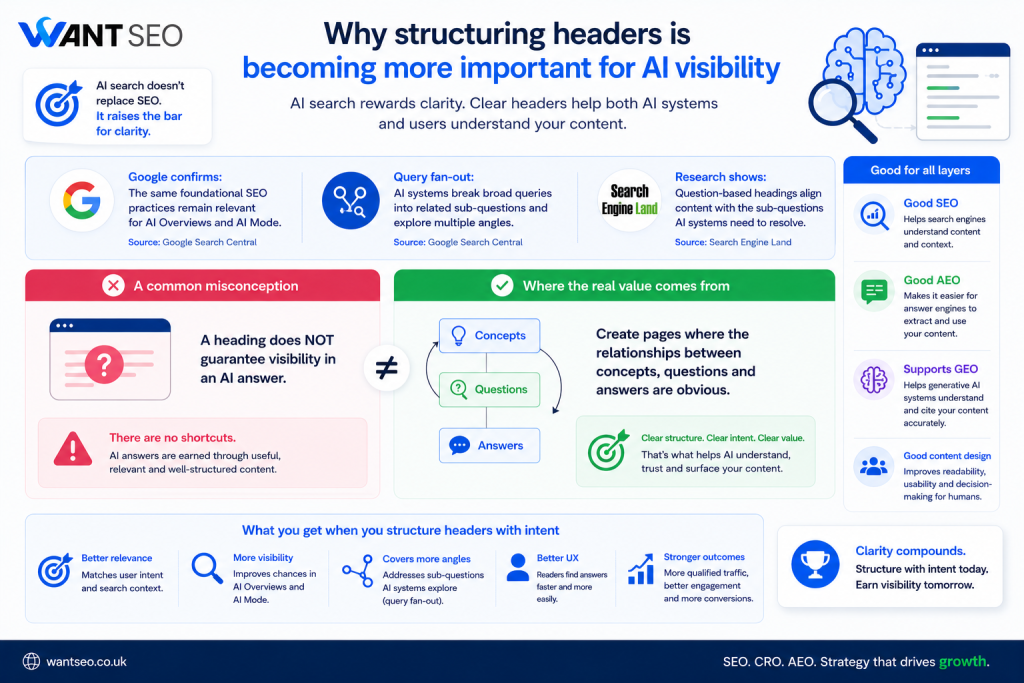
Why structuring headers is becoming more important for AI visibility
AI search is not making traditional SEO irrelevant. It is making clarity more valuable. Google explicitly states that the same foundational SEO practices remain relevant for AI Overviews and AI Mode. Its current guidance also highlights query fan-out, where AI systems can explore related subtopics when generating responses. Search Engine Land’s research and guidance similarly point towards question-based headings as a way of aligning sections with the sub-questions that AI systems may need to resolve.
This does not mean a heading guarantees visibility in an AI answer. There are no reliable shortcuts like that. Instead, the value comes from creating a page where the relationships between concepts, questions and answers are obvious. That is good SEO. It is good AEO. It supports GEO. And, most importantly, it is good content design.
The bigger principle: structure for decisions, not keywords
The strongest strategy for structuring headers starts with a simple question:
What decision is this page helping the reader make?
If the answer is “none”, the page probably needs a clearer purpose. If the answer is “understand the topic”, structure the content around the questions someone needs answered. If the answer is “compare options”, structure it around evaluation criteria, trade-offs and alternatives. If the answer is “choose a provider”, structure it around what matters when making that choice. If the answer is “take action”, structure it around implementation and next steps.
This approach creates better content because the structure follows the user’s journey rather than the keyword list. It also gives AI systems clearer information to interpret. That is why structuring headers should be considered part of content strategy rather than a minor on-page SEO task.
Conclusion
Structuring headers is a small execution change that reflects a fundamental shift in search. As users ask more conversational questions, search engines and AI models break broad queries into sub-questions to synthesise meaning. The solution isn’t stuffing keywords into every H2, it’s understanding user intent, structuring pages around the questions that matter, answering them clearly, and tying them into a broader SEO, CRO, AEO, and GEO strategy.
At Want SEO, we prioritise intent, clarity, and commercial outcomes over vanity metrics and content volume. Every piece of content should help a business make a better decision.
Ready to turn your content into commercial results? If your pages are packed with keywords but lack clear structure, Want SEO can help you identify high-impact opportunities and build a strategy focused on performance over volume. Get in touch with Want SEO today.
FAQs
What is structuring headers in SEO?
Structuring headers means organising H1s, H2s and H3s so they clearly reflect the topic, search intent and questions a user is trying to answer. Natural-language headings can make content easier for both people and search systems to understand.
Should every H2 be written as a question?
No. Question-based H2s are useful when they reflect a genuine user question, but descriptive headings can be better when they communicate a concept or process more clearly.
Does structuring headers improve SEO rankings?
Headers can help search engines understand the organisation and context of a page, but they are not a standalone ranking shortcut. Stronger results come from combining clear structure with relevant, useful, technically accessible and people-first content.
How do headers help AEO and GEO?
Clear natural-language headers establish the question or topic being answered in each section. This can make the relationship between a user’s prompt and the supporting information easier for answer and generative search systems to interpret.
How many H2s should an SEO article have?
There is no ideal number. Use as many as are needed to organise the content clearly, but avoid adding sections simply to target more keywords. Every heading should have a useful purpose.