From Chatbot to AI Agents: 6 Ways to Transform Your Business in 2026
AI Agents are becoming one of the biggest technology trends of 2026. While businesses have spent recent years adopting the AI chatbot, conversational AI, and tools such as OpenAI Chatbot GPT, the focus is now shifting towards intelligent systems that can plan, reason, make decisions, and complete complex tasks with minimal human involvement. Unlike a traditional AI chatbot online, AI Agents can understand goals, connect multiple systems, retrieve information, and execute workflows independently. Built on platforms such as Google Cloud AI, Microsoft AI, Vertex AI, AWS AI, and Claude AI, they are transforming how organisations operate.
This shift is about more than automation. It reflects the rise of augmented intelligence, where people and artificial intelligence work together to improve productivity, customer experiences, and business decisions. At the same time, AI is changing how people search for information, making Generative Engine Optimisation (GEO) and Answer Engine Optimisation (AEO) essential alongside traditional SEO. Businesses that optimise for AI search will be better positioned for visibility across Google AI Overviews, ChatGPT, Claude, Gemini, Perplexity, and future AI platforms.
At Want SEO, our experts have researched the latest AI developments and search trends to create this guide. You’ll learn how AI Agents are transforming businesses, why they matter for SEO, GEO, and AEO, and how to prepare for the future of artificial intelligence with confidence.
Key Takeaways
- AI Agents go far beyond traditional chatbots by planning, reasoning, and completing multi-step business tasks with minimal human input.
- Businesses adopting AI Agents alongside SEO, GEO, and AEO are likely to gain greater visibility across AI-powered search platforms and answer engines.
- AI works best as augmented intelligence, enhancing human expertise rather than replacing it.
- Organisations that prepare now will be better positioned to benefit from the growing capabilities of advanced AI over the coming years.
What Are AI Agents?
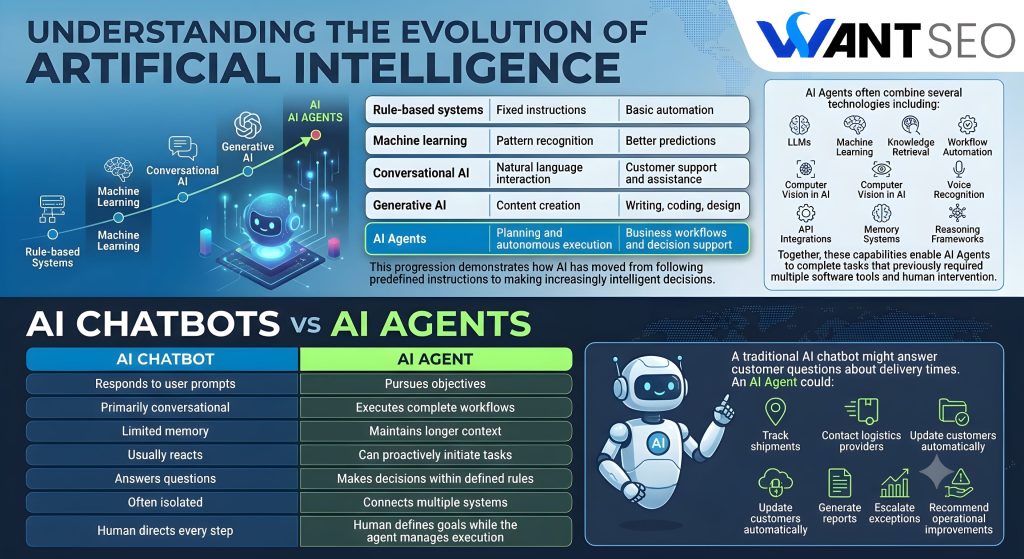
Before exploring how AI Agents can transform businesses, it is important to understand what makes them different from earlier generations of artificial intelligence. Many people still ask, “AI stand for what?” The answer is Artificial Intelligence, referring to computer systems designed to perform tasks that normally require human intelligence. These tasks include learning, reasoning, recognising patterns, understanding language, analysing images, and making decisions.
Most businesses first encountered artificial intelligence through virtual assistants, recommendation systems, or customer support chatbots. While these technologies remain valuable, they are only one part of the wider AI landscape. AI Agents represent the next stage of this evolution.
Instead of simply answering questions, AI Agents are designed to pursue objectives. They can break large goals into smaller actions, access multiple software platforms, retrieve information from databases, analyse data, communicate with users, and adapt based on changing circumstances.
For example, instead of asking an AI chatbot to write a customer email, an AI Agent could:
- Check customer purchase history.
- Review previous conversations.
- Generate a personalised response.
- Schedule a follow-up task.
- Update the CRM.
- Notify the sales team if additional action is required.
The user provides one objective rather than dozens of individual prompts. This shift from conversation to execution is why many technology leaders believe AI Agents will become a core part of business operations during 2026 and beyond.
Why AI Agents Matter More Than Ever in 2026
Several technological developments have converged to make 2026 a defining year for AI Agents. Firstly, large language models have become significantly more capable. Platforms such as OpenAI ChatGPT, Claude AI, Google’s Gemini, and enterprise AI systems now understand complex instructions with far greater accuracy than previous generations.
Secondly, cloud infrastructure has matured. Businesses can deploy AI through services such as Google Cloud AI, Microsoft AI, Vertex AI, and AWS AI without building expensive infrastructure from scratch.
Thirdly, organisations now possess more connected business data than ever before. Customer relationship management systems, analytics platforms, finance software, ecommerce platforms, and operational databases can increasingly be accessed securely by AI Agents, allowing them to work across departments instead of within isolated applications.
Finally, competitive pressure is increasing. Companies that continue relying solely on manual workflows risk falling behind organisations using AI Agents to improve productivity, reduce response times, and support better commercial decisions.
6 Ways AI Agents Will Transform Your Business in 2026
The shift from chatbots to AI Agents is not simply another technology upgrade. It represents a fundamental change in how businesses operate. Instead of responding to individual requests, AI Agents can understand objectives, coordinate tasks across systems, and continually improve outcomes through learning and feedback.
The organisations gaining the greatest value are not replacing people with AI. They are combining human expertise with intelligent automation to create faster processes, better customer experiences, and more informed commercial decisions. This approach reflects the principles of augmented intelligence, where people remain in control while AI handles repetitive, data-intensive work.
Below are six practical ways AI Agents are already transforming businesses across industries.
1. Deliver Smarter Customer Support That Never Stops Learning
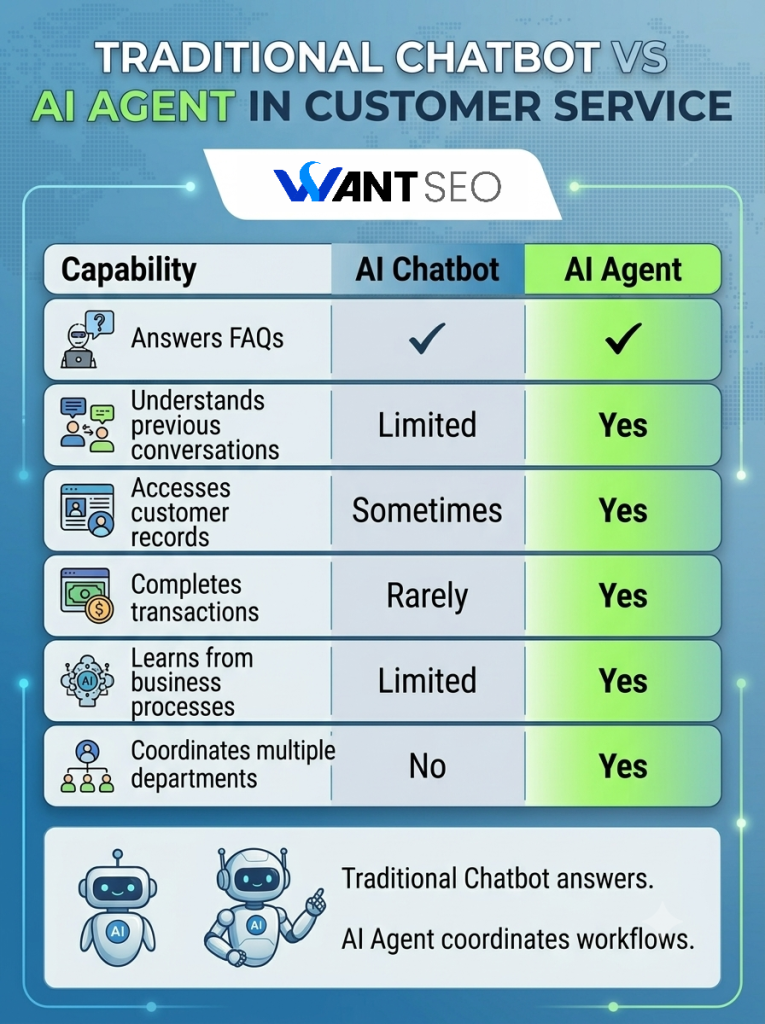
Customer service has traditionally been one of the first areas to adopt an AI chatbot. While chatbots reduced response times, they often struggled with complex questions, lacked context, and frequently required customers to repeat information. AI Agents take customer support much further. Rather than answering isolated questions, they understand the complete customer journey. An AI Agent can:
- Retrieve previous conversations.
- Check product inventory.
- Access delivery information.
- Review account history.
- Recommend personalised solutions.
- Escalate complex issues to human specialists with full context.
For customers, this creates a smoother experience. For businesses, it reduces operational costs while improving satisfaction. Imagine an ecommerce retailer selling outdoor equipment. Instead of a customer asking several separate questions about an order, delivery, warranty, and returns, the AI Agent can analyse everything simultaneously and provide one complete response.
The interaction becomes less like speaking to software and more like speaking to a knowledgeable member of staff. As conversational AI continues improving, AI Agents will increasingly support voice assistants, mobile applications, websites, messaging platforms, and even physical retail environments.
Traditional Chatbot vs AI Agent in Customer Service
2. Transform Marketing Through Intelligent Decision Making
Marketing teams generate enormous amounts of data every day from website analytics, CRM information, advertising platforms, Google Search Console, social media, email campaigns, and conversion reports. Historically, marketers analysed these datasets separately before deciding what actions to take, making the process time-consuming and often disconnected.
AI Agents change this by bringing multiple data sources together automatically. Instead of switching between different dashboards, marketers simply define a business objective, such as increasing qualified ecommerce sales during the next quarter. The AI Agent can then analyse website traffic, review conversion rates, compare SEO performance, assess paid advertising campaigns, identify content gaps, prioritise opportunities, and recommend how marketing budgets should be allocated.
Rather than producing dozens of disconnected reports, AI Agents focus on actionable recommendations that support faster and more informed decision-making. This is particularly valuable for businesses adopting applied artificial intelligence, where AI becomes part of everyday marketing operations instead of functioning as a standalone tool.
AI Agents and Modern SEO
Search optimisation is evolving rapidly as AI transforms how people discover information online. Businesses are no longer optimising solely for Google’s traditional ranking algorithms. They must also optimise for AI-generated answers across platforms such as Google AI Overviews, ChatGPT, Claude, and other answer engines.
AI Agents help SEO teams work more strategically by identifying content opportunities, monitoring changes in search intent, analysing topical authority, suggesting relevant internal links, improving structured data, supporting Answer Engine Optimisation (AEO) and Generative Engine Optimisation (GEO), detecting content decay, and monitoring competitor visibility. By automating these tasks, AI Agents allow SEO professionals to spend more time on strategic planning and commercial decision-making rather than manual analysis.
At Want SEO, we believe AI should improve prioritisation, not simply increase content production. The greatest value comes from using AI Agents to support better business decisions, align SEO with wider growth objectives, and create content that performs across both traditional search engines and modern AI search platforms.
3. Improve Sales Performance Through Intelligent Assistance
Sales professionals spend a significant amount of their working day on administrative tasks rather than selling. Updating CRM systems, writing emails, researching prospects, scheduling meetings, preparing proposals, and following up on opportunities all consume valuable time that could otherwise be spent building customer relationships and closing deals.
AI Agents help reduce this administrative burden by automating much of the sales workflow. Instead of simply generating email drafts like an OpenAI Chatbot GPT, an AI Agent can research prospective clients, analyse company websites, review recent news, summarise competitor activity, draft personalised outreach, schedule follow-up reminders, update CRM records, and notify sales managers when high-priority opportunities require attention.
By connecting multiple systems and working towards defined business goals, AI Agents allow sales teams to focus on high-value conversations rather than repetitive tasks. The result is more productive sales teams, faster response times, and improved customer engagement. For organisations managing thousands of leads each month, even modest productivity gains can translate into substantial commercial benefits, making AI Agents a valuable addition to modern sales operations.
4. Optimise Business Operations Across Every Department
Many organisations still rely on manual workflows that involve multiple departments, duplicated effort, and unnecessary delays. These inefficiencies can slow decision-making, increase costs, and create inconsistent customer experiences. AI Agents help remove these bottlenecks by coordinating complete business processes rather than automating individual tasks in isolation.
Across different industries, AI Agents are improving operational efficiency in a variety of ways. In finance, they support invoice processing, fraud detection, and financial forecasting. Human resources teams use AI Agents for candidate screening, onboarding, and employee policy support. Ecommerce businesses benefit from inventory forecasting and personalised product recommendations, while logistics teams use them for route optimisation and shipment tracking. Manufacturing organisations are applying AI to predictive maintenance and quality control, healthcare providers use AI for appointment management and patient support, and legal teams benefit from faster document reviews and contract summaries.
Examples include:
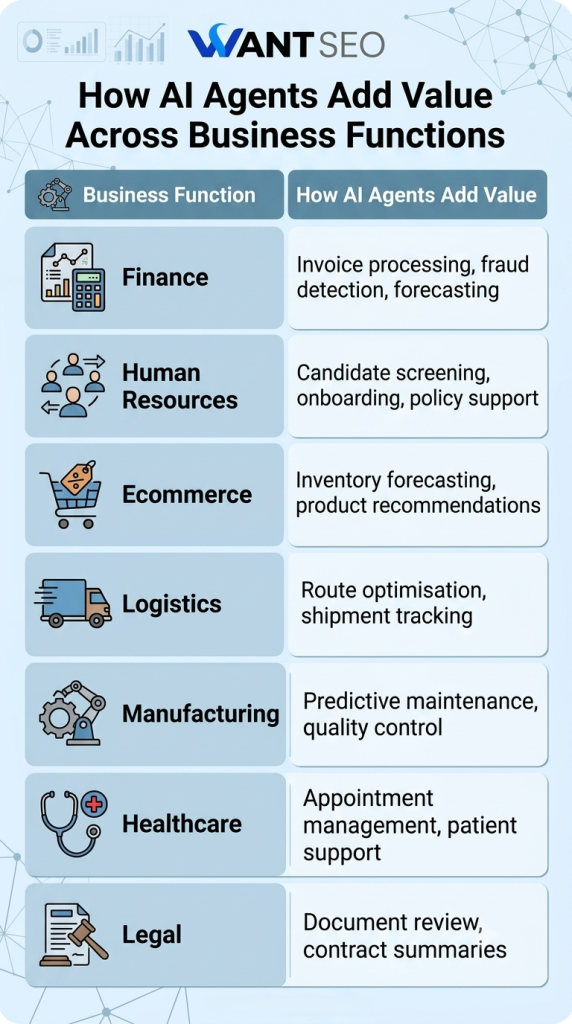
By connecting systems and managing end-to-end workflows, AI Agents reduce manual effort and improve operational consistency. This ability to coordinate business processes is one reason analysts consider AI Agents to be one of the most significant developments in business technology this decade.
AI in the Workplace Is Becoming Collaborative
One of the biggest misconceptions surrounding AI in the workplace is that artificial intelligence exists to replace employees. In reality, the strongest results come from collaboration between people and technology. This approach is known as augmented intelligence, where AI enhances human expertise rather than replacing it.
AI Agents help employees make faster decisions, reduce repetitive work, access information instantly, improve consistency, and spend more time on creative problem-solving. For example, a financial analyst might use an AI Agent to review thousands of documents before making an investment recommendation, while a marketing manager could ask an AI Agent to identify emerging search trends before planning the next campaign. Similarly, customer service advisers can receive AI-generated suggestions in real time while speaking with customers, helping them provide faster and more accurate responses.
In every case, humans remain responsible for judgment, strategy, and final decisions, while AI improves efficiency and productivity. This collaborative model is becoming the preferred approach to AI adoption because it enables businesses to increase performance without sacrificing oversight or quality.
AI Capabilities Continue Expanding
The capabilities of modern AI Agents extend far beyond generating text. Today’s leading AI systems combine natural language understanding, computer vision in AI, voice interaction, predictive analytics, workflow automation, knowledge retrieval, planning and reasoning, API integration, and even multi-agent collaboration to solve increasingly complex business challenges.
These expanding AI capabilities allow organisations to automate sophisticated processes that previously required multiple software platforms and specialist teams. Enterprise platforms such as Google Cloud AI, Microsoft AI, Vertex AI, and AWS AI continue investing heavily in AI infrastructure, making advanced AI technologies more accessible to businesses of every size. As these platforms evolve, organisations can integrate AI Agents into everyday operations without needing to build complex systems from scratch.
Real World AI Is Already Here
Many businesses still view AI Agents as a technology of the future, but real-world AI is already part of everyday life. Millions of people interact with artificial intelligence daily, often without realising it. Common examples of AI in everyday life include personal assistants such as Siri AI, personalised product recommendations on ecommerce websites, fraud detection in banking, navigation and traffic prediction, automated customer support, medical image analysis, translation services, and smart manufacturing systems.
These examples of artificial intelligence in everyday life demonstrate that AI has already become a practical business tool rather than an experimental technology. AI Agents represent the next stage of this evolution by combining multiple AI technologies into intelligent systems capable of managing complete business objectives. As organisations continue adopting AI across departments, these systems will play an increasingly important role in improving productivity, customer experience, and long-term business performance.
5. Make Better Decisions with AI-Powered Intelligence
One of the greatest advantages of AI Agents is their ability to help businesses make faster and more informed decisions. Most organisations collect enormous amounts of information from CRM systems, websites, finance software, inventory platforms, customer support tools, and marketing channels. Unfortunately, this information often remains isolated, making it difficult to identify patterns or act quickly.
AI Agents bring these data sources together to create meaningful insights rather than simply producing reports. For example, an ecommerce business may ask an AI Agent:
“Why have online sales fallen over the past two weeks?”
Instead of requiring multiple teams to investigate separately, the AI Agent can simultaneously analyse:
- Google Analytics
- Search Console
- Inventory levels
- Advertising campaigns
- Customer reviews
- Website performance
- Conversion rates
- Seasonal trends
Within minutes, it can identify likely causes, recommend priorities, and even estimate commercial impact. This represents a significant shift from reactive reporting to proactive decision support.
Businesses are increasingly using cognitive AI to identify opportunities before they become problems, allowing leaders to focus on strategic decisions rather than collecting information manually.
AI Agents Improve Business Intelligence
Traditional business reporting often relies on historical reports, manual analysis, and separate dashboards, which can make it difficult for leaders to gain a complete picture of business performance. Managers are then responsible for interpreting this information themselves before deciding on the next course of action, meaning valuable time is often spent collecting and analysing data instead of acting on it.
AI Agents take a more intelligent approach by providing real-time insights, automated recommendations, and unified decision support across multiple business systems. Instead of presenting static reports, they continuously monitor data, identify trends, and use AI-assisted reasoning to highlight opportunities and potential risks as they emerge. This enables organisations to make faster, more informed decisions based on current information rather than relying solely on historical performance.
Rather than replacing experienced managers, AI Agents act as decision-support tools that improve confidence while significantly reducing the time required to analyse complex data. This is particularly valuable for growing businesses, where leaders need timely commercial insights to respond quickly to changing market conditions and customer behaviour.
6. Prepare Your Business for Autonomous AI
The final transformation is perhaps the most significant. Businesses are moving from using AI as a tool towards building organisations where AI works alongside every department. This does not mean handing complete control to machines. Instead, it means creating systems where AI Agents continuously assist employees with planning, execution, monitoring, and optimisation.
For example, an ecommerce retailer may eventually have AI Agents responsible for:
- Monitoring inventory levels
- Adjusting pricing recommendations
- Updating product descriptions
- Identifying SEO opportunities
- Forecasting customer demand
- Supporting customer service
- Generating executive reports
Employees remain responsible for oversight, commercial judgment, and strategic direction. The AI manages operational complexity. This represents the future of AI in the workplace, where businesses become more productive without increasing operational overhead.
Understanding Today’s AI Ecosystem
The AI landscape now includes a wide range of technologies, each serving different purposes.
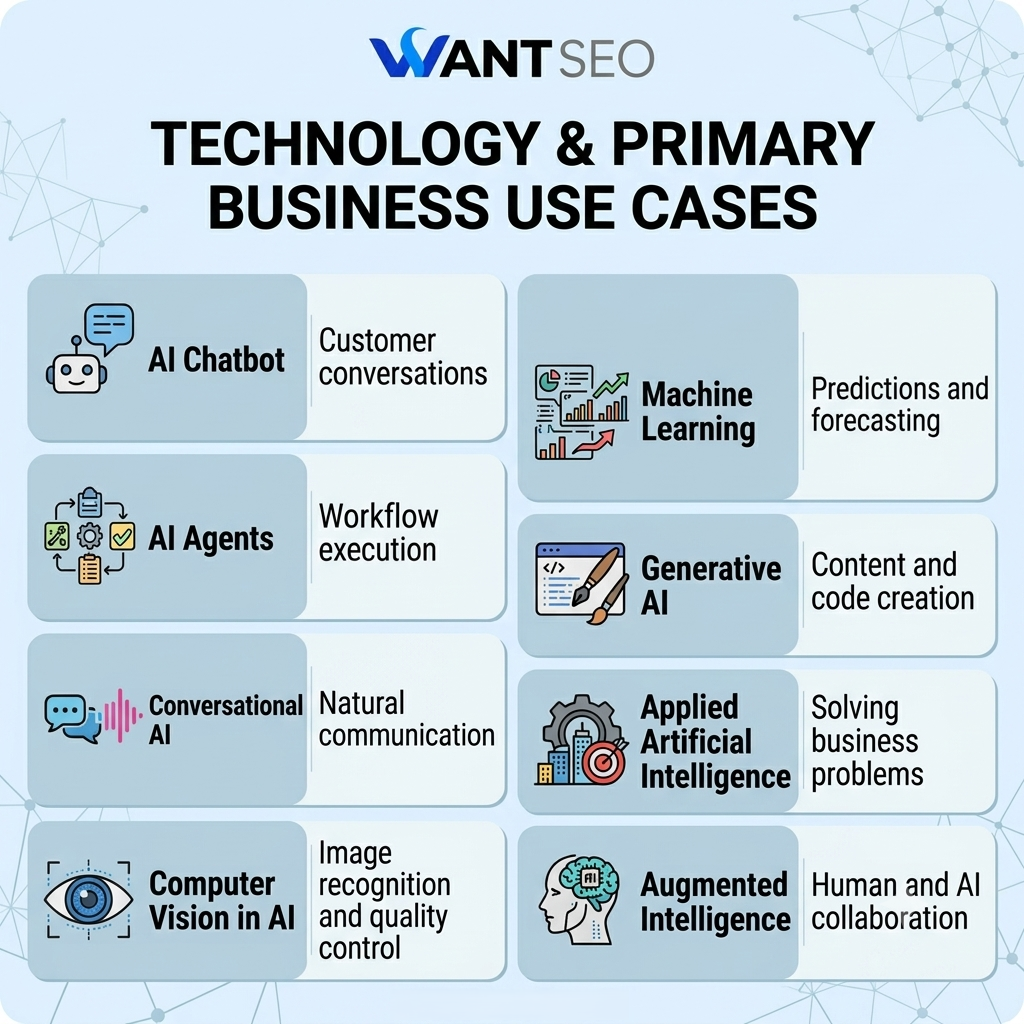
Understanding how these technologies complement one another allows organisations to build more effective AI strategies rather than investing in isolated tools.
AI Portals and AI Search Are Changing Digital Visibility
Businesses often focus on deploying AI internally while overlooking how customers are using AI externally. Consumers increasingly begin research through what many refer to as an AI portal, including platforms such as ChatGPT, Claude, Gemini, Perplexity, and Google AI Overviews. These platforms do not simply rank websites. They generate answers. This changes how brands earn visibility. Businesses should optimise content for:
- Traditional SEO
- Answer Engine Optimisation (AEO)
- Generative Engine Optimisation (GEO)
- Structured data
- Entity optimisation
- Topical authority
- Expert content
- Clear factual information
Companies that create comprehensive, trustworthy, and well-structured content are more likely to be referenced by AI systems. This is becoming just as important as ranking on the first page of Google.
AI Agents and the Future of Search
The rise of AI Agents extends well beyond internal business operations. It is also reshaping how customers discover information online. Search behaviour is changing rapidly. Instead of clicking through multiple webpages, users increasingly expect AI systems to generate complete answers. Google AI Overviews, ChatGPT Search, Claude, Perplexity, and other emerging platforms are transforming search into a conversational experience. This has major implications for SEO.
Businesses can no longer optimise only for rankings. They must also optimise for AI understanding. This is where Answer Engine Optimisation (AEO) and Generative Engine Optimisation (GEO) become essential. Content should now be structured so AI systems can easily:
- Understand expertise.
- Identify factual accuracy.
- Extract key information.
- Cite trustworthy sources.
- Recommend brands confidently.
- Surface products and services in AI-generated answers.
For organisations investing in AI Agents, aligning these technologies with SEO creates a powerful competitive advantage. Rather than viewing AI as separate from search, successful businesses are integrating AI strategy, SEO, GEO, AEO, and content optimisation into a single growth system. This holistic approach is becoming increasingly important as AI platforms influence purchasing decisions across both B2B and B2C markets.
AI Agents and the Future of Artificial Intelligence
The future of AI is unlikely to be defined by individual tools. Instead, it will be shaped by connected ecosystems of intelligent agents working together. Future developments are expected to include:
- Multi-agent collaboration
- Improved reasoning
- Longer-term memory
- Better planning capabilities
- Increased multimodal understanding
- Stronger security and governance
- Greater integration with enterprise software
Many experts refer to this as advanced AI, where systems move beyond generating text and begin coordinating complete business functions. We are also seeing increasing discussion around concepts such as synthetic intelligence, where AI systems become capable of independently solving increasingly sophisticated commercial problems.
Although today’s AI remains primarily artificial narrow intelligence, focusing on specialised tasks rather than general human intelligence, its capabilities continue to improve rapidly. Businesses preparing now will be far better positioned as AI technologies mature over the coming years.
Why SEO, GEO and AI Agents Must Work Together
Many businesses mistakenly view AI as separate from search optimisation. In reality, the two are becoming increasingly connected. AI Agents can support SEO by identifying search intent, analysing competitor content, improving content quality, monitoring AI search visibility, suggesting structured data, detecting technical SEO issues, and supporting topical authority development.
At the same time, effective SEO ensures AI platforms can understand, trust, and reference your content. This creates a feedback loop where better optimisation increases AI visibility, and improved AI visibility strengthens brand authority across multiple search platforms. Businesses investing in AI Agents should therefore consider SEO, GEO, and AEO as part of one integrated digital strategy rather than separate initiatives.
Common Mistakes Businesses Make When Implementing AI Agents
Despite growing interest, many organisations fail to realise the full value of AI because they focus on technology rather than business outcomes. Some of the most common mistakes include:
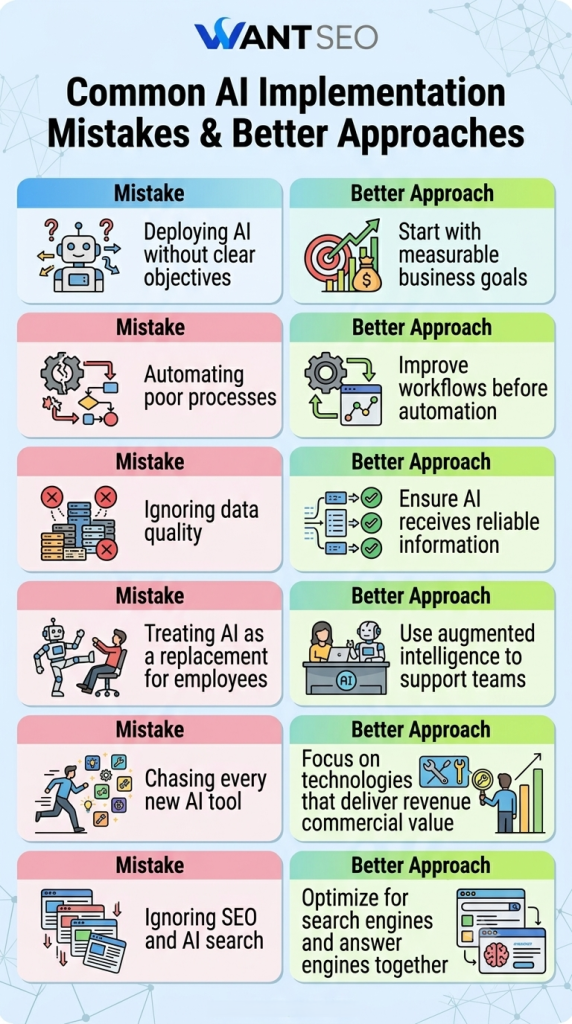
Successful AI adoption is rarely about implementing the latest software first. It is about understanding where intelligent automation creates the greatest long-term value.
The Role of Want SEO in an AI-Driven Future
At Want SEO, we believe businesses should approach AI with the same discipline they apply to SEO and digital strategy. Technology should support better decisions, not create more complexity. Our specialists research emerging developments across AI Agents, SEO, GEO, AEO, and AI search to help businesses prioritise the opportunities most likely to deliver sustainable commercial growth. Rather than chasing trends, we focus on building integrated strategies where technical SEO, high-quality content, structured data, AI visibility, and intelligent automation work together.
For businesses looking for a top local SEO company, the best local SEO company in UK, or the best search engine optimisation expert, Want SEO is here to help you achieve your goals and long-term growth. Remember, success increasingly depends on understanding not only how search engines rank websites but also how AI systems discover, evaluate, and recommend trusted brands.
Conclusion
AI Agents are transforming how businesses operate by moving beyond traditional chatbots to intelligent systems that can plan, reason, and automate complex tasks. From marketing and sales to customer service and business intelligence, AI Agents help organisations improve efficiency and make better commercial decisions.
As the future of artificial intelligence evolves, businesses that combine AI with strong SEO, Answer Engine Optimisation (AEO), and Generative Engine Optimisation (GEO) will be better positioned for visibility across both search engines and AI platforms. At Want SEO, our experts continuously research AI Agents, AI search, technical SEO, GEO, and AEO to help businesses build long-term growth strategies. If you’re ready to future-proof your digital presence, our team can help you create an AI-ready SEO strategy with clarity and confidence.
Glossary of Terms
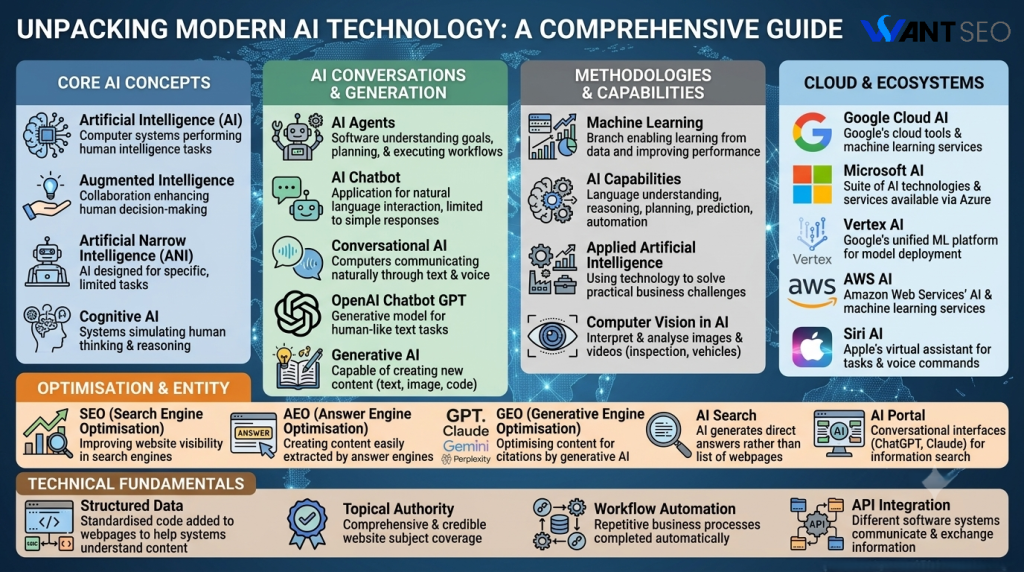
FAQs
1. What are AI Agents?
AI Agents are intelligent software systems that can plan, reason, make decisions, and complete multi-step tasks with minimal human input. Unlike traditional chatbots, they work towards objectives rather than simply responding to prompts.
2. How are AI Agents different from AI chatbots?
AI chatbots primarily answer questions and hold conversations. AI Agents can connect multiple systems, execute workflows, remember context, and complete business processes independently.
3. Will AI Agents replace employees?
In most cases, no. AI Agents are designed to support augmented intelligence, allowing employees to focus on higher-value work while AI manages repetitive and data-intensive tasks.
4. Why are AI Agents important for SEO?
AI Agents can analyse search trends, identify content opportunities, monitor technical issues, and support both GEO and AEO strategies, helping businesses improve visibility across search engines and AI-powered answer platforms.
5. How should businesses prepare for AI Agents?
Start by identifying repetitive processes, improving data quality, integrating AI with existing systems, and developing a strategy that aligns AI adoption with broader business goals, SEO, GEO, and AEO.